Political ClimatePolitical Climate in DeSoto, TX
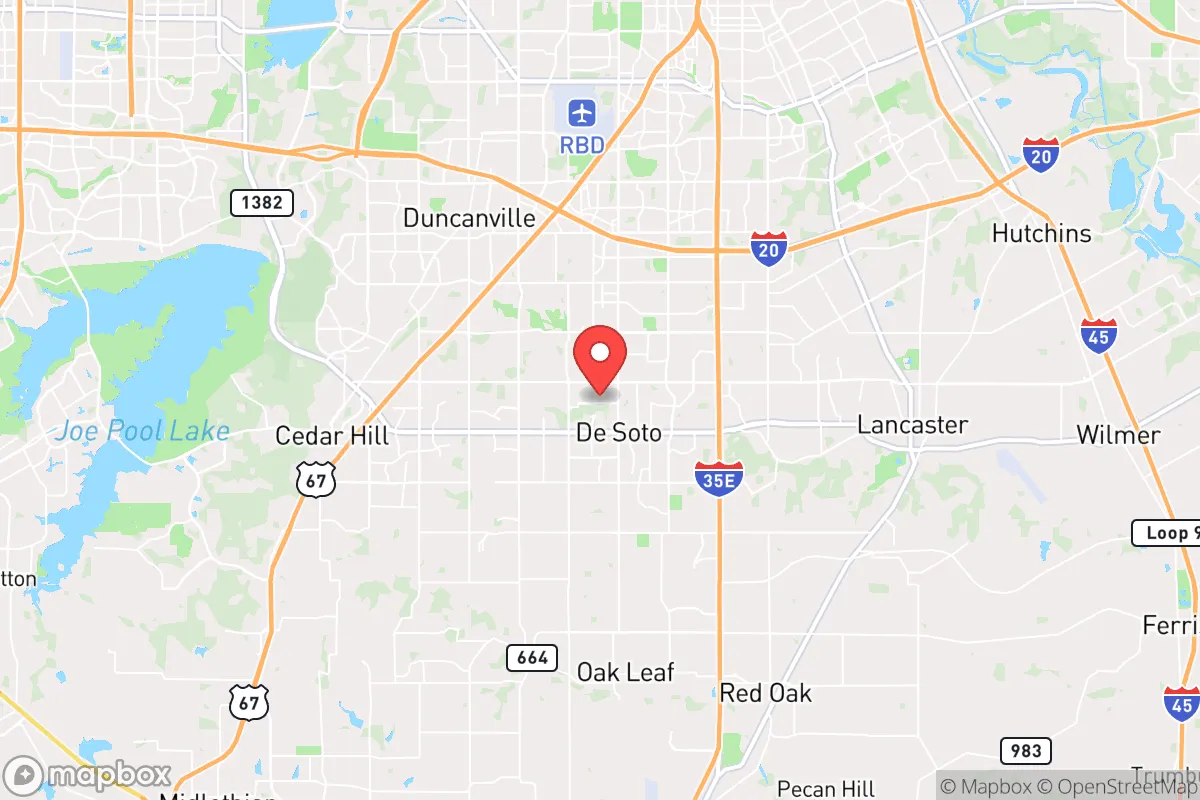
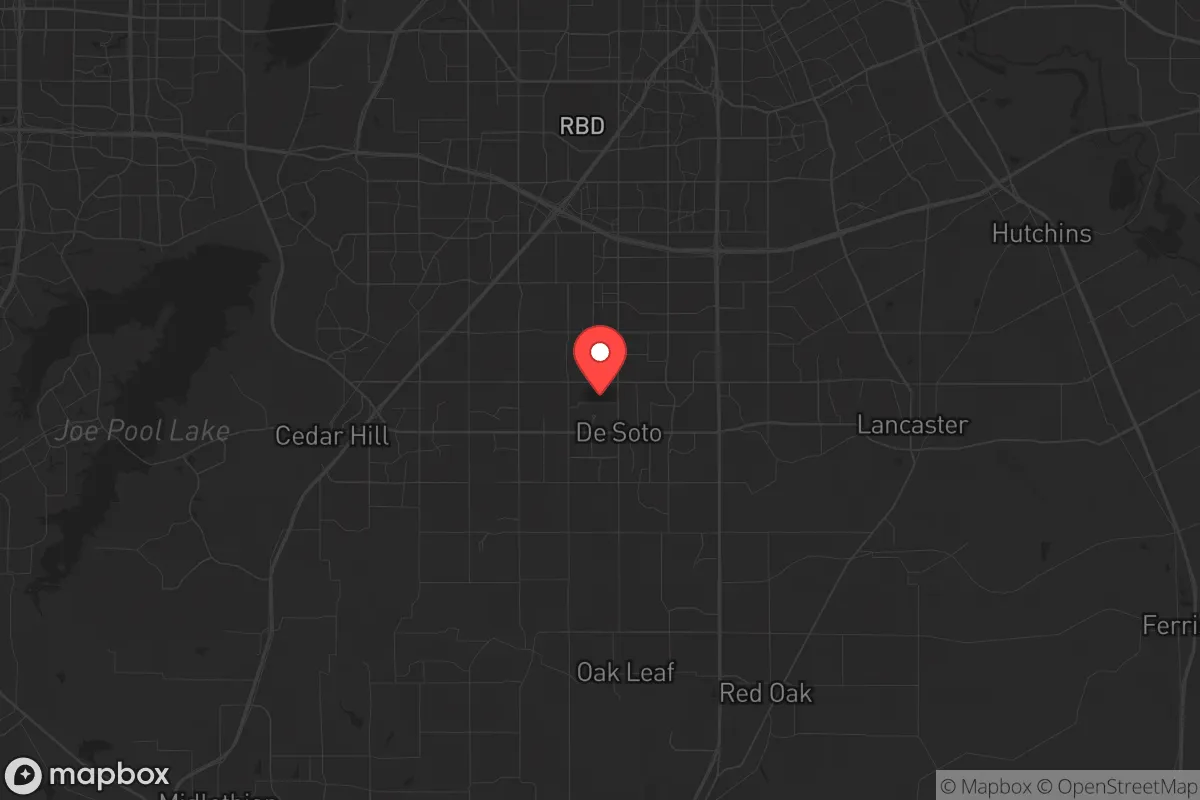
District shown is the primary district for this city’s centroid. Cities may span multiple districts.
Local Political AnalysisPolitical Analysis of DeSoto, TX
DeSoto is a solidly Democratic stronghold in the Dallas-Fort Worth metroplex, with a Cook Partisan Voting Index (PVI) of D+25, making it one of the most reliably blue suburbs in North Texas. This isn't a recent shift—the city has voted overwhelmingly Democratic in presidential elections for decades, and the margin has only widened since 2016. In contrast, the state of Texas as a whole carries a PVI of R+4, meaning DeSoto is a significant outlier, politically speaking, within its own state. The trajectory here is toward even deeper Democratic alignment, driven by a growing, politically engaged African American and progressive-leaning population.
How it compares
To understand DeSoto's political climate, you have to look at the map. Drive ten miles north and you hit Dallas proper, which is also heavily Democratic (D+28), so DeSoto fits that corridor. But head west to Cedar Hill (D+15) or south to Lancaster (D+12), and you'll see the Democratic lean is still strong but less pronounced. The real contrast comes when you go just a few miles east to Duncanville (R+1) or north to Grand Prairie (D+5)—those places are much more competitive or even lean Republican. And if you go further out to suburbs like Southlake (R+18) or Frisco (R+6), the political landscape flips entirely. So DeSoto isn't just a blue dot in a red state; it's part of a distinct Democratic corridor in southern Dallas County that stands out sharply against the surrounding suburban and rural areas.
What this means for residents
For liberal residents, DeSoto offers a rare sense of political alignment in a state where their votes are often drowned out. Local elections, city council races, and school board seats are almost always won by Democrats or left-leaning independents, so progressive policies on housing, policing, and education tend to get a fair hearing. For conservative residents, it can feel like swimming upstream. You'll find plenty of folks who vote Republican, but they're a clear minority in local politics. That said, the area is not hostile—most people are neighborly regardless of party, and conservative viewpoints are respected in private conversation. The practical effect is that DeSoto's local government tends to prioritize social services, affordable housing initiatives, and community policing models that align with Democratic values, while state-level policies (like abortion restrictions or gun laws) still apply uniformly across Texas.
One cultural distinction worth noting: DeSoto has a strong tradition of Black political leadership and civic engagement, which shapes everything from the annual Juneteenth celebrations to the way the city approaches economic development. You won't see the same kind of partisan rancor here that you might in a purple suburb—political disagreements are more about how to implement shared goals than about fundamental values. Looking ahead, as the Dallas-Fort Worth metroplex continues to grow and diversify, DeSoto's political identity is likely to become even more pronounced, not less. The city's Democratic lean is baked into its demographics and history, and that's not changing anytime soon. For anyone moving here, the takeaway is simple: if you're progressive, you'll feel at home; if you're conservative, you'll be in the minority, but you won't be isolated.

State Political ClimatePolitical Climate in Texas
State Political AnalysisPolitical Environment in the State
Texas has been a reliably Republican state for decades, with a Cook Partisan Voting Index of R+4, but the political reality on the ground is far more nuanced than a single number suggests. The state’s dominant coalition has long been built on a mix of socially conservative rural voters, business-friendly suburbanites, and a growing number of fiscally conservative Hispanic voters, particularly in the Rio Grande Valley. Over the past 10–20 years, the trajectory has been a slow but steady shift toward competitiveness: Democrats have made gains in the suburbs and among younger voters, while Republicans have consolidated their hold on rural areas and made inroads with working-class Hispanic communities. The result is a state that still leans right but is no longer a lock for either party in statewide races.
Urban vs. rural divide
The political map of Texas is a study in contrasts. The major metros—Houston, Dallas-Fort Worth, San Antonio, and Austin—are the engines of Democratic growth. Harris County (Houston) and Dallas County have flipped from red to purple to solid blue over the past two cycles, while Travis County (Austin) is one of the most reliably liberal counties in the South. Meanwhile, the vast rural expanse—places like the Panhandle around Amarillo, East Texas timber country, and the Hill Country west of Austin—votes overwhelmingly Republican. The real battleground is the suburbs: Collin County (north of Dallas) and Fort Bend County (southwest of Houston) were once GOP strongholds but have shifted left as diverse, college-educated populations moved in. In 2020, Biden won Fort Bend by 6 points; in 2024, Trump narrowed that gap but still lost it. The Rio Grande Valley, including McAllen and Brownsville, has been a fascinating flip zone: historically Democratic, it swung hard toward Trump in 2020 and 2024, driven by cultural conservatism and economic pragmatism among Hispanic voters.
Policy environment
Texas’s policy environment is defined by a low-tax, low-regulation posture that appeals strongly to conservatives. There is no state income tax, relying instead on high property taxes and sales tax (state rate 6.25%, local add-ons can push it over 8%). The regulatory climate is business-friendly: no state-level minimum wage above the federal $7.25, weak union protections, and a “right-to-work” law. On education, the state funds schools through a complex Robin Hood system that redistributes property tax revenue from wealthy districts to poor ones, but per-pupil spending remains below the national average. School choice is a live issue: the 2023 legislative session saw a push for education savings accounts (ESAs) that failed in the House but is expected to return. Healthcare policy is notably hands-off: Texas did not expand Medicaid under the ACA, leaving roughly 1.5 million uninsured residents, and abortion is effectively banned after a 2021 trigger law took effect post-Dobbs. Election laws were tightened in 2021 with SB 1, which added ID requirements for mail ballots, limited drive-through voting, and restricted early voting hours—changes that have been both praised for security and criticized for suppression.
Recent policy direction
The 2023 and 2025 legislative sessions have pushed Texas further in a conservative direction across multiple fronts. On gun and self-defense law, the state already had permitless carry (HB 1927, 2021) and a strong “stand your ground” statute; recent sessions have focused on expanding firearm access on college campuses and in places of worship. Parental and education rights saw a major shift with HB 900 (2023), which requires book vendors to rate materials for “sexually explicit” content and restricts access in school libraries—a law currently tied up in court. Speech is broadly protected under the state constitution, but a 2023 law (SB 207) prohibits social media platforms from “censoring” users based on viewpoint, a direct challenge to Section 230. On privacy and surveillance, Texas passed a data privacy law (TDPSA) in 2023 giving residents the right to opt out of data collection, but law enforcement access to digital data remains broad. Medical and bodily autonomy is sharply restricted: abortion is banned from conception, with narrow exceptions for the life of the mother, and gender-affirming care for minors was outlawed in 2023 (SB 14). Property rights are strong, with no state-level rent control and a robust homestead exemption for property taxes, though eminent domain battles over pipelines and transmission lines are common. Taxation remains a core selling point: the 2023 session cut property taxes by $18 billion through a combination of rate compression and increased exemptions. Voting and ballot access remains a flashpoint: SB 1 (2021) tightened rules, but turnout in 2024 was still high, suggesting the changes haven’t suppressed participation as much as critics feared.
Civil unrest & political movements
Texas has seen its share of political turbulence. The 2020 Black Lives Matter protests in Austin and Houston were large and occasionally violent, leading to a backlash that helped fuel the 2021 “defund the police” repeal movement. On the right, the “Texas Nationalist Movement” (Texit) has been a persistent but fringe force, polling around 10-15% support for secession. Immigration politics are a daily reality: Governor Abbott’s Operation Lone Star (2021-present) has deployed state troopers and National Guard to the border, bused migrants to New York and Chicago, and installed razor wire along the Rio Grande—a policy that has drawn both praise from conservatives and lawsuits from the Biden administration. Sanctuary city bans (SB 4, 2017) remain in effect, requiring local law enforcement to cooperate with federal immigration authorities. Election integrity controversies have been loud but not disruptive: the 2020 and 2024 elections saw no major fraud findings, but the 2021 voting law was passed in response to unsubstantiated claims of widespread irregularities. A new resident would notice the political polarization in everyday life—yard signs, bumper stickers, and local news coverage are heavily partisan, especially in the suburbs and rural areas.
Projection
Over the next 5–10 years, Texas is likely to remain a Republican-leaning state but with a narrowing margin. The key demographic driver is in-migration: roughly 1,000 people move to Texas each day, many from California and the Northeast, and they tend to be younger, more diverse, and more moderate than the existing population. The suburbs of Dallas, Houston, and Austin will continue to shift left, while rural areas will stay deep red. The wild card is the Hispanic vote: if Republicans continue to gain ground with this group (as they did in 2024), the state could remain red for another decade. If Democrats re-engage them, Texas could become a true swing state by 2032. Policy-wise, expect continued battles over school choice, property tax reform, and water rights (a growing issue as the state’s population booms). The abortion ban is unlikely to be repealed, but exceptions may be expanded. A new resident moving in now should expect a state that is politically vibrant, deeply divided, and still fundamentally conservative—but with a growing progressive counterweight that makes every election a nail-biter.
For a new resident, the bottom line is this: Texas offers a low-tax, high-freedom environment that rewards economic ambition, but the political climate is intensely polarized and policy can change rapidly with each legislative session. If you’re conservative, you’ll find a state government that largely shares your values on guns, taxes, and education. If you’re liberal, you’ll find strong communities in the cities and a growing movement that is slowly shifting the state’s direction—but you’ll also face a state government that is actively hostile to many of your priorities. Either way, you’ll be living in a place where politics is never boring, and where your vote actually matters.
* Values derived from national, state, county, city and local statistics and may differ in a specific area. Last updated: 2026-07-20T01:36:54.000Z
Narrative content on this page is AI-generated and may contain mistakes. Verify any details that matter before acting on them.
ReloMaps may earn a commission from affiliate links at no extra cost to you.

