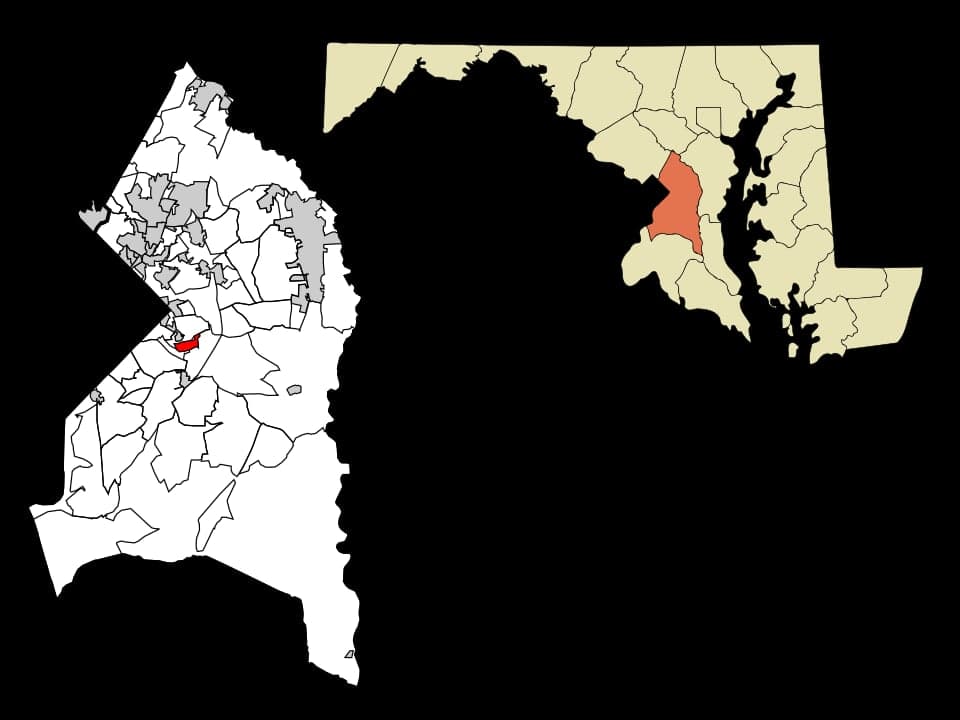
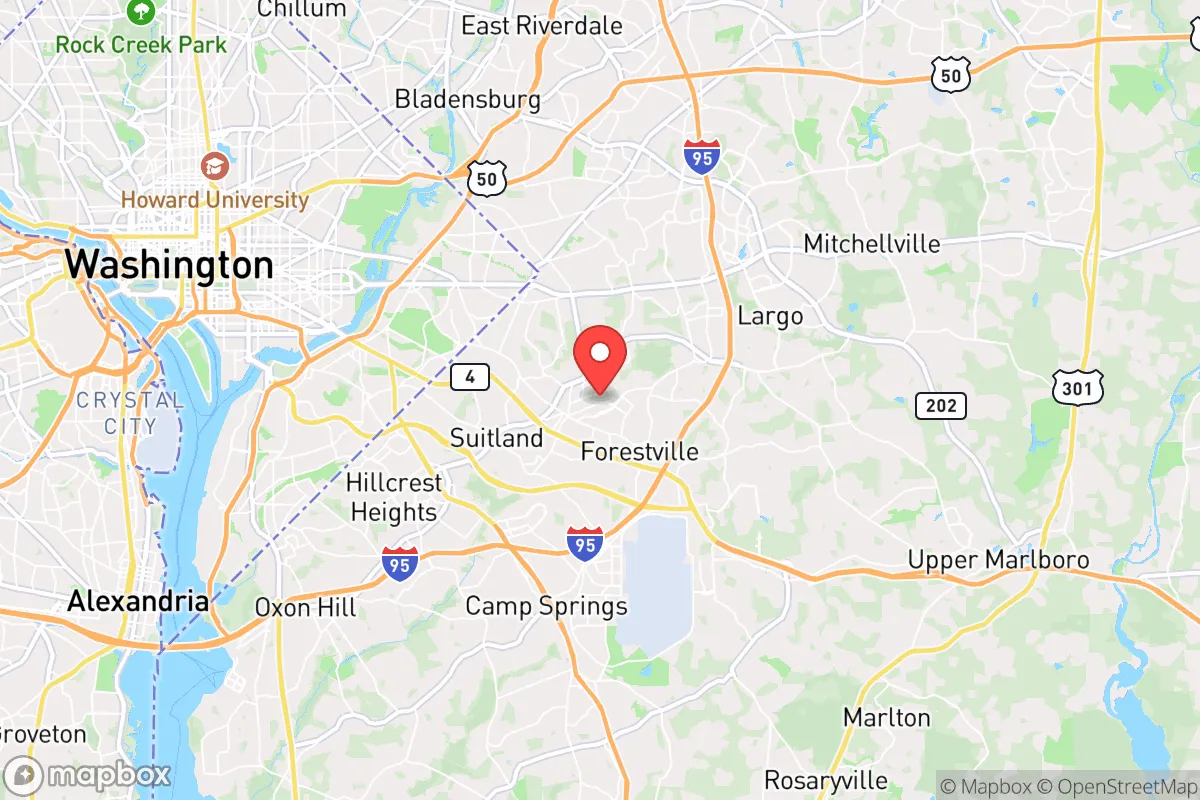
Photo: Wikipedia
Demographics of District Heights, MD
Affluence Level in District Heights, MD
A below-average socioeconomic profile. Incomes, home values, and educational attainment trail the U.S., with higher poverty and unemployment.
People of District Heights, MD
District Heights, Maryland, is a densely settled, predominantly Black suburban community of 5,888 residents, where nearly 88% of the population identifies as Black or African American. The city is characterized by a strong sense of local identity rooted in post-war suburbanization, with a modest foreign-born share of 8.1% and a Hispanic population of 5.7%. Its residents are largely working- and middle-class, with 30.4% holding a college degree, and the city’s human history is one of deliberate community building by Black families seeking homeownership and stability in the mid-20th century.
How the city was settled and grew
District Heights was not a colonial settlement or an industrial mill town. It was platted and developed in the 1930s and 1940s as a planned suburban community for federal government employees working in nearby Washington, D.C. The land was originally part of larger agricultural tracts in Prince George’s County, but the city’s founding was driven by the post-Depression housing boom and the expansion of the federal workforce under the New Deal. The earliest residents were predominantly white, middle-class families drawn by affordable single-family homes and easy access to the capital via the newly built Pennsylvania Avenue and Suitland Road corridors. The original subdivisions — District Heights proper (the core grid of streets around the municipal center) and Forestville (the adjacent unincorporated area that later became part of the city’s sphere) — were marketed to government clerks and military personnel. By the 1950s, the city had filled in with modest Cape Cods and ranchers, and its population peaked near 7,000 as white families moved in from D.C.’s older row-house neighborhoods.
Modern era (post-1965)
The 1968 Fair Housing Act and subsequent civil rights-era shifts transformed District Heights. As white families began a broader suburban exodus to farther-out counties like Charles and Calvert, Black families — many moving from D.C.’s historically Black neighborhoods such as Anacostia and Barry Farm — purchased homes in District Heights at accelerating rates. By 1980, the city had become majority Black, a transition that was largely complete by 1990. The neighborhoods of Pennsylvania Avenue Heights (the area north of Pennsylvania Avenue near the D.C. line) and Walker Mill (the southeastern quadrant near the Walker Mill Regional Park) absorbed much of this in-migration, as homes were sold by retiring white owners or through blockbusting practices common in Prince George’s County at the time. The city’s foreign-born population remained low through the 1990s and 2000s, and today’s 8.1% foreign-born share is modest compared to neighboring communities like Hyattsville or Langley Park. The small Hispanic population (5.7%) is concentrated in the Marlboro Pike corridor, where newer rental apartments and townhouses have attracted Central American and Mexican families, while the East/Southeast Asian share (0.1%) and Indian-subcontinent share (0.0%) are negligible. The Black population has remained stable at roughly 88% since 2010, with little racial turnover.
The future
District Heights is not homogenizing further — it has been overwhelmingly Black for three decades — but it is slowly diversifying at the margins. The Hispanic share has grown from roughly 3% in 2010 to 5.7% today, driven by families moving into the Marlboro Ridge and Forestville Heights rental complexes. The foreign-born population, while still small, is rising as immigrants from West Africa (particularly Nigeria and Ghana) and Central America settle in the area, drawn by lower home prices compared to D.C. and inner-ring suburbs. The city’s population has declined slightly from its 1970 peak of 7,000 to 5,888 today, reflecting smaller household sizes and an aging housing stock that has not attracted large-scale new construction. Over the next 10–20 years, District Heights is likely to remain a predominantly Black, middle-income suburb, with a slowly growing Hispanic and immigrant presence. The city is not tribalizing into distinct ethnic enclaves — rather, it is experiencing a gentle, incremental diversification within a stable Black majority. For a conservative-leaning mover, this means a community with deep roots, low transience, and a clear identity, but limited demographic dynamism or new development.
For someone moving in now, District Heights offers a settled, family-oriented environment where the population is stable and the character is distinctly suburban and Black-led. The city is not a boomtown or a melting pot — it is a place where the human history is one of deliberate community building by Black homeowners, and where the future points to gradual, modest diversification rather than rapid change. New residents will find a city that values stability, local governance, and proximity to D.C., with a population that is overwhelmingly native-born and long-established.

* Values derived from national, state, county, city and local statistics and may differ in a specific area. Last updated: 2026-04-22T01:14:30.000Z
Narrative content on this page is AI-generated and may contain mistakes. Verify any details that matter before acting on them.
ReloMaps may earn a commission from affiliate links at no extra cost to you.

