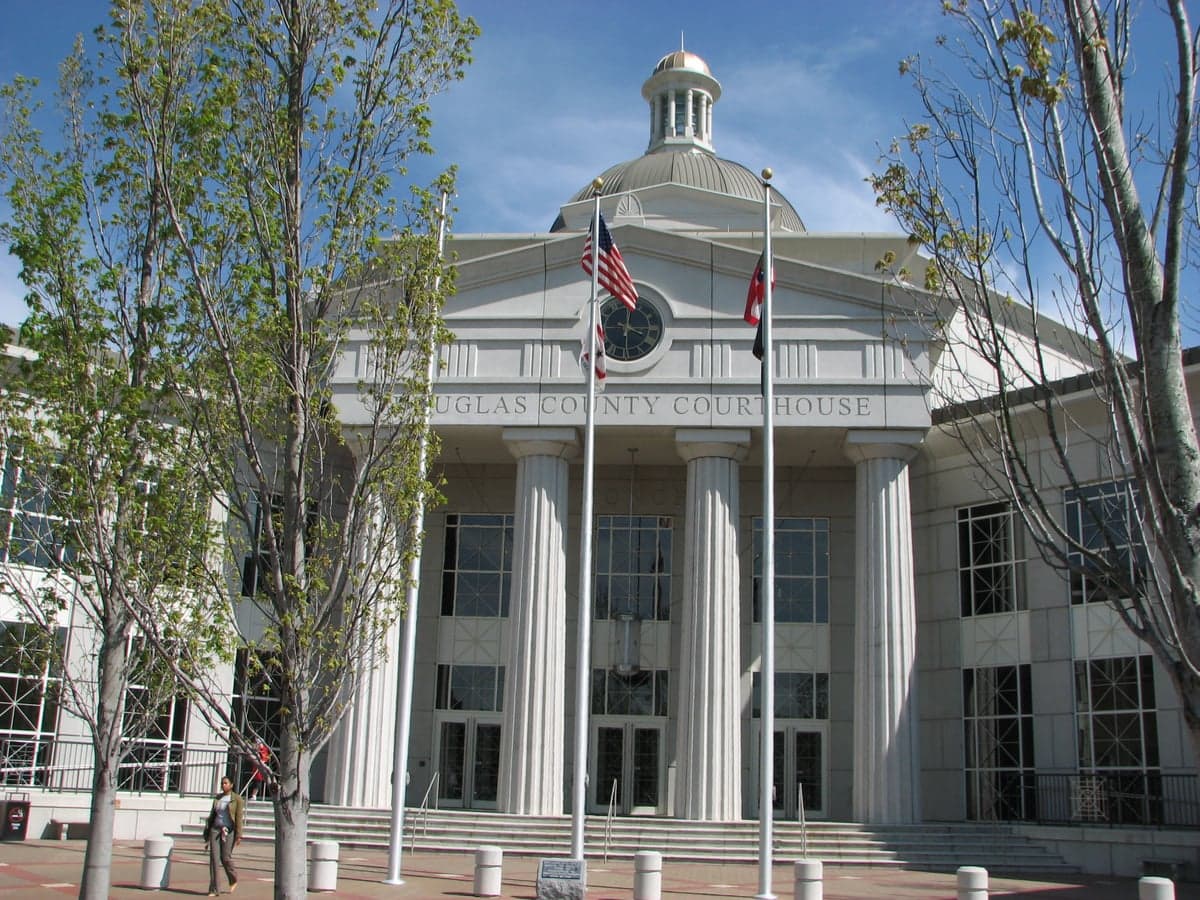
Photo: Wikipedia
Demographics of Douglasville, GA
Affluence Level in Douglasville, GA
A middle-class area roughly in line with national averages across income, home values, education, and employment.
People of Douglasville, GA
Douglasville, Georgia, is a majority-Black city of 36,284 residents where 64.5% of the population identifies as Black or African American, 21.9% as White, 8.2% as Hispanic, and less than 2% as East/Southeast Asian or Indian. The city’s character is shaped by its dual identity as a historic railroad town and a fast-growing Atlanta exurb, with a distinctive mix of established Black middle-class neighborhoods and newer subdivisions drawing families from across the metro area. With a college-educated rate of 36.7% and a foreign-born share of just 2.4%, Douglasville remains a predominantly native-born, English-speaking community where church life, local sports, and civic pride anchor daily life.
How the city was settled and grew
Douglasville was founded in 1875 as a railroad stop on the Georgia Pacific line, replacing the earlier crossroads settlement of Skinned Chestnut. The original population was overwhelmingly White, drawn by cotton farming and the rail depot that made the town a regional shipping hub. The historic Downtown Douglasville district, centered on Broad Street and Church Street, was built by these early merchants and farmers, with many of the original storefronts and Victorian homes still standing. A small Black population arrived during Reconstruction, working as sharecroppers and domestic laborers, and settled in the Fairview neighborhood east of the railroad tracks. By 1900, the town had roughly 1,000 residents, with the Black community concentrated in Fairview and along what is now Hospital Drive. The arrival of the automobile and U.S. Highway 78 in the 1920s spurred modest growth, but Douglasville remained a sleepy farming town of fewer than 5,000 people through the 1950s.
Modern era (post-1965)
The 1965 Immigration and Nationality Act had little direct effect on Douglasville — the city’s foreign-born share remains tiny at 2.4% — but the post-1965 era transformed the city through domestic migration. The construction of Interstate 20 in the 1970s turned Douglasville into a viable Atlanta commuter suburb, and White families moved in large numbers to new subdivisions like Chapel Hills and Hunter’s Ridge in the northern and western parts of the city. At the same time, Black families from Atlanta’s historic Westside neighborhoods — pushed by urban renewal and pulled by affordable land — began settling in the Winston area and along Fairburn Road. By the 1990s, Douglasville’s Black population had grown to roughly 40%, and the city elected its first Black mayor in 1997. The 2000s and 2010s saw continued Black in-migration from both Atlanta and other parts of Georgia, while many White families moved farther west to Carrollton or into unincorporated Douglas County. Today, the Black population is 64.5%, concentrated in the central and southern neighborhoods like Fairview, Winston, and the Hunter’s Ridge area (which has become majority-Black since 2010). White residents, now 21.9%, are most numerous in the newer subdivisions west of I-20, such as Chapel Hills and the Arbor Place corridor. The Hispanic population, at 8.2%, is the fastest-growing group, with families settling in the Fairburn Road corridor and around the Douglasville Marketplace shopping center, drawn by construction and service jobs. East/Southeast Asian residents (0.8%) and Indian residents (0.7%) are small but visible in the medical and tech sectors, with no single ethnic enclave.
The future
Douglasville’s population is likely to continue growing, driven by Atlanta’s outward expansion and the city’s relatively affordable housing stock — the median home value is roughly $215,000, well below the metro average. The Black majority is expected to hold steady or increase slightly, as Black families from Atlanta’s increasingly expensive intown neighborhoods continue to move west. The White population will likely continue a slow decline, though the Chapel Hills area may retain a White plurality due to its newer, larger homes and proximity to the county’s best schools. The Hispanic share is projected to grow from 8.2% toward 12-15% over the next decade, driven by natural increase and continued migration from Mexico and Central America, with the Fairburn Road corridor becoming a more defined Hispanic commercial strip. East/Southeast Asian and Indian communities will likely remain small, as Douglasville lacks the tech-job density and ethnic infrastructure that draw these groups to cities like Johns Creek or Alpharetta. The city is not tribalizing into hostile enclaves, but it is sorting by race and income: the I-20 corridor acts as a rough dividing line, with wealthier, whiter neighborhoods to the north and west, and older, majority-Black neighborhoods to the south and east. Newer subdivisions like Chapel Hills and the Arbor Place area are more mixed, reflecting a slow trend toward integration among middle-class families of all backgrounds.
For someone moving to Douglasville today, the city offers a stable, family-oriented environment with a strong Black middle-class identity, low crime relative to similar-sized metro Atlanta suburbs, and a cost of living that remains below the national average. The population is becoming slightly more diverse but remains overwhelmingly native-born and English-speaking, with a conservative-leaning political culture that values local schools, churches, and community events. The main trade-off is distance from Atlanta — a 30- to 45-minute commute on I-20 — and a limited nightlife and dining scene compared to closer-in suburbs. For families seeking affordable space and a slower pace in a majority-Black community, Douglasville is a practical choice; for those seeking ethnic diversity or a vibrant urban atmosphere, it is not.

* Values derived from national, state, county, city and local statistics and may differ in a specific area. Last updated: 2026-04-30T13:12:51.000Z
Narrative content on this page is AI-generated and may contain mistakes. Verify any details that matter before acting on them.
ReloMaps may earn a commission from affiliate links at no extra cost to you.

