Political ClimatePolitical Climate in Dover, DE
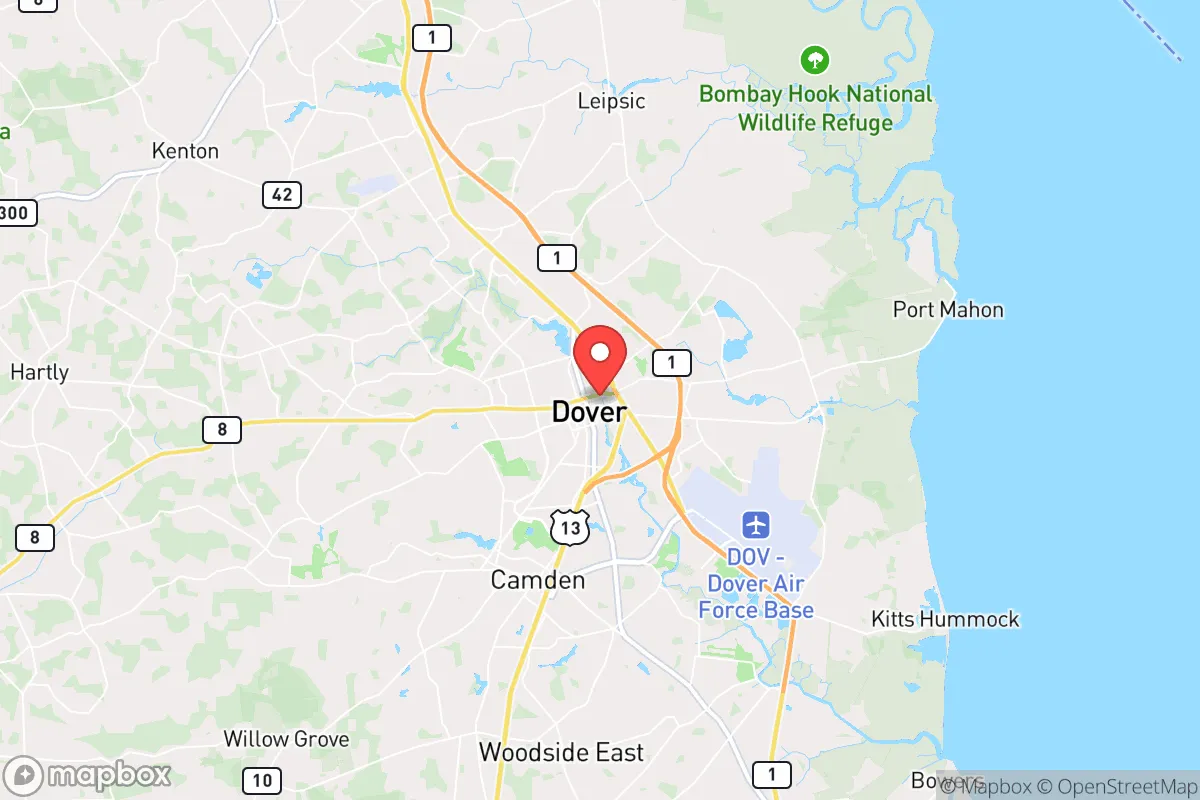
District shown is the primary district for this city’s centroid. Cities may span multiple districts.
Inherited from parent state — no local data available.
Local Political AnalysisPolitical Analysis of Dover, DE
Dover, Delaware, leans heavily Democratic, with a Cook PVI of D+8, meaning the city votes about eight points more Democratic than the national average. This wasn't always the case—I remember when Dover was a lot more balanced, a place where you could have a real conversation with your neighbor about politics without it turning into a shouting match. But over the last decade or so, the shift has been pretty dramatic, driven largely by an influx of government workers and folks moving up from more liberal areas like Wilmington and even parts of Maryland. The city council and county offices are now firmly in progressive hands, and the voting patterns reflect that, with Democrats routinely winning by double-digit margins in local races.
How it compares
If you drive just 15 minutes south to Milford or head west toward Camden-Wyoming, you'll find a completely different political landscape. Those areas are much more conservative, with a strong independent streak and a lot of skepticism about the kind of top-down policies you see in Dover. The contrast is stark: in Dover, you've got a city government that's been pushing things like stricter zoning laws, higher property taxes to fund new social programs, and a general expansion of local government's role in daily life. Meanwhile, in the surrounding towns, folks are more focused on keeping taxes low, protecting property rights, and pushing back against what they see as government overreach. It's a real split, and it means that if you live in Dover proper, you're living under a set of rules that a lot of your neighbors just a few miles away would never tolerate.
What this means for residents
For the average person living in Dover, the biggest practical impact is a steady creep of regulations and costs. The city council has been pretty aggressive about adopting progressive policies—things like mandatory inclusionary zoning, which forces developers to set aside units for low-income housing, and a push for higher minimum wages that small businesses say are killing them. Property taxes have gone up noticeably in the last few years, and there's a growing sense that the city government is more interested in social engineering than in keeping the streets safe or fixing the potholes. If you value personal freedom—the freedom to run your business without a dozen new permits, the freedom to decide how to use your own land, the freedom to keep more of what you earn—Dover's political climate is heading in the wrong direction. The long-term trajectory looks like more of the same, with the city likely to become even more progressive as the older, more moderate residents move out or pass on.
One thing that really sets Dover apart culturally is the outsized influence of state government. The state capitol is here, so you've got a huge number of state employees and lobbyists who shape the local conversation. That means policies that might be controversial elsewhere—like expanding Medicaid, increasing business regulations, or pushing for stricter environmental rules—are often seen as just part of the job here. It creates a kind of bubble where progressive ideas are rarely challenged in a serious way. For someone who leans conservative, it can feel like you're constantly swimming against the current. The best advice I can give is to keep an eye on the local elections and get involved in the civic groups that still push back, because if you don't, the city will just keep moving further left, and your voice will get even smaller.

State Political ClimatePolitical Climate in Delaware
State Political AnalysisPolitical Environment in the State
Delaware has long been a blue state in presidential elections, voting Democratic by double digits in every cycle since 2008, but its political climate is far more nuanced than the statewide totals suggest. The northernmost county, New Castle, home to Wilmington and the corporate headquarters corridor along I-95, drives the state’s leftward lean with overwhelming Democratic margins. Meanwhile, the two southern counties — Kent and Sussex — have been trending redder over the past two decades, creating a sharp urban-rural divide that makes Delaware a fascinating case study for a conservative considering relocation.
Urban vs. rural divide
The political map of Delaware is essentially a tale of three counties. New Castle County, which contains roughly 55% of the state’s population, votes reliably Democratic — in 2024, it delivered about 65% of its vote to Kamala Harris. The city of Wilmington is the Democratic stronghold, with precincts routinely hitting 80-90% Democratic. Suburbs like Newark (home to the University of Delaware) and Bear lean left as well, though some outer suburbs like Hockessin show more competitive splits. Kent County, anchored by the state capital Dover, is a true swing county — it voted for Trump in 2016 and 2020 but flipped back to Biden in 2024 by a razor-thin margin. Sussex County, the southernmost and fastest-growing part of the state, has become reliably Republican. Towns like Georgetown, Millsboro, and Seaford now vote red by double digits, driven by retirees, farmers, and exurbanites fleeing higher-tax states. The beach communities — Rehoboth Beach, Bethany Beach, and Lewes — are more purple, with a mix of year-round conservatives and seasonal liberals.
Policy environment
Delaware’s state-level policy leans decidedly progressive, and that’s the first thing a conservative mover needs to understand. The state has a progressive income tax structure with rates from 2.2% to 6.6%, and property taxes are relatively low compared to neighboring Maryland and Pennsylvania — a plus for homeowners. But the regulatory posture is heavy: Delaware has some of the strictest environmental regulations on the East Coast, and the state’s corporate-friendly legal structure (the Court of Chancery) coexists with a thicket of business licensing requirements that can frustrate small operators. Education policy is a mixed bag. The state funds schools well above the national average, but parental rights have been a flashpoint. In 2023, Governor John Carney signed a law requiring all public schools to adopt policies that affirm LGBTQ+ students’ gender identities, overriding local school board discretion. Election laws are among the most liberal in the nation: no-excuse absentee voting, same-day registration, and automatic voter registration are all in place. For a conservative, the policy environment feels like a one-party state — Democrats control the governorship and both legislative chambers, and veto-proof majorities are common.
Trajectory & freedom
Over the past five years, Delaware has become less free by most conservative metrics. The state passed a near-total abortion ban in 2022? No — actually, it did the opposite: in 2022, the General Assembly passed a law codifying abortion access into state statute, removing any restrictions that might have survived a Roe reversal. On gun rights, the trend is unmistakably restrictive. In 2023, Delaware enacted a ban on “assault weapons” and large-capacity magazines, along with a permit-to-purchase requirement for handguns. The law is currently being challenged in court, but it’s on the books. Parental rights took a hit with the 2023 gender-affirming school policy, which requires schools to keep a student’s gender identity confidential from parents if the student requests it. On the plus side, Delaware has no state sales tax, which is a genuine freedom win for consumers. But property taxes, while low, are supplemented by a high personal income tax burden. The state also expanded Medicaid under the Affordable Care Act and has its own state-based health insurance exchange, which keeps premiums relatively stable but limits private-market options. The trajectory is clear: Delaware is moving further left on social and cultural issues, even as it remains business-friendly in its corporate law niche.
Civil unrest & political movements
Delaware is not a hotbed of civil unrest, but it has its flashpoints. In 2020, Wilmington saw several nights of protests and some property damage following George Floyd’s death, though nothing on the scale of Philadelphia or Baltimore. The state has a small but vocal progressive activist network centered in Wilmington and Newark, often pushing for police reform and environmental justice. On the right, the conservative movement is strongest in Sussex County, where groups like the Sussex County Republican Committee and the Delaware Family Policy Council are active. Immigration politics are relatively quiet — Delaware is not a border state and has no major sanctuary city policies, though Wilmington has a “welcoming city” ordinance that limits cooperation with ICE. Election integrity has been a recurring concern among conservatives: the state’s widespread use of mail-in voting and same-day registration has led to calls for tighter ID laws, but those efforts have gone nowhere in the Democratic-controlled legislature. The most visible political flashpoint in recent years has been the gun control debate, with pro-Second Amendment rallies drawing hundreds to the state capitol in Dover.
Projection
Looking ahead five to ten years, Delaware’s political trajectory is likely to continue its leftward drift, but the pace may slow. The key demographic driver is in-migration from the Northeast — particularly New York, New Jersey, and Pennsylvania — into Sussex County. These newcomers are often retirees or remote workers who bring moderate-to-conservative fiscal views but may be socially liberal, diluting the county’s solid red base. Meanwhile, New Castle County continues to attract young professionals and academics who reinforce the Democratic majority. The wild card is the growing Hispanic population in Sussex County, which could shift the political calculus if that community becomes more politically engaged. For a conservative moving in now, the realistic expectation is that Delaware will remain a blue state with a strong red minority in the south. The state’s small size means that individual elections can be swayed by a few thousand votes, but the structural advantages for Democrats — concentrated population in New Castle, union influence, and a well-funded party machine — are unlikely to erode significantly. If you’re looking for a state where your vote will matter in a statewide race, Delaware is not it — but your local elections in Sussex or Kent County can be genuinely competitive.
Bottom line for a new resident: If you’re a conservative considering Delaware, you’ll find a welcoming community in Sussex County and parts of Kent County, with low property taxes and no sales tax as genuine financial benefits. But you’ll also be living under a state government that is actively expanding its reach into gun rights, parental authority, and education policy. The trade-off is clear: you get a lower cost of living than the mid-Atlantic average and a slower pace of life, but you’ll be fighting an uphill battle on cultural and political issues. Visit Lewes or Millsboro to get a feel for the conservative side of the state — and be prepared to engage locally if you want to preserve what you find there.
* Values derived from national, state, county, city and local statistics and may differ in a specific area. Last updated: 2026-04-29T21:39:41.000Z
Narrative content on this page is AI-generated and may contain mistakes. Verify any details that matter before acting on them.
ReloMaps may earn a commission from affiliate links at no extra cost to you.

