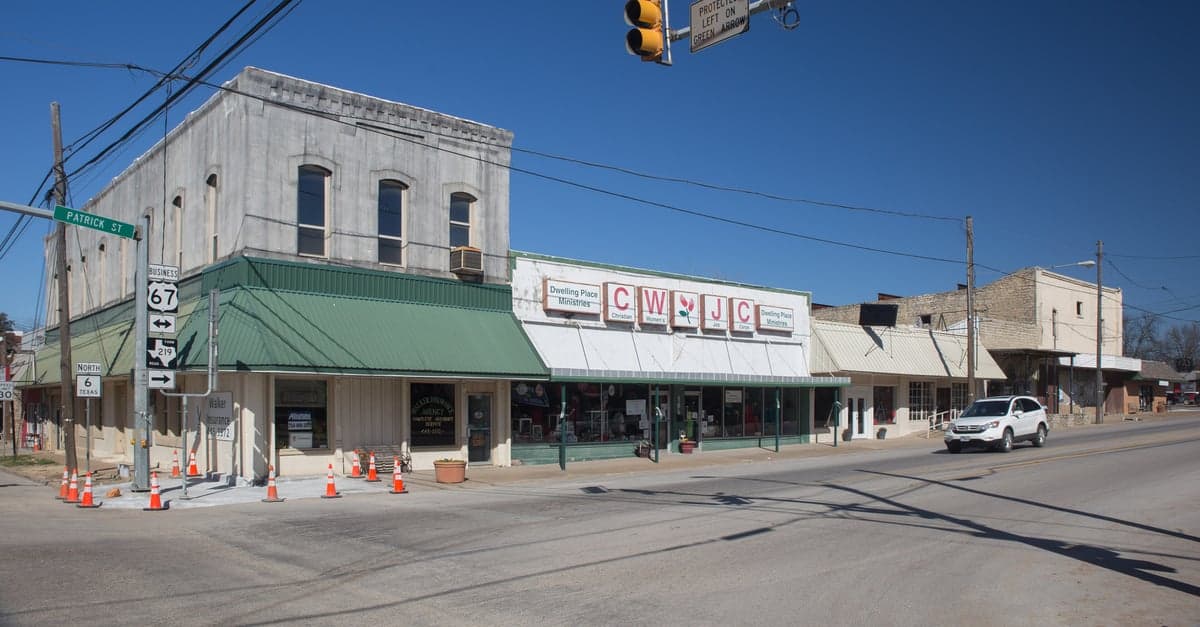
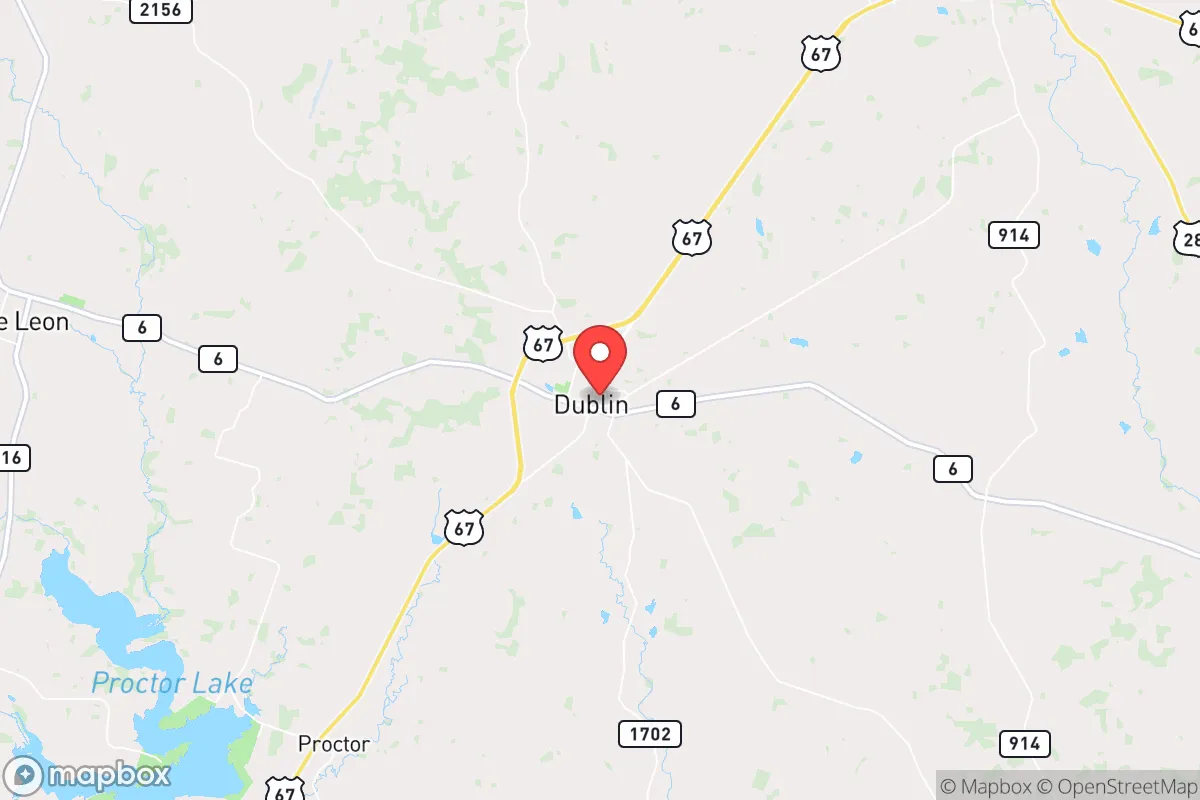

Photo: Wikipedia
Demographics of Dublin, TX
Affluence Level in Dublin, TX
A below-average socioeconomic profile. Incomes, home values, and educational attainment trail the U.S., with higher poverty and unemployment.
People of Dublin, TX
The people of Dublin, Texas today form a predominantly Hispanic and white community of 3,404 residents, with a notable 15.0% foreign-born population that gives the city a distinctive binational character uncommon in rural Erath County. The city’s identity is shaped by its deep ranching and agricultural roots, a strong sense of small-town independence, and a demographic profile that is 50.3% Hispanic and 41.1% white, with virtually no Black, Asian, or Indian subcontinent populations. This is a working-class town where 19.3% of adults hold a college degree, and the population is younger and more family-oriented than the county average, with a visible Catholic and evangelical Protestant presence that anchors community life.
How the city was settled and grew
Dublin was founded in 1854 on land grants originally surveyed for the Texas and Pacific Railroad, with the first permanent settlers arriving from the U.S. South and Midwest. The original Anglo-American families—names like Gentry, Huckabay, and Moore—built homesteads in what is now the Old Town Dublin district, centered around the courthouse square on Patrick Street. The arrival of the railroad in the 1880s spurred a second wave of settlers: German and Czech immigrants who established farms and small businesses in the North Side neighborhood, where their descendants still maintain the historic St. Mary’s Catholic Church and the Czech Heritage Museum. By 1900, Dublin had grown to about 1,200 residents, with a third wave of Irish and Italian laborers drawn by the cotton gins and the Dublin Bottling Works (home of Dr Pepper). These groups settled in the South Side area, near the railroad depot, creating a dense, ethnically mixed working-class corridor that remains the city’s most diverse block today. The population plateaued around 2,500 through the 1950s, as the agricultural economy stabilized and outmigration to Dallas-Fort Worth began.
Modern era (post-1965)
The post-1965 period brought the most significant demographic shift: the arrival of Mexican-American and Mexican immigrant families drawn by labor demand in the region’s dairy farms, feedlots, and the expanding Dublin Bottling Works plant. These families initially settled in the West End neighborhood, a cluster of modest ranch-style homes and mobile homes west of the railroad tracks, which by 1990 had become majority Hispanic. The 1990s and 2000s saw continued Hispanic in-migration, with many families moving into the Eastside Addition, a newer subdivision built on former ranchland east of U.S. Highway 377. Today, the Hispanic population is 50.3%, while the white population has declined from 70% in 1990 to 41.1% in 2026. The foreign-born share of 15.0% is nearly all from Mexico and Central America, with very few immigrants from Asia, India, or the Middle East. The Black population remains at 0.0%, reflecting the city’s historic lack of a significant African-American community—a pattern common in many small West Texas towns. The college-educated share of 19.3% is below the Texas average of 32%, reflecting the city’s blue-collar economic base and the limited presence of professional-class jobs.
The future
Dublin’s population is projected to grow slowly, reaching roughly 3,600 by 2035, driven primarily by natural increase among the Hispanic population and continued immigration from Mexico. The city is not homogenizing into a single enclave; rather, the West End and Eastside Addition are becoming more uniformly Hispanic, while the Old Town Dublin and North Side neighborhoods remain predominantly white and older. This pattern suggests a gradual tribalization along ethnic and generational lines, with limited integration between the two groups. The immigrant community is growing, not plateauing, as family reunification and labor demand in the dairy industry continue to draw new arrivals. However, the city’s small size and lack of economic diversification mean that outmigration of young adults—both white and Hispanic—to larger cities like Fort Worth and Stephenville will likely offset some growth. For someone moving in now, Dublin offers a stable, family-oriented environment with a strong sense of local identity, but the demographic divide between the Hispanic-majority west side and the white-majority east side is a reality that shapes daily life and community institutions.
Dublin is becoming a more Hispanic, more binational small town, where the old Anglo-German-Czech heritage is slowly receding into the background. The city’s future is one of modest growth, cultural persistence, and a quiet demographic transition that will likely see the Hispanic share approach 60% by 2040. For a conservative-leaning family or individual, this means a community that values faith, hard work, and local tradition, but one where the cultural and linguistic landscape is visibly shifting—a reality that newcomers should understand before making the move.

* Values derived from national, state, county, city and local statistics and may differ in a specific area. Last updated: 2026-05-10T04:09:11.000Z
Narrative content on this page is AI-generated and may contain mistakes. Verify any details that matter before acting on them.
ReloMaps may earn a commission from affiliate links at no extra cost to you.

