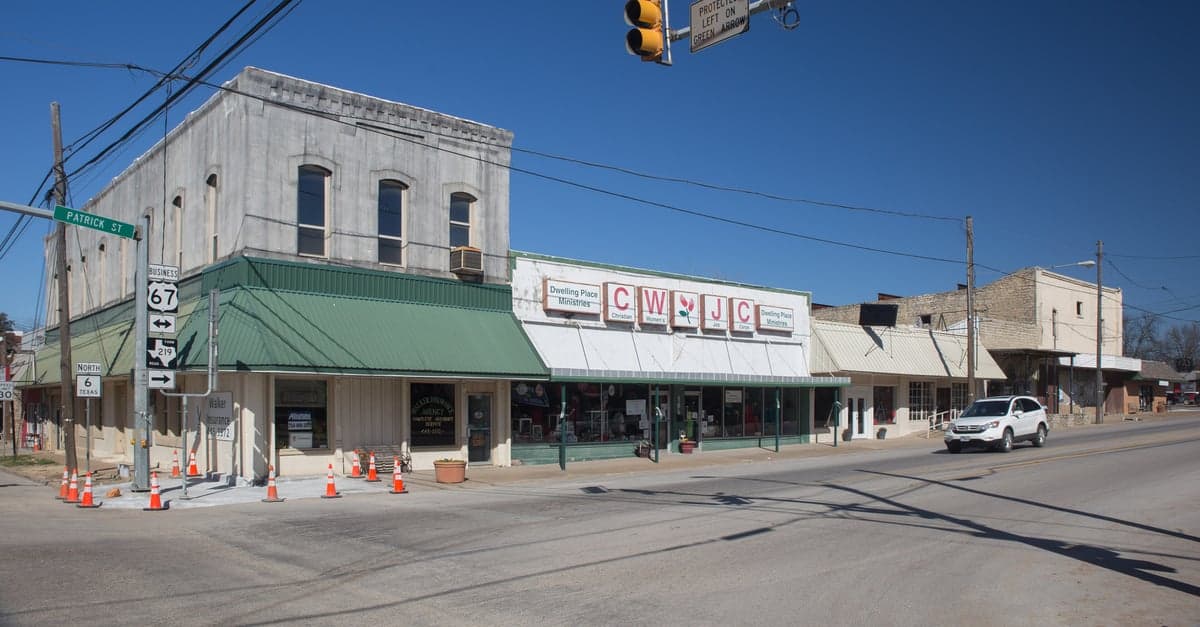
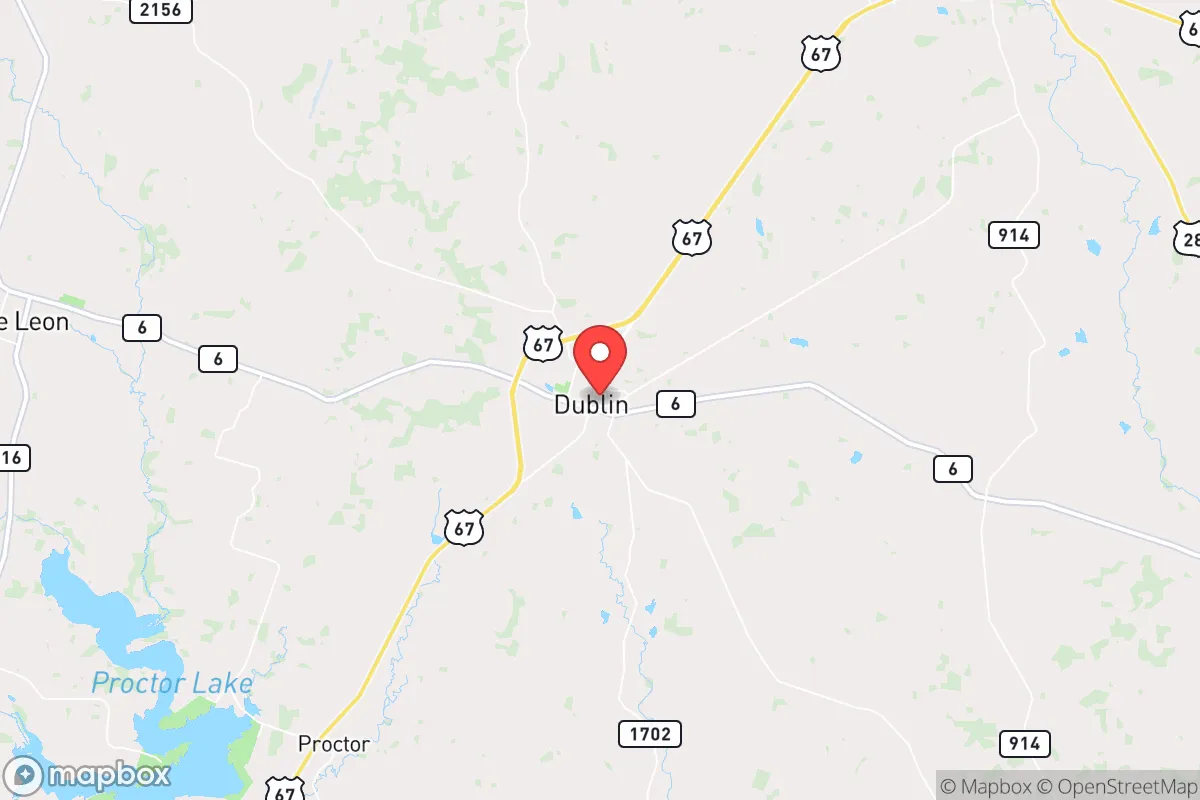

Photo: Wikipedia
Political ClimatePolitical Climate in Dublin, TX
District shown is the primary district for this city’s centroid. Cities may span multiple districts.
Local Political AnalysisPolitical Analysis of Dublin, TX
Dublin, Texas has long been a place where folks value their independence and don't take kindly to being told how to live their lives. The political climate here leans solidly conservative, reflecting the deep-rooted traditions of Erath County, which has voted Republican by wide margins in every recent presidential election. While the state of Texas as a whole carries a Cook PVI of R+4, Dublin and its surrounding rural areas are noticeably more conservative than that, with a strong distrust of government overreach into personal freedoms, gun rights, and local decision-making. In recent years, you've seen a quiet but real shift—some younger folks moving in from bigger cities like Fort Worth or even Austin have brought more progressive ideas, but the old guard here still holds the line, and most folks are watching that trend with a wary eye.
How it compares
Compared to the broader state of Texas, Dublin feels like a throwback to a time when neighbors knew each other and the government stayed out of your business. The state's R+4 rating means Texas is reliably red, but Dublin is deeper red than that—think more like a +20 or +25 lean in local elections. Nearby towns like Stephenville, just a few miles up the road, share that same conservative bent, but you'll find a stark contrast if you head east toward places like Granbury, which has seen an influx of retirees and suburbanites who sometimes vote more moderately. The real eye-opener is when you compare Dublin to cities like Austin or Dallas, where progressive policies on taxes, property rights, and even school curriculum have taken hold. Here in Dublin, the county commissioners and school board still prioritize local control and resist state or federal mandates that feel like overreach. That's a big deal for residents who remember when the government didn't meddle in everything from your truck's emissions to what your kid reads in class.
What this means for residents
For the people who call Dublin home, this political climate means a daily life that's less about red tape and more about common sense. Property taxes are a constant concern, but the local government tends to keep them lower than in more progressive areas, and there's a strong push to protect Second Amendment rights without extra hoops. You won't find the same kind of zoning battles or housing regulations that choke smaller towns near big cities. That said, the recent shifts toward progressive ideology in some parts of Texas are a real worry—folks here are paying close attention to how state-level policies on energy, land use, and education could trickle down. The long-term concern is that as more people move out from urban centers, they might bring ideas that erode the freedoms that make Dublin a good place to raise a family. For now, the community stays engaged, showing up at town hall meetings and voting in every local election to keep things on the right track.
Culturally, Dublin stands apart from much of Texas by holding onto a slower, more self-reliant way of life. There's no push for the kind of progressive social experiments you see in bigger cities—no talk of defunding the police or imposing strict environmental rules on small farms. The local economy still revolves around agriculture and small businesses, and the policy debates here are about keeping government out of the way, not inviting it in. If you're looking for a place where your rights aren't up for debate and the community looks out for each other without a bureaucrat's permission, Dublin is that kind of town. Just keep an eye on the newcomers—some are good folks who fit right in, but others might try to change what makes this place special.

State Political ClimatePolitical Climate in Texas
State Political AnalysisPolitical Environment in the State
Texas remains a solidly Republican state at the statewide level, with a Cook PVI of R+4, but that number masks a dramatic 20-year shift. From 2004 to 2024, the GOP’s dominance in the suburbs of Houston, Dallas, and San Antonio has eroded, while the rural and exurban vote has become even more deeply red. The state’s overall partisan lean is now a tug-of-war between a fast-growing, diversifying urban core and a sprawling, deeply conservative countryside that still turns out reliably. If you’re looking at Texas today, you’re seeing a state that is still Republican, but the margin of comfort has shrunk from double digits to a few points, and the internal fractures are real.
Urban vs. rural divide
The political map of Texas is a story of two worlds. The major metros—Houston, Dallas-Fort Worth, San Antonio, and Austin—are the engines of Democratic growth. Harris County (Houston) and Dallas County have both flipped from red to blue over the past decade, and Travis County (Austin) is now one of the most liberal urban counties in the South. Meanwhile, the rural and exurban counties that ring these cities—like Collin County (north of Dallas), Montgomery County (north of Houston), and Comal County (north of San Antonio)—have become GOP strongholds, often voting 70-80% Republican. The divide is stark: you can drive 30 minutes from downtown Austin to Bastrop County and go from a deep-blue city to a county that voted +15 for Trump in 2024. The Rio Grande Valley (Hidalgo County) is a fascinating exception—historically Democratic, it shifted right in 2020 and 2024, driven by conservative social values and frustration with border policy. That shift alone is a major reason Texas hasn’t flipped blue yet.
Policy environment
Texas’s policy environment is a study in contrasts. On taxes, there is no state income tax—a huge draw for relocating families and individuals. Property taxes are high (around 1.6-2.2% of assessed value), but the state’s 2023 property tax cut package (SB 2) provided some relief, compressing rates for homeowners. The regulatory posture remains business-friendly: no state-level occupational licensing for many trades, and a right-to-work law that keeps unions weak. On education, the state passed school choice legislation in 2023 (HB 3), creating education savings accounts for special needs students, but a broader universal voucher bill failed in the House. Healthcare is a mixed bag: Texas has not expanded Medicaid under the ACA, leaving a coverage gap for low-income adults, but the state has also resisted federal vaccine mandates and COVID-19 lockdowns more aggressively than most. Election laws tightened after 2020 with SB 1 (2021), which banned drive-through voting, restricted mail-in ballot access, and added ID requirements—a move that drew national criticism but was popular with conservatives who distrust election integrity. The state also passed a permitless carry law (HB 1927) in 2021, allowing most adults to carry a handgun without a license.
Trajectory & freedom
On the freedom front, Texas has moved in two directions simultaneously. On personal liberty, the state has expanded gun rights (permitless carry, 2021), protected parental rights in education (HB 3979, 2021, which limits critical race theory instruction), and banned abortion after a heartbeat is detected (SB 8, 2021, and the trigger law in 2023). These moves are popular with conservatives. But on medical freedom, the state has taken a heavy-handed approach: Governor Abbott’s executive orders during COVID-19 banned vaccine mandates for private employers (2021), but also allowed local governments to impose mask mandates early on—a flip-flop that frustrated many. More concerning for libertarians is the state’s aggressive use of the Texas National Guard at the border (Operation Lone Star), which has cost billions and raised questions about federalism and civil liberties. Property rights remain strong—no statewide rent control, and eminent domain protections are decent—but homeowners associations (HOAs) have broad power, and some cities like Austin have experimented with land-use restrictions that limit building. Overall, Texas is still freer than California or New York, but the state government’s willingness to intervene in local affairs (e.g., overriding Austin’s homeless camping ban in 2021) is a double-edged sword.
Civil unrest & political movements
Texas has seen its share of political flashpoints. The 2020 Black Lives Matter protests in Austin and Dallas were large and occasionally violent, leading to property damage and a police funding debate that still simmers. On the right, the “Texas Nationalist Movement” (Texit) has gained some traction, with a 2022 poll showing 18% support for secession—mostly a protest vote, not a serious movement. Immigration politics dominate the border region: El Paso and the Rio Grande Valley have seen migrant surges, and the state’s busing of migrants to New York and Chicago (2022-2024) was a deliberate political statement. Sanctuary city policies are illegal in Texas (SB 4, 2017), and local law enforcement is required to cooperate with ICE. Election integrity remains a hot-button issue: the 2020 and 2022 cycles saw lawsuits over Harris County’s handling of polling places, and the 2024 election saw record turnout in rural counties. A new resident will notice the political polarization in yard signs, bumper stickers, and local news—especially in the suburbs of Fort Worth and San Antonio, where the divide between red and blue is visible block by block.
Projection
Over the next 5-10 years, Texas is likely to remain Republican at the statewide level, but the margin will continue to narrow. The key demographic driver is in-migration: most new residents come from California and the Northeast, and while many are conservative-leaning (attracted by low taxes and business climate), a significant portion are moderates or liberals who will vote Democratic. The Dallas-Fort Worth suburbs (Collin, Denton, Tarrant counties) are the battleground—they are growing fast and becoming more diverse. If Democrats can flip Tarrant County (Fort Worth) consistently, the statewide map gets very tight. The Rio Grande Valley’s rightward shift may stall as younger, more progressive Hispanic voters come of age. On policy, expect continued fights over school choice (a universal voucher bill will likely pass in 2025 or 2027), property tax compression, and border security. The state’s political culture will remain conservative, but the flavor will shift from “country club Republican” to a more populist, culturally combative style. A new resident moving in now should expect a state that is still red, but where every election feels like a knife fight.
Bottom line for a new resident: Texas offers a low-tax, business-friendly environment with strong gun rights and parental control in education. But the political climate is increasingly polarized, especially in the suburbs and cities. If you value personal freedom and limited government, you’ll find plenty to like—but you’ll also need to navigate a state where local politics can swing wildly from deep red to deep blue depending on which county you’re in. The best bet for a conservative-leaning family or individual is to target the exurbs or smaller cities like Lubbock or Tyler, where the political culture is stable and the growth hasn’t yet diluted the conservative base. In the metros, you’ll find more friction, but also more economic opportunity. Choose your county carefully—it matters more than the state as a whole.
* Values derived from national, state, county, city and local statistics and may differ in a specific area. Last updated: 2026-05-10T04:09:11.000Z
Narrative content on this page is AI-generated and may contain mistakes. Verify any details that matter before acting on them.
ReloMaps may earn a commission from affiliate links at no extra cost to you.

