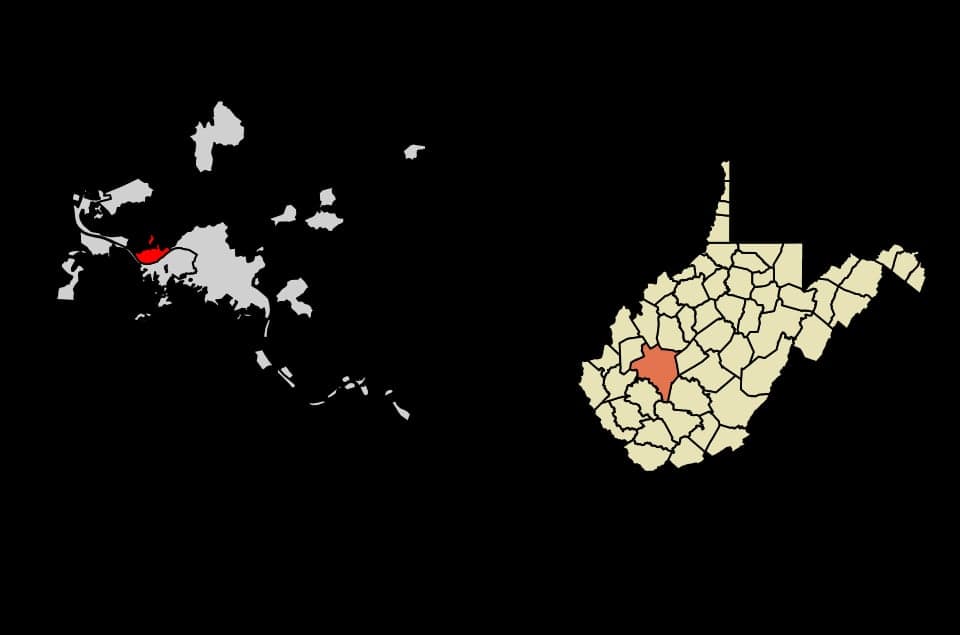
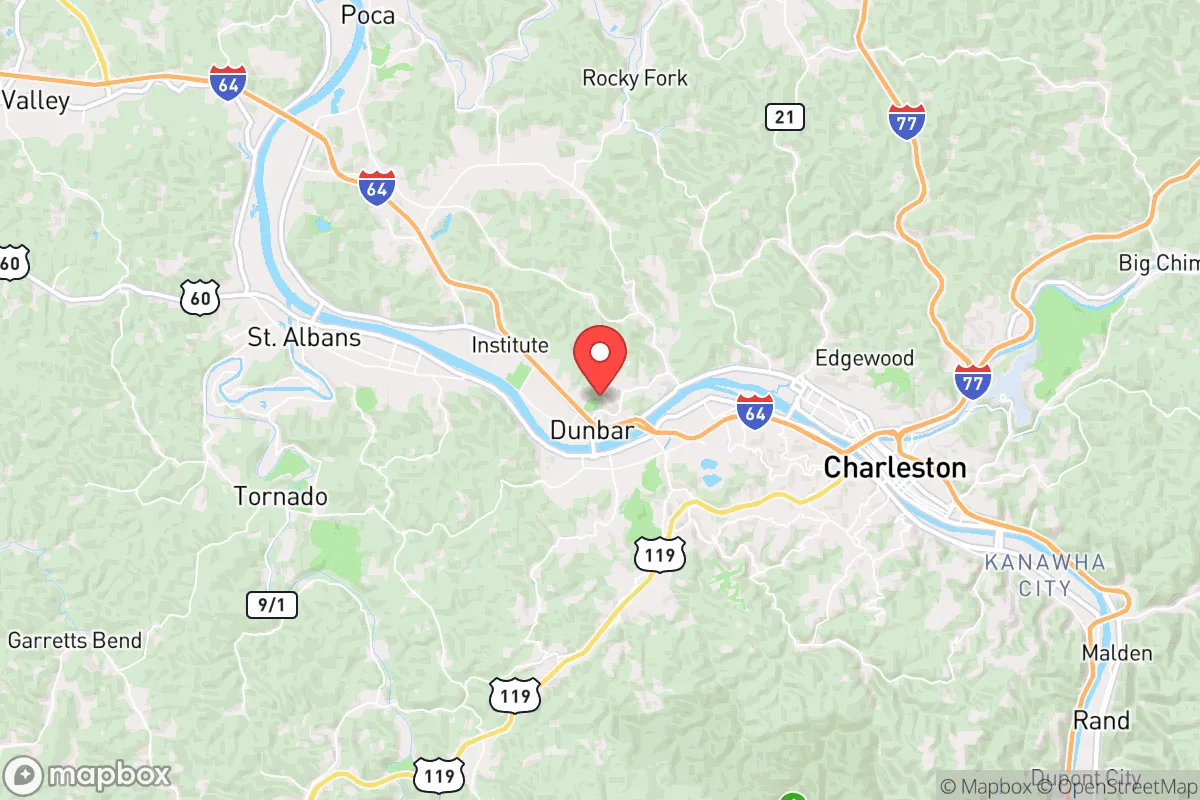
Photo: Wikipedia
Demographics of Dunbar, WV
Affluence Level in Dunbar, WV
A middle-class area roughly in line with national averages across income, home values, education, and employment.
People of Dunbar, WV
Dunbar, West Virginia, is a small, predominantly white city of 7,340 residents, marked by a strong working-class identity rooted in its industrial and railroad past. The population is notably homogenous, with 75.1% identifying as white, 12.2% as Black, and 3.5% as Hispanic, while the foreign-born population stands at 0.0%. This is a community where generational ties run deep, and the city’s character is defined by its stability, modest growth, and a sense of place that is distinctly Appalachian and Kanawha Valley.
How the city was settled and grew
Dunbar’s human history begins not with colonial settlement but with the arrival of the Chesapeake and Ohio Railway in the late 19th century. The city was officially incorporated in 1921, but its growth was driven by the railroad and the coal industry. The original population was overwhelmingly white, drawn from the surrounding Appalachian region and from European immigrant groups—primarily Irish, Italian, and German—who came to work on the railroad and in the nearby coal mines and chemical plants. These early settlers built their homes in what is now Historic Downtown Dunbar, a compact grid of streets near the railroad tracks, and in the Dunbar Addition neighborhood, which grew as the city expanded northward in the 1920s and 1930s. The city’s early character was shaped by the railroad depot, the Dunbar High School (built in 1915), and the many small businesses that lined Dunbar Avenue. The population peaked at around 9,000 in the 1950s, reflecting the post-war industrial boom of the Kanawha Valley.
Modern era (post-1965)
After the 1965 Hart-Cellar Act, Dunbar saw little direct impact from new immigration, as the foreign-born population remains at 0.0% today. Instead, the city’s modern demographic story is one of domestic in-migration and suburbanization. The 1970s and 1980s saw a gradual out-migration of younger families to newer suburbs like Cross Lanes and Teays Valley, while Dunbar itself became a stable, older community. The Black population, which grew during the mid-20th century as African American families moved from rural West Virginia and the South for industrial jobs, concentrated in the Rosedale neighborhood, a historically Black area near the city’s eastern edge, and in the Dunbar Heights area, which developed as a mixed-income community. The Hispanic population, now at 3.5%, began to grow slowly in the 1990s and 2000s, largely through domestic migration from other parts of the U.S., and is dispersed throughout the city, with no single ethnic enclave. The white population, while still the majority, has aged in place, with many younger white residents moving to larger cities for employment. The college-educated share is 30.8%, slightly above the state average, reflecting a modest professional class that works in Charleston’s healthcare, government, and energy sectors.
The future
Dunbar’s population is likely to remain stable or decline slightly over the next 10–20 years, as the city’s aging white population is not being replaced by younger families at a sufficient rate. The 0.0% foreign-born share means there is no immigrant-driven growth to offset natural decrease. The Black population is expected to remain steady, while the Hispanic share may grow modestly as families move from other parts of the U.S. for affordable housing and proximity to Charleston. The city is not tribalizing into distinct ethnic enclaves; rather, it is homogenizing into a predominantly white, older community with a small but stable Black minority. New development is concentrated in the Dunbar Village area near the Kanawha River, where a mix of townhomes and apartments is attracting some younger residents, and in the South Dunbar neighborhood, where infill housing is being built on vacant lots. The city’s future depends on its ability to attract families—particularly those seeking lower housing costs and a slower pace of life—while retaining its existing residents.
For someone moving in now, Dunbar offers a stable, affordable, and safe community with strong local schools and easy access to Charleston’s jobs and amenities. It is a place where neighbors know each other, where the pace is slow, and where the past is still present. The city is not growing or diversifying rapidly, but it is not in decline either—it is a steady, rooted community that rewards those who value continuity over change.

* Values derived from national, state, county, city and local statistics and may differ in a specific area. Last updated: 2026-05-01T17:05:52.000Z
Narrative content on this page is AI-generated and may contain mistakes. Verify any details that matter before acting on them.
ReloMaps may earn a commission from affiliate links at no extra cost to you.

