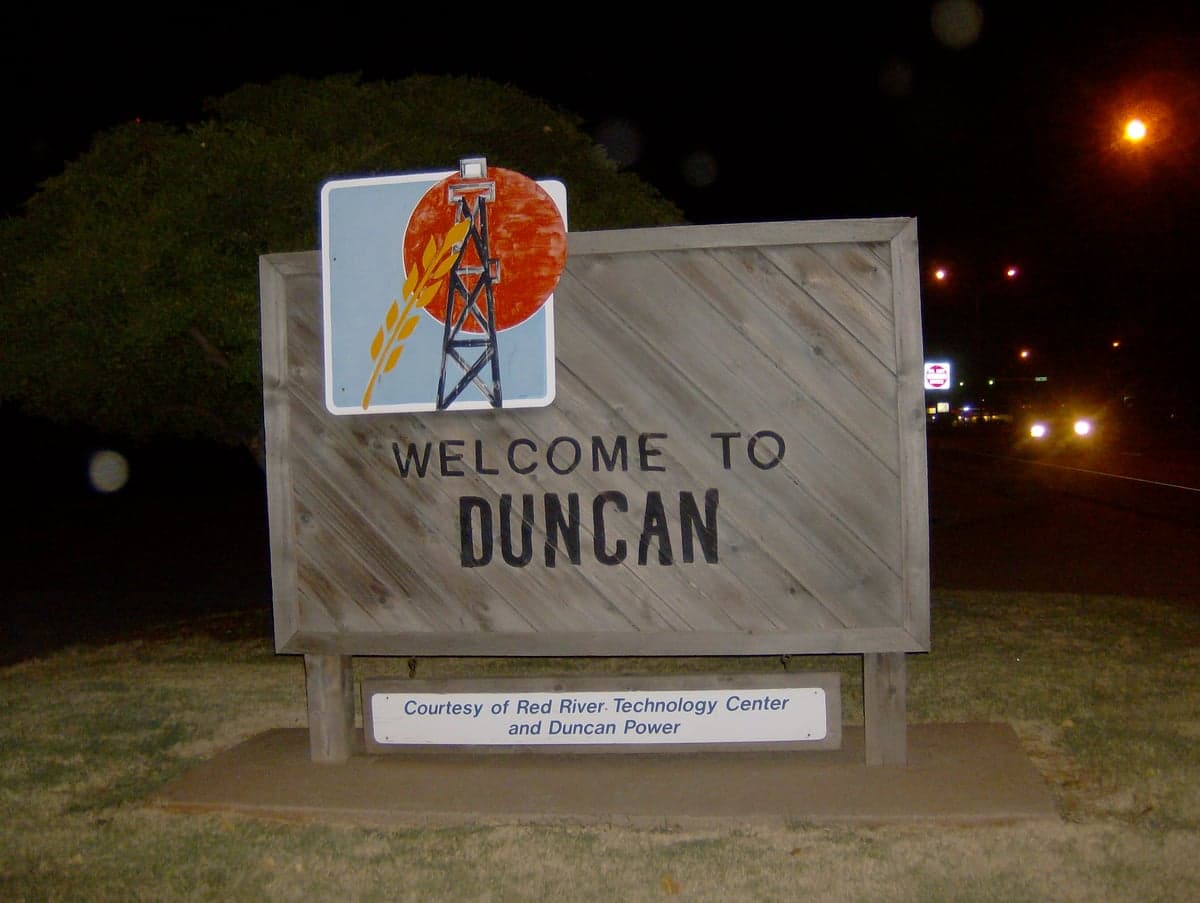
Photo: Wikipedia
Demographics of Duncan, OK
Affluence Level in Duncan, OK
A below-average socioeconomic profile. Incomes, home values, and educational attainment trail the U.S., with higher poverty and unemployment.
People of Duncan, OK
The people of Duncan, Oklahoma, today form a predominantly white, native-born community of roughly 22,872 residents, characterized by a strong working-class identity rooted in the oil and gas industry. With a foreign-born population of just 2.2% and a Hispanic share of 10.9%, the city remains ethnically homogeneous compared to national averages, while its low college attainment rate (19.5%) reflects a blue-collar, family-oriented culture. Distinctive markers include a deep sense of local pride, a conservative political tilt, and a social fabric woven from generations of families who have stayed put, creating a stable but slowly aging population.
How the city was settled and grew
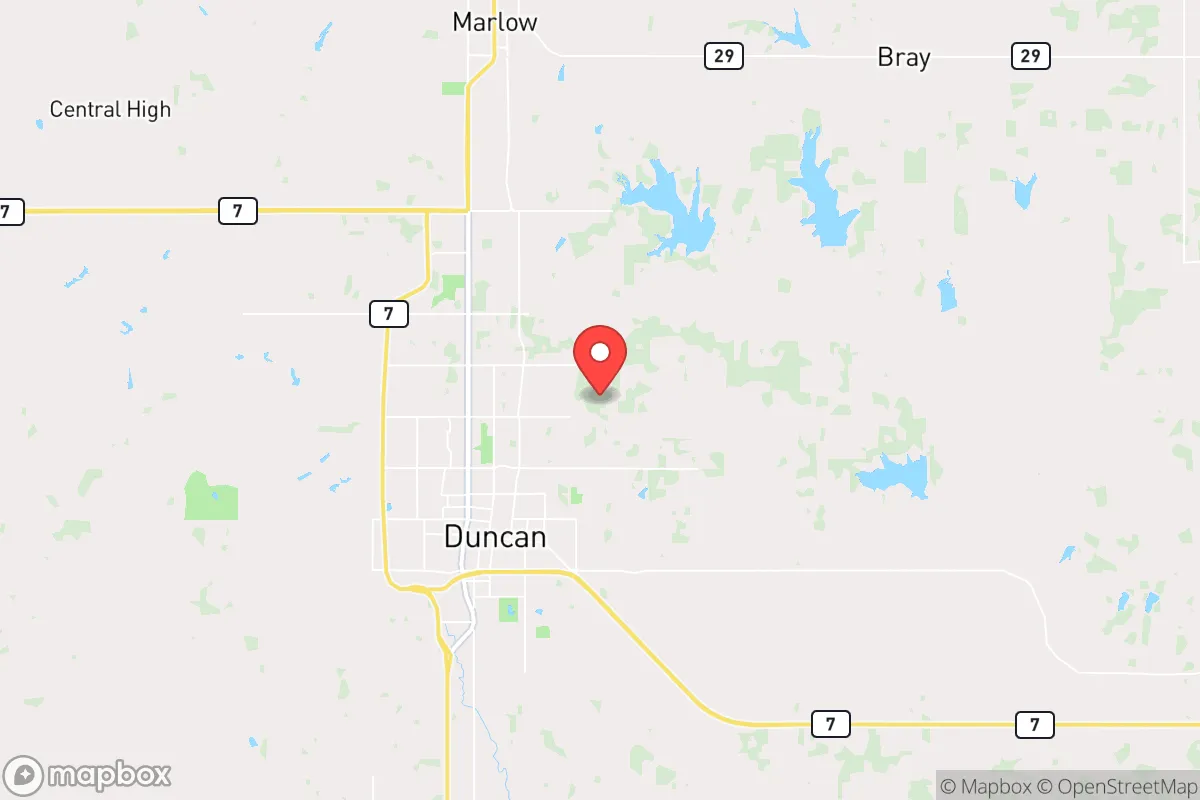
Duncan was founded in 1892 as a railroad town on the Chicago, Rock Island and Pacific line, drawing its first wave of settlers from other parts of the South and Midwest. The discovery of oil in the nearby Healdton Field in 1913 transformed the town, sparking a boom that brought roughnecks, drillers, and entrepreneurs from Texas, Kansas, and Appalachia. These early oil workers settled in the Northwest Duncan area, where modest bungalows and company-built houses still line the streets, and in the East Side near the rail yards, which became a working-class enclave. By the 1920s, the city’s population had surged past 8,000, and the Southwest Duncan neighborhood emerged as a more affluent district for oil executives and business owners, featuring larger homes and tree-lined avenues. The Great Depression slowed growth, but the post-World War II oil boom of the 1950s brought a second wave of migrants, many from rural Oklahoma and northern Texas, who filled new subdivisions like Highland Park and Westwood, areas that remain predominantly white and middle-class today.
Modern era (post-1965)
After the 1965 Hart-Cellar Act, Duncan saw minimal immigration from outside the United States, consistent with its current foreign-born share of just 2.2%. The city’s demographic story in the modern era is one of domestic in-migration and suburbanization rather than ethnic diversification. The oil bust of the 1980s caused a population decline from a peak of roughly 24,000 in 1980 to about 20,000 by 1990, leading to a consolidation of existing residents rather than an influx of new groups. The Northwest Duncan neighborhood, historically home to oil-field workers, saw an aging population as younger families moved to newer subdivisions like Furr Park and Country Club Estates in the 1990s and 2000s. The Hispanic population, now 10.9%, began to grow modestly in the 1990s, driven by agricultural and service-sector jobs, and is concentrated in the East Side and parts of Southwest Duncan, where rental housing is more available. The Black population (2.3%) and East/Southeast Asian population (0.5%) remain very small, with no distinct ethnic enclaves; these groups are dispersed across the city, primarily in the older central neighborhoods near Main Street. The Indian-subcontinent population is effectively zero, reflecting the city’s lack of tech or professional sectors that attract such migrants.
The future
Duncan’s population is projected to remain stable or decline slightly over the next 10–20 years, as the city lacks the economic drivers—such as a major university, tech hub, or immigrant gateway—that fuel growth elsewhere. The white population (74.7%) is aging, with many younger adults leaving for college or jobs in Oklahoma City (80 miles north) or Dallas (120 miles south), a trend that will likely accelerate. The Hispanic share is expected to grow slowly, possibly reaching 15–18% by 2040, as families in the East Side and Northwest Duncan expand, but this growth will be gradual and will not create a large ethnic enclave. The city is not homogenizing into a single identity, but rather tribalizing along economic lines: Country Club Estates and Southwest Duncan will remain more affluent and white, while older neighborhoods like Highland Park and the East Side will see a mix of aging white residents and younger Hispanic families. No significant immigrant communities are emerging, and the foreign-born share will likely stay below 5%.
For someone moving in now, Duncan is becoming a quieter, more settled place—a conservative, family-oriented community where the population is stable but slowly graying. New residents will find a city where roots run deep, neighborhood identities are clear, and the pace of change is measured, making it ideal for those seeking predictability and a low cost of living rather than diversity or rapid growth.

* Values derived from national, state, county, city and local statistics and may differ in a specific area. Last updated: 2026-04-25T13:51:25.000Z
Narrative content on this page is AI-generated and may contain mistakes. Verify any details that matter before acting on them.
ReloMaps may earn a commission from affiliate links at no extra cost to you.

