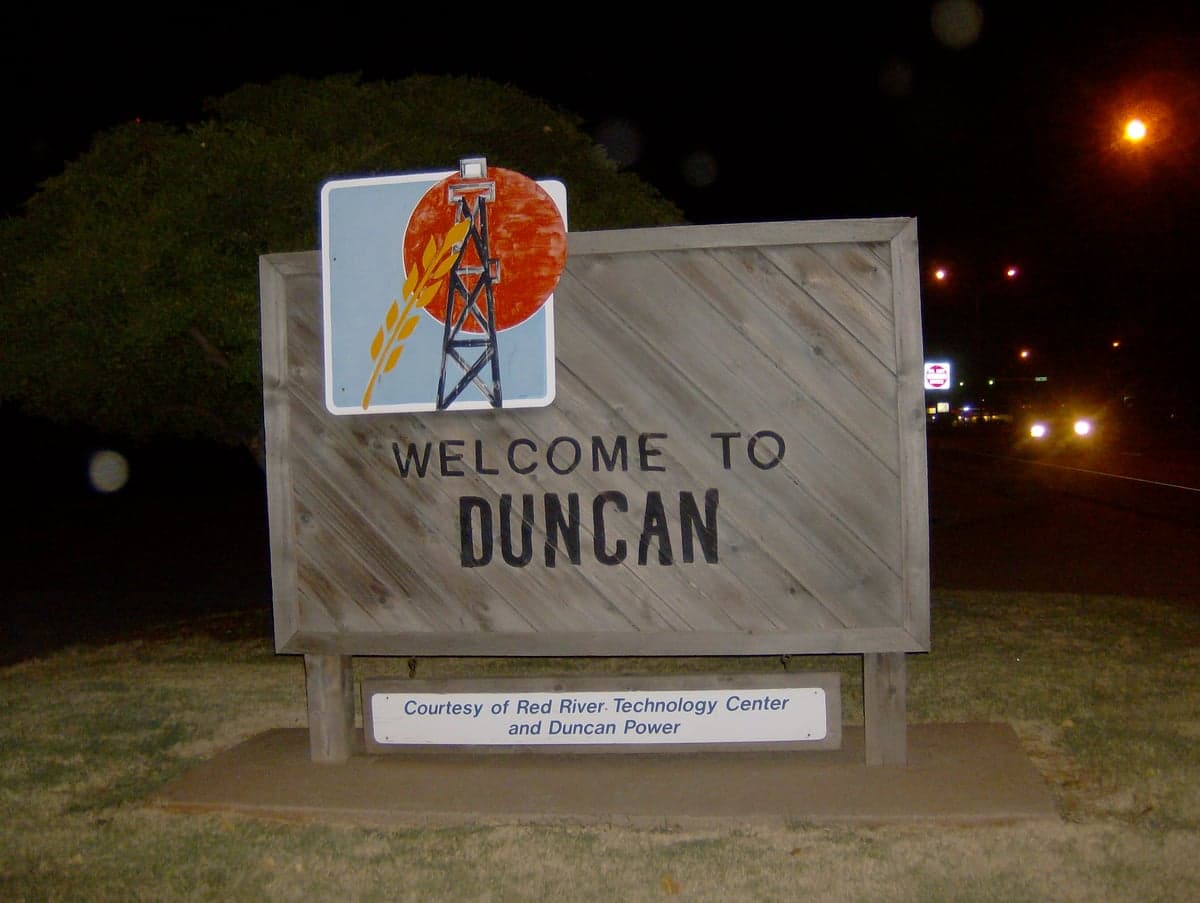
Photo: Wikipedia
Political ClimatePolitical Climate in Duncan, OK
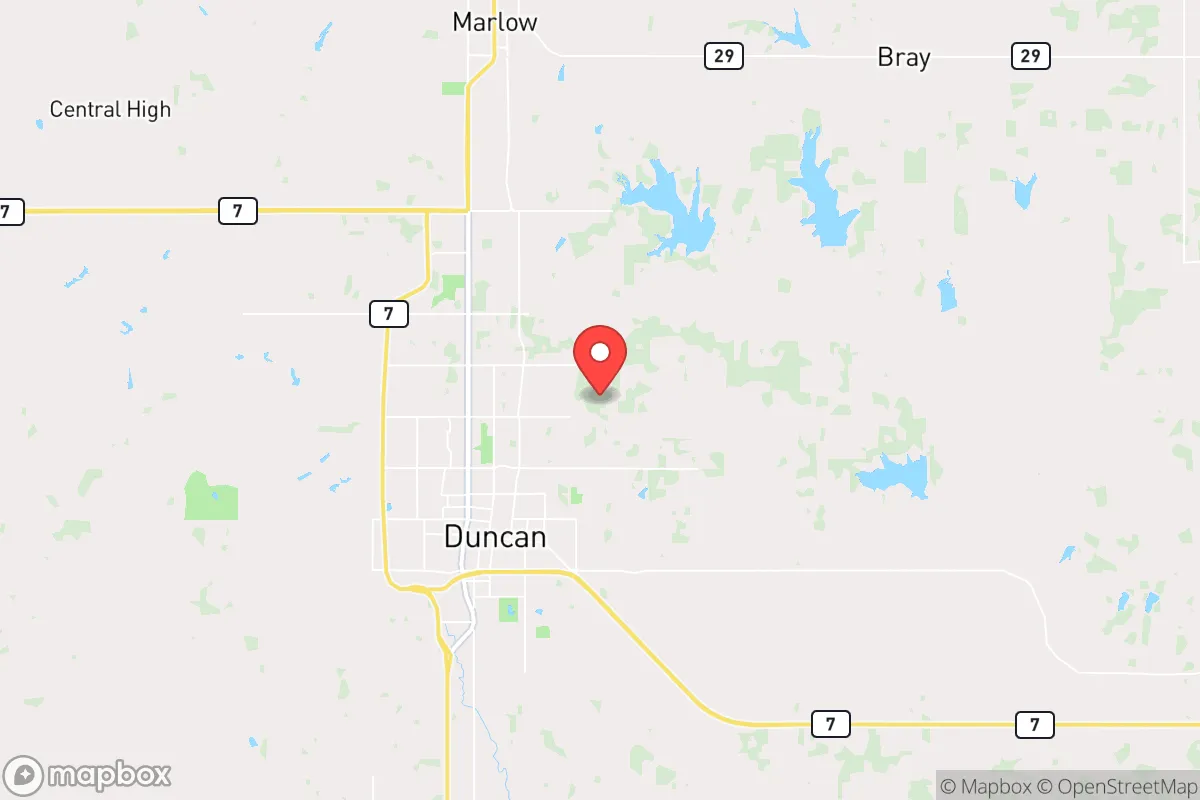
District shown is the primary district for this city’s centroid. Cities may span multiple districts.
Local Political AnalysisPolitical Analysis of Duncan, OK
Duncan, Oklahoma, sits deep in reliably conservative territory, with a Cook PVI of R+17 that reflects generations of voters who prioritize limited government and personal responsibility. The city and surrounding Stephens County have long been a place where folks expect their elected officials to stay out of their business, not meddle in how they raise their kids, run their small businesses, or practice their faith. While the area hasn't swung dramatically left like some parts of the state, there's a quiet unease among longtime residents about the slow creep of progressive policies from the state capitol and federal level, especially when it comes to property rights and school curriculum.
How it compares
Drive thirty minutes north to Lawton, and you'll feel a noticeable shift in the political temperature. Lawton's larger military and more diverse population gives it a slightly more moderate lean, though it still votes reliably red in most races. Head east toward Ardmore, and you'll find a similar conservative baseline, but with a stronger libertarian streak—folks there are even more skeptical of zoning laws and business regulations. Duncan, by contrast, has a more traditional, church-centered conservatism. The real contrast, though, is with Oklahoma City, about 80 miles north. The capital has seen a steady influx of out-of-state transplants and younger professionals, pushing its inner suburbs toward a purple tint. Duncan's political climate feels more insulated from that shift, but the worry is that state-level policies—like expanded Medicaid or new diversity mandates in public schools—could start to erode the local culture of self-reliance.
What this means for residents
For the average Duncan resident, the R+17 lean translates into a daily life where government overreach is still more of a distant threat than a present reality. Property taxes remain low, and there's little appetite for new local ordinances that would tell homeowners what they can do with their land or how they can run a home-based business. The school board elections here still tend to favor candidates who emphasize parental rights and local control over state or federal dictates. But the concern is real: as the national Democratic Party pushes harder on issues like gun control and gender ideology in schools, even a solidly red county like Stephens isn't immune to pressure from state-level bureaucrats. The recent fights over library books and mask mandates in nearby towns have put residents on alert. The feeling is that if you don't stay engaged locally, you could wake up one day with new rules that feel like they came from a city council in Portland or Austin, not from your own neighbors.
Culturally, Duncan still holds onto distinctions that set it apart from more progressive parts of the state. The annual Chisholm Trail Festival and the strong presence of the oil and gas industry reinforce a work ethic that values independence over government handouts. There's a noticeable pride in the fact that the local economy doesn't rely on federal grants or tourism gimmicks. The biggest policy distinction you'll notice is the near-total absence of any serious discussion about zoning reform or affordable housing mandates—the prevailing attitude is that if you want to build or buy, the market and your own effort should decide, not a planning commission. That said, the long-term trajectory depends on whether Duncan can hold the line against the same cultural shifts that have turned once-red suburbs in Texas and Colorado blue. For now, it's still a place where a handshake means something and the government is expected to stay in its lane, but the fight to keep it that way is getting harder every election cycle.

State Political ClimatePolitical Climate in Oklahoma
State Political AnalysisPolitical Environment in the State
Oklahoma has been a reliably red state for decades, with Republicans holding every statewide office and supermajorities in both legislative chambers. The state hasn’t voted for a Democratic presidential candidate since 1964, and in 2024, Donald Trump carried it by over 34 points. But beneath that solid veneer, the political landscape is shifting — the rural-urban divide is widening, and in-migration from blue states is slowly changing the character of its growing suburbs. For a conservative considering relocation, Oklahoma still offers some of the strongest protections for gun rights, parental authority, and low taxes in the nation, but the battle lines are being drawn in places like Oklahoma City, Tulsa, and Norman.
Urban vs. rural divide
The political map of Oklahoma is a study in contrasts. The vast rural expanse — from the Panhandle down through the Red River counties — votes overwhelmingly Republican, often by margins of 70-80%. Counties like Texas County, Cimarron County, and Roger Mills County are among the most conservative in the nation. The urban centers tell a different story. Oklahoma City and its suburbs lean Republican overall, but the city proper has trended leftward, with Democratic mayors and city council members pushing progressive policies on homelessness and policing. Tulsa is more evenly split; its downtown and midtown areas vote blue, while the southern suburbs like Broken Arrow and Bixby are deep red. Norman, home to the University of Oklahoma, is the state’s most liberal city, regularly electing Democrats and passing local measures on environmentalism and social justice. The real flashpoint is the suburban ring around OKC — places like Edmond, Yukon, and Mustang — where conservative families are moving in from California and Texas, but also where younger professionals are bringing more moderate views on issues like marijuana legalization and education funding.
Policy environment
Oklahoma’s policy environment is a conservative dream in many respects. The state has a flat income tax of 4.75%, and the legislature has been steadily cutting it — a bill in 2025 proposed dropping it to 3.99% by 2028. There is no state property tax on vehicles, and property taxes overall are among the lowest in the nation, averaging about 0.9% of home value. The regulatory climate is business-friendly, with right-to-work laws and minimal zoning restrictions outside major cities. On education, the state has embraced school choice: the Oklahoma Parental Choice Tax Credit Act (2023) provides up to $7,500 per child for private school tuition, and the number of charter schools has exploded. However, education funding per pupil remains near the bottom nationally, and teacher pay, while improved, still lags regional averages. Healthcare is a mixed bag: Oklahoma rejected Medicaid expansion until 2021, and the state still has one of the highest uninsured rates. Election laws are strict — voter ID is required, and the state purges inactive voters regularly. There is no early voting by mail without an excuse, though in-person early voting is available. For a conservative, the policy environment is largely aligned with limited government, but the education funding gap and healthcare access are persistent concerns.
Trajectory & freedom
Oklahoma has been on a trajectory of expanding personal freedom in several key areas, but with some notable exceptions. On gun rights, the state is a constitutional carry state (since 2019) — no permit needed to carry a concealed firearm. The Second Amendment Preservation Act (2021) prohibits state enforcement of any future federal gun bans. On parental rights, the Oklahoma Parental Rights in Education Act (2022) requires schools to notify parents of any curriculum involving sexuality or gender identity, and the state has banned transgender athletes from girls’ sports. Medical autonomy took a hit in 2024 when the legislature passed a near-total abortion ban, with exceptions only for rape, incest, or life of the mother — this has been a major point of contention, but for pro-life conservatives, it’s a win. On the other hand, marijuana policy has been a battleground: medical marijuana was legalized in 2018, and the state has one of the most permissive medical programs in the country, but recreational legalization failed at the ballot in 2022 and 2024. Property rights are strong — there is no statewide rent control, and eminent domain is rarely abused. The biggest freedom concern is the state’s heavy reliance on oil and gas tax revenue, which makes the budget volatile and can lead to sudden cuts in services. Overall, Oklahoma is becoming more free on cultural and Second Amendment issues, but the economic freedom is tied to a boom-and-bust energy cycle.
Civil unrest & political movements
Oklahoma has seen its share of political flashpoints, but they tend to be localized rather than statewide. The most visible movement in recent years has been the “OK Parents” group, which organized school board protests over mask mandates and critical race theory in 2021-2022, successfully flipping several school boards in suburbs like Edmond and Owasso. On the left, the “Tulsa for All” coalition has pushed for police reform and affordable housing, but has struggled to gain traction outside the city limits. Immigration politics are relatively quiet — Oklahoma is not a border state, and the legislature passed a bill in 2024 requiring law enforcement to cooperate with ICE, but enforcement is lax in practice. There was a notable protest in 2023 when the state executed a death row inmate after a controversial clemency hearing, drawing national attention from abolitionist groups. Election integrity has been a hot topic: the state’s voter ID law and strict absentee ballot rules have been praised by conservatives, but a 2022 audit found no evidence of widespread fraud. The most visible civil unrest in recent memory was the 2020 George Floyd protests in Tulsa and Oklahoma City, which saw some property damage but were smaller than in many other states. For a new resident, the political climate is generally calm, but the school board meetings and local elections are where the real action happens.
Projection
Over the next 5-10 years, Oklahoma is likely to remain solidly red, but the margins will narrow in urban and suburban areas. In-migration from California, Colorado, and Texas is bringing a wave of new residents — many of them conservative, but some with more moderate views on issues like marijuana and education funding. The suburbs of Oklahoma City, particularly Edmond and Mustang, are growing fast, and these areas are becoming the new battlegrounds for school board and city council races. The rural population is shrinking, which means the political center of gravity is slowly shifting toward the I-35 corridor. On policy, expect continued tax cuts, further expansion of school choice, and possibly a push for recreational marijuana if the medical program continues to grow. The biggest wildcard is the state’s budget: if oil prices crash, the legislature may have to raise taxes or cut services, which could trigger a backlash. For a conservative moving in now, the next decade will likely bring more of the same — low taxes, strong gun rights, and parental control in schools — but with increasing cultural friction in the growing suburbs. The key is to get involved early in local politics, because that’s where the real decisions are being made.
For a new resident, the bottom line is this: Oklahoma offers a high degree of personal freedom, low taxes, and a political culture that respects traditional values. The state is not without its challenges — education funding is thin, healthcare access is spotty, and the economy is tied to energy — but for a conservative looking to escape high-tax, high-regulation states, Oklahoma is a solid bet. Just be prepared to engage at the local level, because the real fights are in the school boards and city councils of places like Edmond, Broken Arrow, and Norman. If you want a state where your vote counts and your voice matters, Oklahoma delivers — but you have to show up.
* Values derived from national, state, county, city and local statistics and may differ in a specific area. Last updated: 2026-04-25T13:51:25.000Z
Narrative content on this page is AI-generated and may contain mistakes. Verify any details that matter before acting on them.
ReloMaps may earn a commission from affiliate links at no extra cost to you.

