
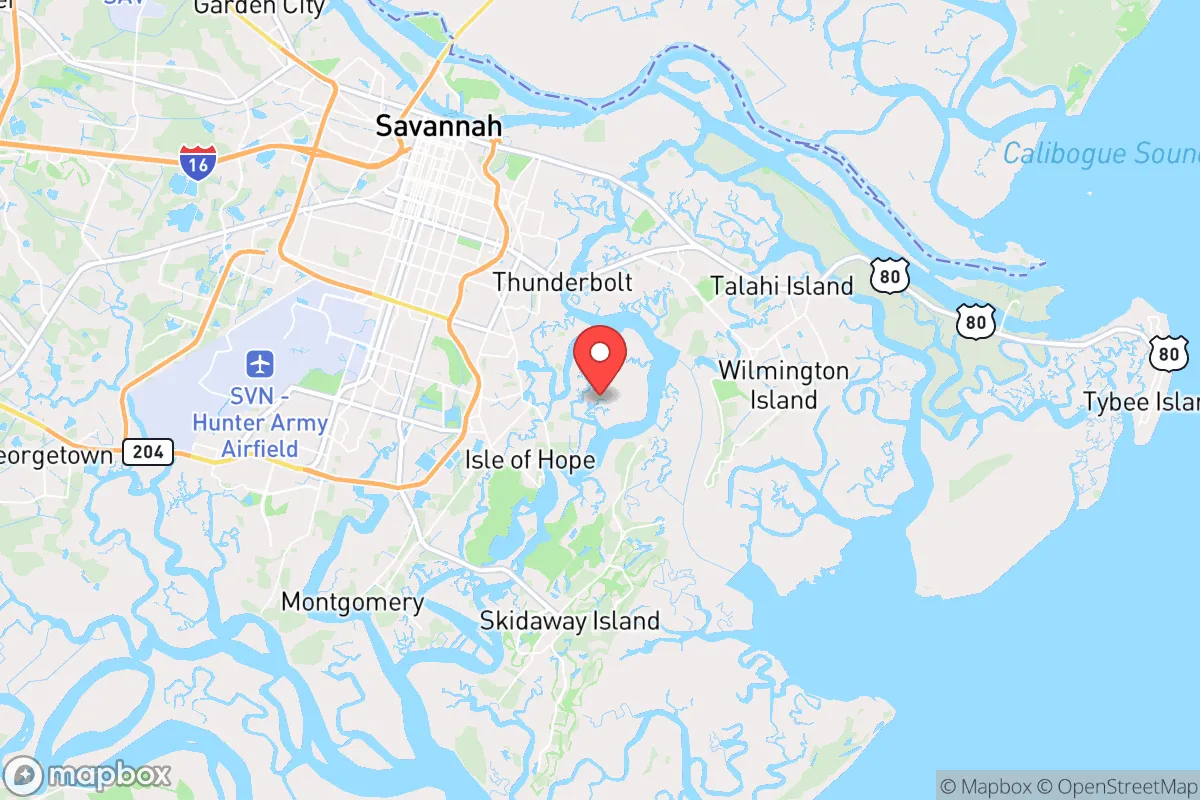
Political ClimatePolitical Climate in Dutch Island, GA
District shown is the primary district for this city’s centroid. Cities may span multiple districts.
Local Political AnalysisPolitical Analysis of Dutch Island, GA
Dutch Island leans solidly Republican, with a Cook Partisan Voting Index of R+8, making it significantly more conservative than the national average and broadly in line with the deeply red character of coastal Georgia. The area has been reliably Republican for decades, and while the broader state of Georgia has shifted toward competitiveness in presidential elections—turning blue in 2020 and 2024—Dutch Island has remained a GOP stronghold. If you’ve lived here a while, you’ve seen the same pattern: national waves barely ripple the local politics, and the precincts here consistently deliver margins that would make a statewide candidate breathe easy.
How it compares
Georgia as a whole is now a true battleground state, with a Cook PVI of R+3 in 2024, but Dutch Island’s R+8 rating places it well to the right of the state average. That gap is driven by the area’s demographics and geography: Dutch Island is a suburban and exurban community near Savannah, where retirees, military-affiliated families, and commuters to the port and manufacturing sectors have created a stable conservative base. In contrast, the city of Savannah itself leans Democratic (D+12), and nearby Chatham County has trended blue in recent cycles. Towns like Pooler and Richmond Hill are more mixed, but Dutch Island’s voting patterns more closely resemble those of Effingham County or Bryan County—both reliably red. The practical effect is that a Republican candidate can expect to win Dutch Island by 15 to 20 points in a typical election, while statewide races in Georgia are decided by margins of 1 to 3 points.
What this means for residents
For conservative residents, the political climate feels natural and affirming. Local elected officials—county commissioners, school board members, and state representatives—are almost uniformly Republican, and policy debates tend to focus on tax cuts, Second Amendment rights, and limited government. Conservative voters here rarely feel the need to defend their views; the culture of the area reinforces them. For liberal residents, the reality is more nuanced. They are a clear minority, but not an invisible one. There are active Democratic clubs and progressive groups in the broader Savannah area, and many liberal-leaning Dutch Island residents commute into the city for work or social life. That said, local elections can feel discouraging—progressive candidates rarely win, and policy discussions at the county level often bypass their concerns entirely. The social atmosphere is generally polite, but political conversations can be tense, especially around national issues like abortion or gun policy. Most people here avoid bringing up politics at the dinner table unless they know the room.
Culturally, Dutch Island reflects its conservative lean in tangible ways. The area has a strong military and veteran presence, with many residents connected to nearby Fort Stewart or Hunter Army Airfield. Gun ownership is common, and local businesses often display American flags and patriotic signage. There is no local income tax, and property taxes are relatively low compared to other parts of coastal Georgia. Public schools in the area emphasize traditional values and have avoided the culture-war battles seen in more urban districts. For newcomers, the biggest adjustment is often the pace of life—slower, more private, and less politically charged than in Savannah or Atlanta. Whether that feels like a relief or a limitation depends entirely on your own politics, but for most residents, it’s simply the way things have always been.

State Political ClimatePolitical Climate in Georgia
State Political AnalysisPolitical Environment in the State
Georgia has transformed from a reliably Republican stronghold into the nation’s most competitive swing state over the past two decades, a shift driven by explosive growth in the Atlanta metro and a diversifying electorate. The state’s current political reality is a razor-thin balance: Joe Biden won it by fewer than 12,000 votes in 2020, and both Senate seats flipped Democratic in 2021, yet Republicans still control the governorship, the legislature, and every other statewide office. For a relocator, this means living in a state where the political culture is genuinely contested — neither party has a comfortable grip, and the policy environment reflects that tension.
Urban vs. rural divide
The political map of Georgia is a textbook study in the urban-rural chasm. The Atlanta metropolitan area, home to roughly 60% of the state’s population, is the engine of Democratic growth. Core counties like Fulton (Atlanta), DeKalb (Decatur), and Clayton are deep blue, while the fast-growing suburban ring — Cobb (Marietta), Gwinnett (Lawrenceville), and Henry County — have flipped from red to purple to solidly Democratic over the last three election cycles. Outside the metro, the story flips: rural south Georgia, from Albany to Valdosta, votes overwhelmingly Republican, as do the exurban and small-town counties of north Georgia, like Hall (Gainesville) and Whitfield (Dalton). The state’s second-largest city, Augusta, leans Democratic but is surrounded by deep-red Richmond County suburbs. Columbus and Savannah are blue-leaning islands in conservative regions. The political divide isn’t just geographic — it’s demographic: the Atlanta suburbs are younger, more educated, and more diverse, while rural areas are older and whiter. This split means statewide elections are decided by turnout in the metro, particularly in the formerly Republican suburbs that have shifted left since 2016.
Policy environment
Georgia’s policy landscape is a mix of conservative governance and pragmatic moderation. The state has a flat income tax — currently 5.49%, with a legislatively mandated glide path down to 4.99% by 2029 — and a relatively low property tax burden compared to the national average. There is no state-level rent control, and zoning is largely a local affair, which has kept housing supply responsive in most markets outside Atlanta proper. The regulatory climate is business-friendly: Georgia is a right-to-work state, meaning union membership is voluntary and union power is limited. On education, the state has expanded school choice through the Georgia Promise Scholarship Act (2024), which provides state-funded vouchers for students in low-performing school zones to attend private schools. Healthcare policy is more mixed: Georgia did not expand Medicaid under the Affordable Care Act, leaving a coverage gap for low-income adults, but the state has pursued a limited waiver program (Georgia Pathways) that requires work or community engagement for eligibility. Election laws have been a flashpoint: the Election Integrity Act of 2021 (SB 202) added voter ID requirements for absentee ballots, limited drop box locations, and restricted third-party ballot collection, while also expanding early voting hours in rural counties. Gun laws are permissive — Georgia is a permitless carry state (HB 218, 2022), with no state-level red flag law and no waiting periods for purchase.
Recent policy direction
The last five years have seen Georgia’s legislature move decisively on several fronts that matter to relocators weighing personal liberty. On gun and self-defense law, the 2022 permitless carry law (HB 218) allows any legal gun owner to carry a concealed firearm without a license, though a license is still available for reciprocity with other states. Parental and education rights have been a major focus: the 2022 Parents’ Bill of Rights (SB 449) requires school districts to notify parents of instructional materials involving sexuality and to obtain parental consent before a child can change their name or pronouns at school. The 2024 Promise Scholarship Act creates state-funded education savings accounts for students in the bottom 25% of schools. On medical and bodily autonomy, Georgia’s 2019 Living Infants Fairness and Equality (LIFE) Act bans abortion after a fetal heartbeat is detected (roughly six weeks), with limited exceptions for rape, incest, and medical emergencies — a law that took effect after the 2022 Dobbs decision. Property rights are generally strong: Georgia is a title-theory state for mortgages, and there is no state-level homestead exemption cap for property tax purposes (counties set their own). Voting and ballot access tightened under SB 202, but Georgia also has automatic voter registration through the Department of Driver Services and no-excuse absentee voting (though with stricter ID rules). Privacy and surveillance are less protected: Georgia has no comprehensive state data privacy law, and law enforcement can access cell-site location data with a court order under state law.
Civil unrest & political movements
Georgia has been a focal point for political activism on both sides. The 2020 election cycle saw massive, sustained protests in Atlanta following the murder of George Floyd, with the city becoming a national hub for racial justice organizing. The 2021 election law (SB 202) sparked corporate backlash — Major League Baseball moved the 2021 All-Star Game from Atlanta to Denver — and continues to fuel activist campaigns around voting rights. On the right, the state has seen a surge in grassroots conservative organizing, particularly around school board elections and library content challenges in suburban counties like Cobb and Forsyth. Immigration politics are less volatile than in border states, but Georgia has a 2011 law (HB 87) that allows law enforcement to check immigration status of suspects and penalizes transporting undocumented immigrants; it remains on the books but has been partially enjoined. There is no sanctuary city policy in Georgia — state law (SB 160, 2009) prohibits local governments from adopting sanctuary ordinances. Election integrity remains a live issue: the 2020 recount and audit process in Georgia was among the most scrutinized in the nation, and the state’s new election board rules (2024) have given county boards more power to investigate irregularities before certifying results. A new resident would notice the political energy most in the Atlanta suburbs, where yard signs, campaign mailers, and local activist groups are a constant presence during election years.
Projection
Over the next five to ten years, Georgia is likely to remain a competitive swing state, but the trajectory favors Democrats in presidential elections and Republicans in state-level races — a pattern already visible. The Atlanta metro’s continued growth, driven by domestic migration from other states and international immigration, will keep adding Democratic-leaning voters in the suburbs. However, rural and exurban areas are also growing, and Republican gains in places like Forsyth County (north of Atlanta) and along the coast (Bryan County, near Savannah) are real. The wild card is turnout: Georgia’s electorate is younger and more diverse than most swing states, but that demographic is also less reliable in midterm and local elections. For a relocator, the practical implication is that the state’s policy environment will remain a tug-of-war: Republican control of the legislature and governor’s mansion means continued conservative movement on taxes, school choice, and gun rights, while Democratic gains in the suburbs will push back on abortion restrictions and election laws. A decade from now, Georgia will likely look more like North Carolina — a purple state with a Republican legislature and occasional Democratic statewide wins — than like Texas or Florida.
For someone moving to Georgia, the bottom line is that you’ll be living in a state where your vote genuinely matters, but where the day-to-day policy environment is shaped by a Republican legislature regardless of who wins the White House. Conservatives will find a low-tax, business-friendly climate with strong gun rights and school choice options. Liberals will find a state where their votes are competitive but where progressive policy wins require winning both chambers of the legislature — a tall order. The practical takeaway: Georgia rewards political engagement. If you show up, you’ll have a say in a state that is still defining what it wants to become.
* Values derived from national, state, county, city and local statistics and may differ in a specific area. Last updated: 2026-07-14T18:17:41.000Z
Narrative content on this page is AI-generated and may contain mistakes. Verify any details that matter before acting on them.
ReloMaps may earn a commission from affiliate links at no extra cost to you.

