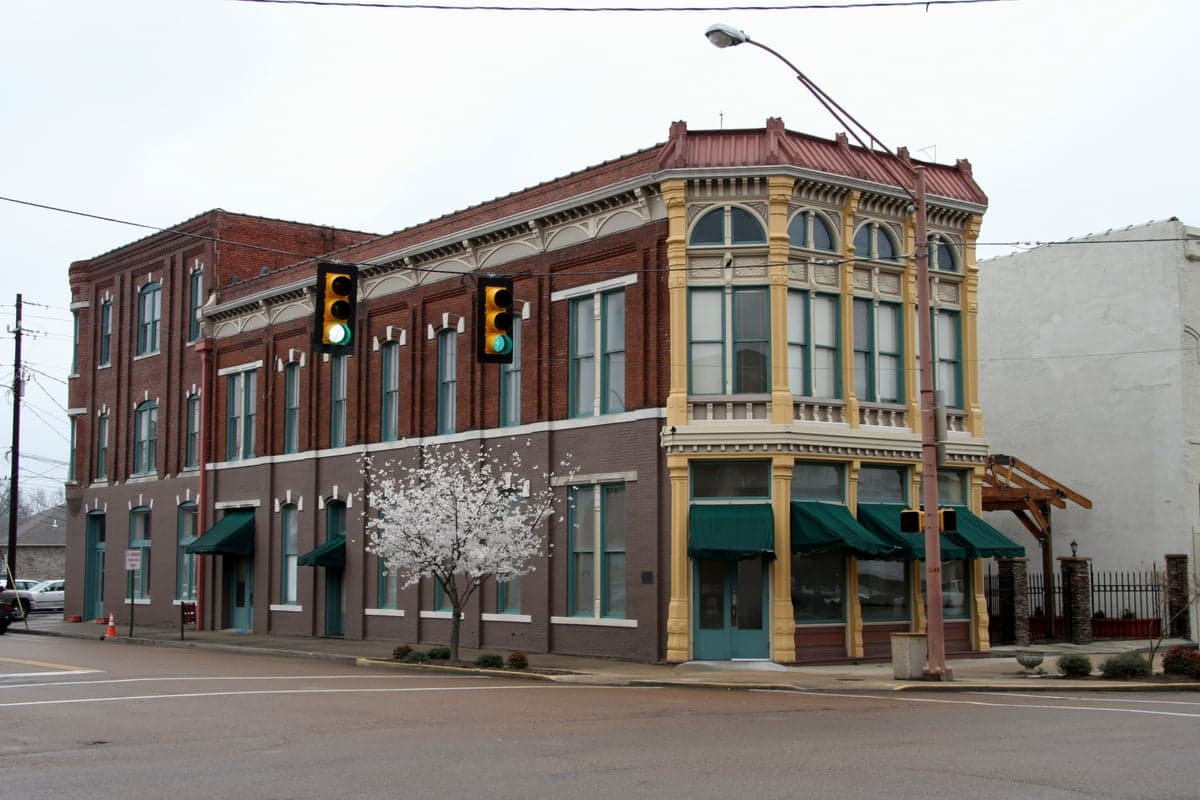
Photo: Wikipedia
Personal Sovereignty in Dyersburg, TN
Viable for self-reliance. Generally workable, though some barriers may limit total independence.
What does Personal Sovereignty tell us?
Personal Sovereignty measures your capacity for self-reliance and independence with minimal government friction. Higher scores mean fewer barriers between you and the way you want to live... but it assumes you have the space you need and good neighbors.
What does this tell us?
Personal Sovereignty measures your capacity for self-reliance and independence with minimal government friction. Higher scores mean fewer barriers between you and the way you want to live... but it assumes you have the space you need and good neighbors.
State Policy
Energy independence: Importer (25% of energy produced in-state)
Personal Liberty
Homesteading

Personal Liberty Analysis
Dyersburg, Tennessee, offers a notably high degree of personal sovereignty compared to much of the country, particularly for those who prioritize minimal government interference in daily life. As a conservative-leaning individual or parent evaluating relocation options, you’ll find a legal and cultural environment that strongly favors individual autonomy over collective mandates, with state-level preemption laws limiting local government overreach. The city’s position in the rural western part of the state, combined with Tennessee’s broader political posture, creates a space where self-reliance isn’t just tolerated—it’s expected.
Tax burden and regulatory posture in Dyersburg
Tennessee’s tax structure is a major draw for those seeking to maximize personal financial sovereignty. The state has no personal income tax on wages, and Dyersburg residents pay no state-level tax on earned income, interest, or dividends. Property taxes in Dyer County are among the lowest in the state, with an effective rate around 0.65% of assessed home value, meaning a $200,000 home carries an annual tax bill of roughly $1,300. Sales tax is higher—combined state and local rates hover near 9.75%—but this consumption-based model allows residents to control their tax burden through spending habits. Regulatory posture is equally favorable: Tennessee is a right-to-work state with minimal business licensing requirements, and Dyersburg’s local government generally avoids the kind of zoning overreach seen in more urbanized areas. There are no county-level building codes for agricultural structures, and the city’s planning department is known for a hands-off approach to residential improvements, provided they meet basic safety standards.
Self-defense rights and gun law specifics in Tennessee
For those prioritizing the right to self-defense, Tennessee offers some of the strongest protections in the nation. The state operates under a constitutional carry law (permitless carry) for both open and concealed handguns, effective since 2021, with no requirement for a license or training to carry. Dyersburg is in a county where sheriff’s office issuance of enhanced carry permits is straightforward, and the state’s preemption statute explicitly prohibits local governments from enacting their own firearm restrictions—meaning Dyersburg city council cannot ban guns in parks or businesses. Stand-your-ground laws are fully codified, with no duty to retreat in any place where a person is lawfully present. For parents, this extends to school zones: while federal law restricts carry in K-12 buildings, Tennessee allows permit holders to carry on school property with written authorization from the school administrator, a provision rarely available in blue states. Magazine capacity, ammunition types, and firearm features (including suppressors and short-barreled rifles) are all unregulated at the state level, subject only to federal NFA rules.
Self-reliance and homesteading viability in Dyersburg
Dyersburg’s rural character makes it a strong candidate for those seeking a self-reliant lifestyle. Lot sizes in the city proper range from standard quarter-acre residential plots to 1-5 acre parcels in the outskirts, while unincorporated Dyer County offers 10- to 40-acre tracts at prices under $4,000 per acre. Zoning is minimal: the city has basic residential and commercial designations, but there are no restrictions on keeping chickens, goats, or bees within city limits, and no county-level zoning exists at all for agricultural use. Off-grid feasibility is high—Tennessee has no state-level prohibition on rainwater collection, and Dyersburg’s average annual rainfall of 52 inches provides ample water for cistern systems. Solar panel installation requires no special permits beyond standard electrical inspection, and net metering is available through the local utility, Dyersburg Electric System. Septic systems are permitted by the county health department with a straightforward soil test, and well drilling is legal on parcels of one acre or more. For those concerned about supply chain disruptions, the region’s agricultural heritage means local feed stores, farm supply co-ops, and livestock auctions are within a 30-minute drive.
Personal liberties: parental rights, medical autonomy, speech, and property
Tennessee has become a national leader in protecting parental rights, with laws that give parents explicit authority over their children’s education and medical decisions. The state’s Parental Bill of Rights (enacted 2022) requires school districts to obtain written parental consent before administering any mental health or medical survey, and it prohibits school personnel from encouraging a child to withhold information from parents. Dyersburg City Schools have fully complied, with no reported incidents of curriculum overreach. Medical autonomy is similarly robust: Tennessee has no vaccine mandate for adults or children beyond standard school-entry requirements (which allow broad religious and medical exemptions), and the state’s COVID-era executive orders were among the first rescinded nationally. Speech protections are strong under both the Tennessee Constitution and state law, which explicitly prohibits local governments from restricting speech in public forums. Property rights are reinforced by Tennessee’s Private Property Protection Act, which requires government entities to compensate landowners for any regulatory taking that reduces property value by more than 20%. Dyersburg’s local government has not pursued eminent domain for private development in over a decade, and property tax assessments are appealable through a straightforward county board process.
Overall, Dyersburg represents a stronghold of personal sovereignty in a region that already ranks among the most liberty-oriented in the United States. Compared to the coastal states or even parts of the Midwest, you’ll find fewer layers of bureaucracy, lower tax burdens, and a legal framework that assumes individual competence rather than requiring government permission. The trade-off is limited urban amenities and a slower pace of life, but for those who view self-reliance as a core value—whether through homesteading, firearms ownership, or simply raising a family without state interference—Dyersburg delivers a level of autonomy that is increasingly rare. It’s not a libertarian utopia, but it’s a place where the default answer from government is “yes” rather than “no,” and that counts for a lot in today’s regulatory climate.

* Values derived from national, state, county, city and local statistics and may differ in a specific area. Last updated: 2026-05-07T00:12:21.000Z
Narrative content on this page is AI-generated and may contain mistakes. Verify any details that matter before acting on them.
ReloMaps may earn a commission from affiliate links at no extra cost to you.

