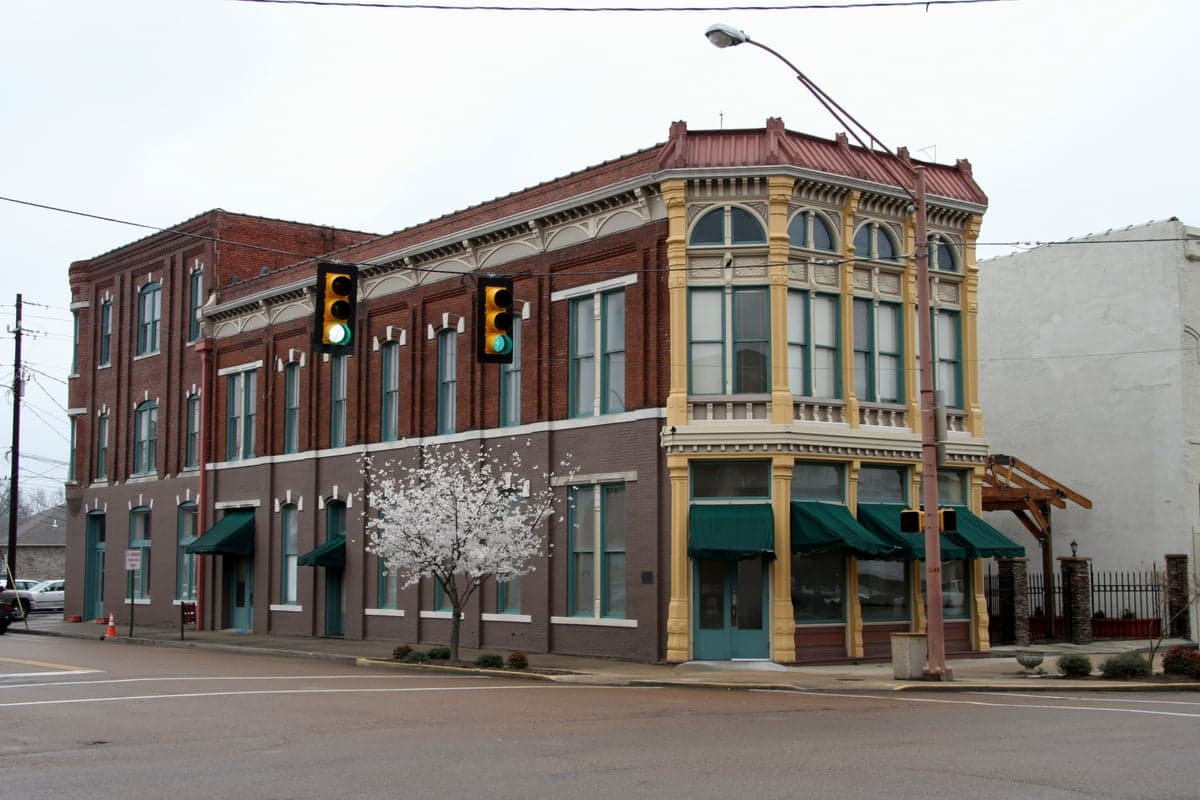
Photo: Wikipedia
Political ClimatePolitical Climate in Dyersburg, TN
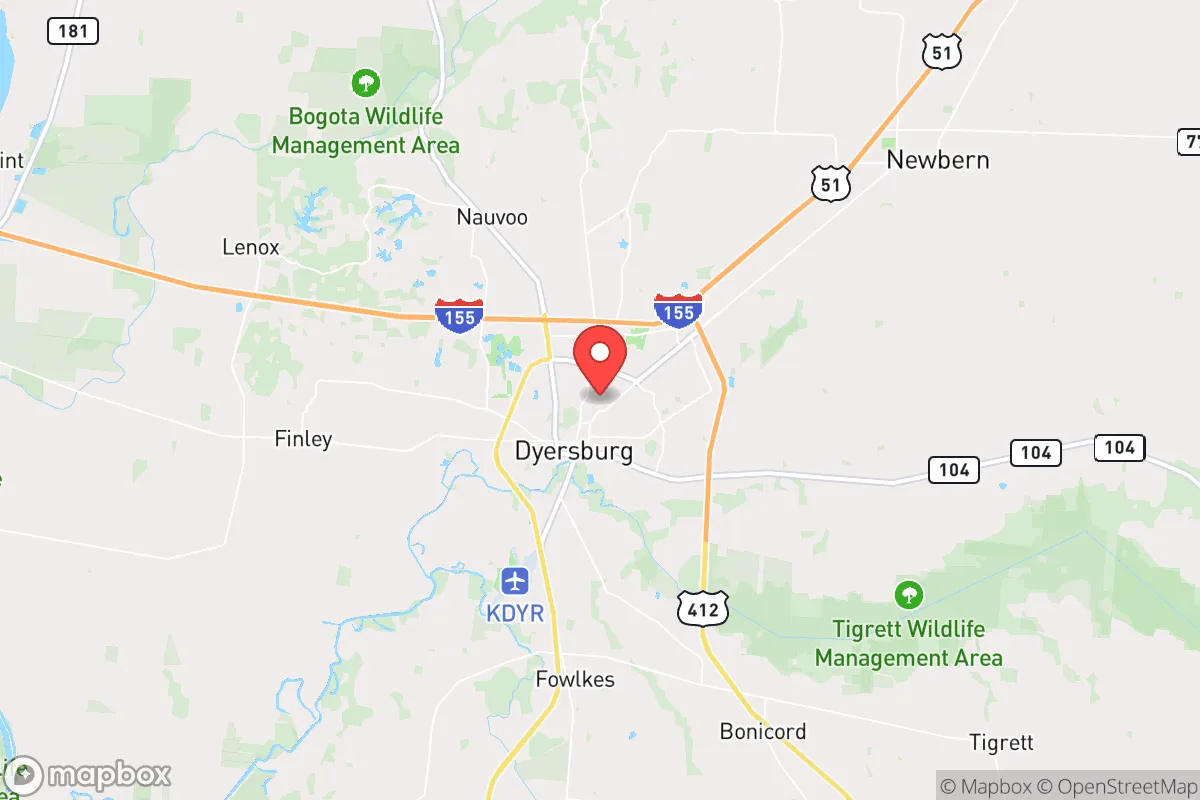
District shown is the primary district for this city’s centroid. Cities may span multiple districts.
Local Political AnalysisPolitical Analysis of Dyersburg, TN
Dyersburg is about as reliably conservative as it gets in West Tennessee, and that’s not changing anytime soon. The Cook PVI here sits at R+21, a solid eight points redder than the state’s already strong R+13 rating, meaning this area votes Republican with a consistency that makes statewide trends look moderate by comparison. In the 2024 presidential race, Dyer County went for Trump by a margin north of 70%, and local races rarely see a competitive Democrat—the last time a Democrat carried the county in a presidential election was 1996. This isn’t a purple community flirting with change; it’s a place where conservative values are baked into the culture, and any drift toward progressive policies feels like an unwelcome intrusion.
How it compares
Compared to Tennessee as a whole, Dyersburg is noticeably more conservative, and the gap is widening. While the state’s R+13 PVI reflects growing Republican strength in suburbs like Williamson County and rural areas, Dyersburg’s R+21 shows a deeper resistance to the kind of moderate or left-leaning shifts you see in places like Nashville or Memphis. For context, drive 45 minutes south to Jackson, and you’ll find a similar red tilt but with a slightly more diverse economy and a handful of Democratic-leaning precincts near the city center. Head east to Clarksville, and the military presence brings a more transient, less reliably conservative vote. Dyersburg, by contrast, is insulated—it’s a small manufacturing and agricultural hub where the local Democratic Party is practically nonexistent, and the few progressive voices that pop up (usually around the community college or a handful of transplants) get drowned out in every election cycle. The surrounding towns—like Newbern, Halls, and Ripley—are cut from the same cloth, but Dyersburg’s size makes it the political anchor of the region.
What this means for residents
For folks living here, the political climate means government overreach is kept at arm’s length. Local officials, from the county commission to the school board, tend to prioritize low taxes, Second Amendment rights, and minimal interference in daily life—things that matter when you’re raising a family or running a small business. There’s a healthy skepticism of federal mandates, whether it’s COVID-era restrictions or environmental regulations that could hit the area’s farming and manufacturing base. The downside? If you lean left, you’ll feel isolated. There’s no real progressive infrastructure—no active Democratic clubs, no local candidates pushing for things like rent control or expanded public transit. That homogeneity keeps things stable, but it also means any shift toward progressive ideology, even a small one, gets met with serious pushback at the ballot box. The long-term trajectory looks steady: as long as the economy stays tied to agriculture and light industry, and as long as the population doesn’t see a major influx from blue states, Dyersburg will stay deep red.
Culturally, this translates into a community where church attendance is high, gun ownership is the norm, and the phrase “government knows best” gets laughed out of the room. You won’t find mask mandates or critical race theory debates in the local schools—those fights were shut down fast. The biggest policy distinction from the state level is that Dyersburg’s local government is even more hands-off than Nashville’s, with fewer zoning restrictions and a tax rate that’s among the lowest in the region. If you value personal freedom and a government that stays out of your business, this is a good place to be. Just don’t expect it to change—because it won’t.

State Political ClimatePolitical Climate in Tennessee
State Political AnalysisPolitical Environment in the State
Tennessee is a deeply conservative state with a Cook PVI of R+13, a dominance that has only solidified over the past two decades as rural and suburban voters have consolidated behind the GOP while the state’s few urban centers have become increasingly isolated Democratic strongholds. The shift accelerated after 2010, when the state legislature flipped to a supermajority and began enacting a muscular conservative agenda on taxes, guns, and education that has made Tennessee one of the most reliably red states in the country. For a conservative-leaning individual or family looking to relocate, Tennessee offers a political environment where Republican control is not just a trend but a structural reality—one that shows little sign of weakening.
Urban vs. rural divide
The political map of Tennessee is a textbook case of the urban-rural split. The state’s two major metros—Nashville (Davidson County) and Memphis (Shelby County)—vote overwhelmingly Democratic, with Nashville delivering about 65% for Biden in 2020 and Memphis closer to 80%. These cities are the only real blue anchors, and they’re surrounded by a sea of deep-red counties. Knoxville (Knox County) is a mixed bag: the city itself leans slightly left, but the county as a whole is reliably Republican, voting about 60% for Trump. Chattanooga (Hamilton County) has been trending purple, flipping to Biden by a narrow margin in 2020, but the surrounding suburbs and exurbs—places like Ooltewah and Signal Mountain—remain conservative. The real engine of the state’s red lean is the vast rural expanse: counties like Lincoln, Giles, and Macon routinely vote 75-80% Republican. The suburbs of Nashville, particularly Williamson County (Franklin, Brentwood), are among the most conservative affluent areas in the nation, with Trump winning Williamson by 20 points in 2020. This geographic split means that state policy is driven entirely by rural and suburban voters, with urban Democrats having little influence outside their city limits.
Policy environment
Tennessee’s policy environment is aggressively conservative and built around low taxes, limited regulation, and cultural traditionalism. The state has no income tax on wages, and the Hall Tax on investment income was fully repealed in 2021, making Tennessee one of the most tax-friendly states in the country. Sales tax is high—around 9.55% in most areas—but the absence of income tax is a major draw for families and earners. The regulatory posture is business-friendly: Tennessee is a right-to-work state, and the legislature has consistently blocked efforts to expand labor union power. On education, the state has embraced school choice aggressively, with the Education Savings Account program expanding in 2023 to include more counties, and a robust charter school sector in Nashville and Memphis. The state also passed a “Parents’ Bill of Rights” in 2022 (SB 1856), which requires schools to notify parents about curriculum changes and allows them to opt their children out of certain materials. Election laws have tightened: Tennessee now requires photo ID to vote, has strict voter roll maintenance, and in 2023 passed a law banning private funding of election administration (a response to the Zuckerberg-funded 2020 grants). On healthcare, Tennessee did not expand Medicaid under the Affordable Care Act, and the state has some of the most restrictive abortion laws in the country, with a near-total ban enacted in 2023 (SB 1256) that prohibits the procedure from conception with narrow exceptions. For a conservative, the policy environment is a feature, not a bug—low taxes, parental rights, and limited government interference are the norm.
Trajectory & freedom
Tennessee is moving in a direction that expands personal liberty in several key areas, though with some notable caveats. On gun rights, the state became a constitutional carry state in 2021 (SB 765), allowing permitless carry of handguns for anyone 21 or older. This was a major expansion of Second Amendment freedom. On parental rights, the 2022 Parents’ Bill of Rights and the 2023 law banning gender transition procedures for minors (SB 1) reflect a trajectory toward protecting children from medical and ideological overreach. On speech and religious liberty, the state passed a law in 2023 protecting religious organizations from being forced to perform or facilitate same-sex marriages (SB 596). However, there are areas where freedom has contracted. The state’s medical marijuana program remains nonexistent, and CBD-only laws are extremely restrictive. Property rights have been a flashpoint: the state’s use of eminent domain for private development projects, particularly in Memphis and Nashville, has drawn criticism from both left and right. The 2023 law banning public drag shows (SB 3) was framed as protecting children but raised free speech concerns among some conservatives. Overall, the trajectory is toward more freedom on guns, family, and religion, but with a heavy hand on social issues and drug policy that some libertarian-leaning residents find restrictive.
Civil unrest & political movements
Tennessee has seen its share of political flashpoints, but they are largely contained to the urban centers. The most visible unrest occurred in Memphis after the death of Tyre Nichols in January 2023, which led to protests and a national spotlight on police reform. Nashville has seen periodic protests over abortion and LGBTQ issues, including a 2023 protest at the state capitol that led to the expulsion of two Democratic state representatives. On the right, the most organized movement is the Tennessee Firearms Association, which has been instrumental in pushing constitutional carry and opposing any gun restrictions. Immigration politics are less heated than in border states, but the legislature passed a law in 2023 requiring local law enforcement to cooperate with federal immigration authorities (SB 1680), and there is no sanctuary city policy anywhere in the state. Election integrity controversies have been minimal compared to states like Georgia or Arizona, though the 2020 election saw some grassroots activism around ballot security. The most visible political movement in rural areas is the “Tennessee Stands” coalition, which organizes around school choice, gun rights, and opposition to federal overreach. For a new resident, the political climate is stable and orderly outside of the occasional protest in Nashville or Memphis—most of the state is quiet, with conservative values reflected in daily life.
Projection
Over the next 5-10 years, Tennessee is likely to become even more conservative, driven by in-migration from blue states and the continued exodus of younger, left-leaning residents from Nashville and Memphis to more affordable areas. The state’s population grew by about 8% between 2010 and 2020, with most growth in the conservative suburbs of Nashville (Williamson, Rutherford, Wilson counties) and the Chattanooga area. These new arrivals are often families and retirees from California, Illinois, and New York who are fleeing high taxes and progressive policies—they tend to reinforce the state’s red lean. The Democratic strongholds in Nashville and Memphis are becoming more isolated as the state legislature continues to preempt city ordinances on everything from minimum wage to plastic bag bans. The 2024 election will likely see Trump win Tennessee by a margin similar to 2020 (about 23 points), and the state’s congressional delegation will remain 8-1 Republican. The only wildcard is the growing libertarian streak among younger conservatives, who may push back on social issues like drug policy and surveillance. For someone moving in now, expect a state that is reliably red, with a policy environment that prioritizes low taxes, gun rights, and family autonomy, and a political culture that is stable, orderly, and increasingly resistant to progressive influence.
For a conservative individual or family, Tennessee offers a political environment where your values are the majority, your taxes are low, and your rights to self-defense and parental authority are protected by law. The state is not without its tensions—the urban-rural divide is real, and the occasional protest in Nashville or Memphis can make headlines—but the overall trajectory is toward more freedom in the areas that matter most to conservatives. If you’re looking for a place where the government is more likely to stay out of your life than get in it, Tennessee is one of the strongest bets in the country.
* Values derived from national, state, county, city and local statistics and may differ in a specific area. Last updated: 2026-05-07T00:12:21.000Z
Narrative content on this page is AI-generated and may contain mistakes. Verify any details that matter before acting on them.
ReloMaps may earn a commission from affiliate links at no extra cost to you.

