Photo: Wikipedia
Demographics of Dyersburg, TN
Affluence Level in Dyersburg, TN
A below-average socioeconomic profile. Incomes, home values, and educational attainment trail the U.S., with higher poverty and unemployment.
People of Dyersburg, TN
Dyersburg, Tennessee, is a small city of 16,075 residents where the population is predominantly white (66.7%) with a substantial Black minority (27.7%) and very small Hispanic (2.6%), East/Southeast Asian (0.4%), and foreign-born (1.5%) communities. The city’s character is rooted in its agricultural and industrial past, with a noticeably low college attainment rate (23.0%) and a demographic profile that has remained remarkably stable over the past several decades. For a conservative-leaning audience, Dyersburg represents a deeply traditional, slow-changing community where the population is neither rapidly diversifying nor experiencing significant out-migration.
How the city was settled and grew
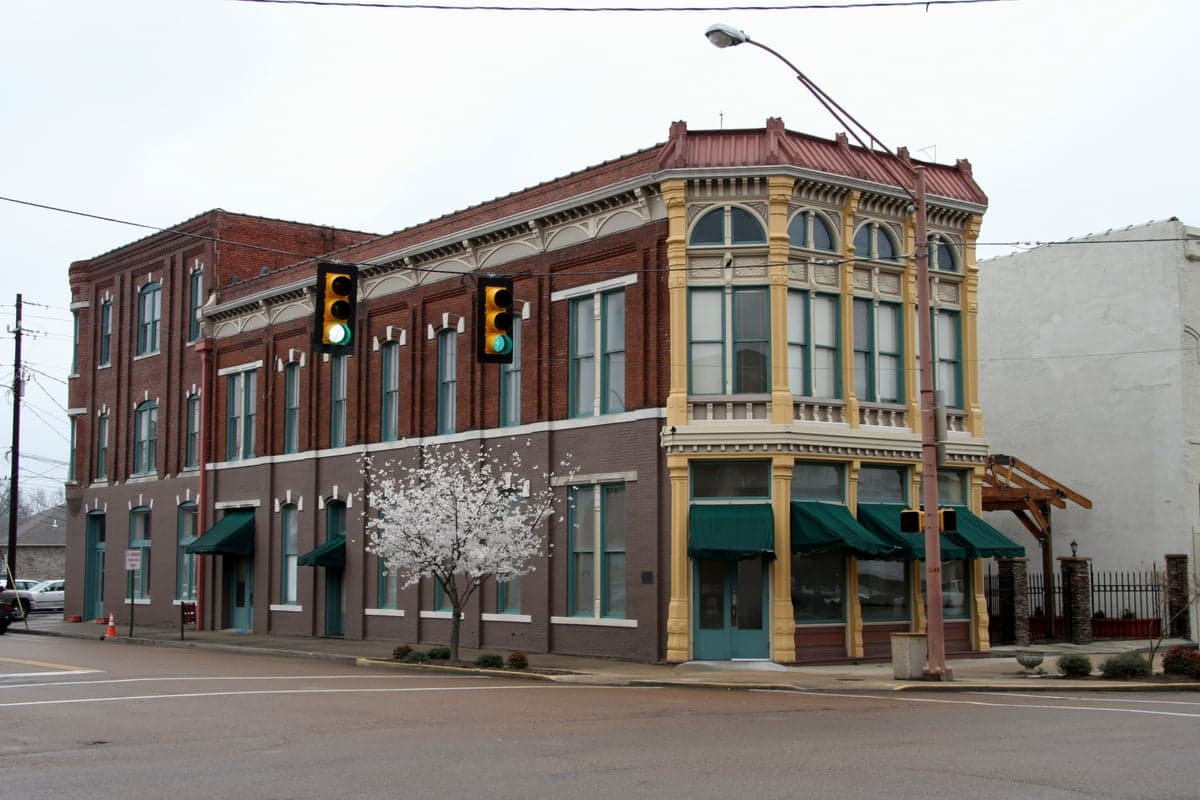
Dyersburg was founded in 1825 as the seat of Dyer County, named after Tennessee state senator Joel Dyer. The original settlers were primarily Scots-Irish and English farmers drawn by the fertile bottomlands of the Mississippi River floodplain, just 15 miles west of the city. These early families established the Courthouse Square as the civic and commercial heart, and the surrounding grid of streets—now the Historic Downtown District—was built by these pioneer families who operated cotton gins, general stores, and law offices. The city’s growth accelerated after the arrival of the Nashville, Chattanooga and St. Louis Railway in the 1870s, which turned Dyersburg into a regional cotton and timber shipping hub. By the early 1900s, a second wave of white tenant farmers and sharecroppers from the Upper South moved in to work the cotton fields, settling in what became the Northside neighborhood, a working-class area of modest frame houses built between 1900 and 1930. The Black population grew during the same period, with African American families arriving from rural West Tennessee and Mississippi to work as field hands and domestic laborers. They established a distinct community in the Southside neighborhood, centered around the historic St. John Baptist Church (founded 1870s) and the now-closed Bruce School, which served as the segregated Black school until integration. A smaller wave of Italian immigrants arrived around 1910 to work on railroad construction and in the cotton mills, settling in a pocket of the West End near the rail yards, though their numbers never exceeded a few hundred families. By 1950, Dyersburg’s population had reached roughly 12,000, with the racial and ethnic composition already closely resembling today’s figures.
Modern era (post-1965)
After the 1965 Hart-Cellar Act, Dyersburg saw virtually no new immigration. The foreign-born share remains at just 1.5%, and the East/Southeast Asian population (0.4%) is almost entirely composed of a small number of Vietnamese and Filipino families who arrived in the late 1970s as refugees, settling in the Eastside neighborhood near the Dyersburg Factory (now closed). The Indian subcontinent population is effectively zero (0.0%), and the Hispanic share (2.6%) is a recent, very modest addition—mostly Mexican and Central American workers who came in the 2000s for jobs in the poultry processing plants and light manufacturing, living in rental housing along Lake Road. The dominant domestic trend since 1965 has been white flight from the Southside to newer subdivisions on the city’s northern and western edges. The Northwood subdivision, developed in the 1970s and 1980s, became the primary destination for white families leaving the older core, offering larger lots and newer homes. Meanwhile, the Black population consolidated in the Southside and parts of the Central Avenue corridor, where the public housing projects (Dyersburg Housing Authority) were built in the 1960s and 1970s. The city’s overall population peaked at around 17,500 in 1980 and has since declined slowly, as the loss of textile and apparel manufacturing jobs (e.g., the 1999 closure of the Dyersburg Fabrics plant) pushed younger workers to leave for Nashville or Memphis. The college-educated share (23.0%) is below the state average (28.0%), reflecting a workforce still heavily reliant on manufacturing, warehousing, and healthcare at Dyersburg Regional Medical Center.
The future
Dyersburg’s population is likely to continue its slow decline, with the 2020 census showing 16,164 and the 2024 estimate at 16,075. The city is not homogenizing into a single identity; rather, it is tribalizing along geographic and racial lines that have been stable for decades. The white population (66.7%) is aging and concentrated in Northwood and newer subdivisions like Hickory Ridge, while the Black population (27.7%) remains younger and centered in the Southside and Central Avenue areas. The Hispanic community, though small, is growing slowly as families settle in the Lake Road corridor, but it is not large enough to shift the overall demographic balance. The East/Southeast Asian community is plateauing, with no new refugee resettlement programs active. The foreign-born share is unlikely to rise significantly given the lack of major employers recruiting immigrant labor and the city’s distance from interstate corridors. For a new resident, Dyersburg offers a low-cost, low-crime environment (relative to Memphis) with a deeply rooted, socially conservative culture, but the population decline means fewer amenities, a shrinking tax base, and limited economic dynamism. The city is becoming a quieter, older version of itself—not a place of rapid change or new diversity, but a stable, traditional community where most residents have deep family ties to the area.
In summary, Dyersburg is a slowly shrinking, racially stable, and culturally traditional city where the population is aging and the economy is shifting from manufacturing to healthcare and logistics. For a conservative-leaning individual or family moving in, the city offers affordable housing, low crime, and a community where neighbors have known each other for generations—but also limited job growth, a low college attainment rate, and a demographic future that looks very much like the present.

* Values derived from national, state, county, city and local statistics and may differ in a specific area. Last updated: 2026-05-07T00:12:21.000Z
Narrative content on this page is AI-generated and may contain mistakes. Verify any details that matter before acting on them.
ReloMaps may earn a commission from affiliate links at no extra cost to you.

