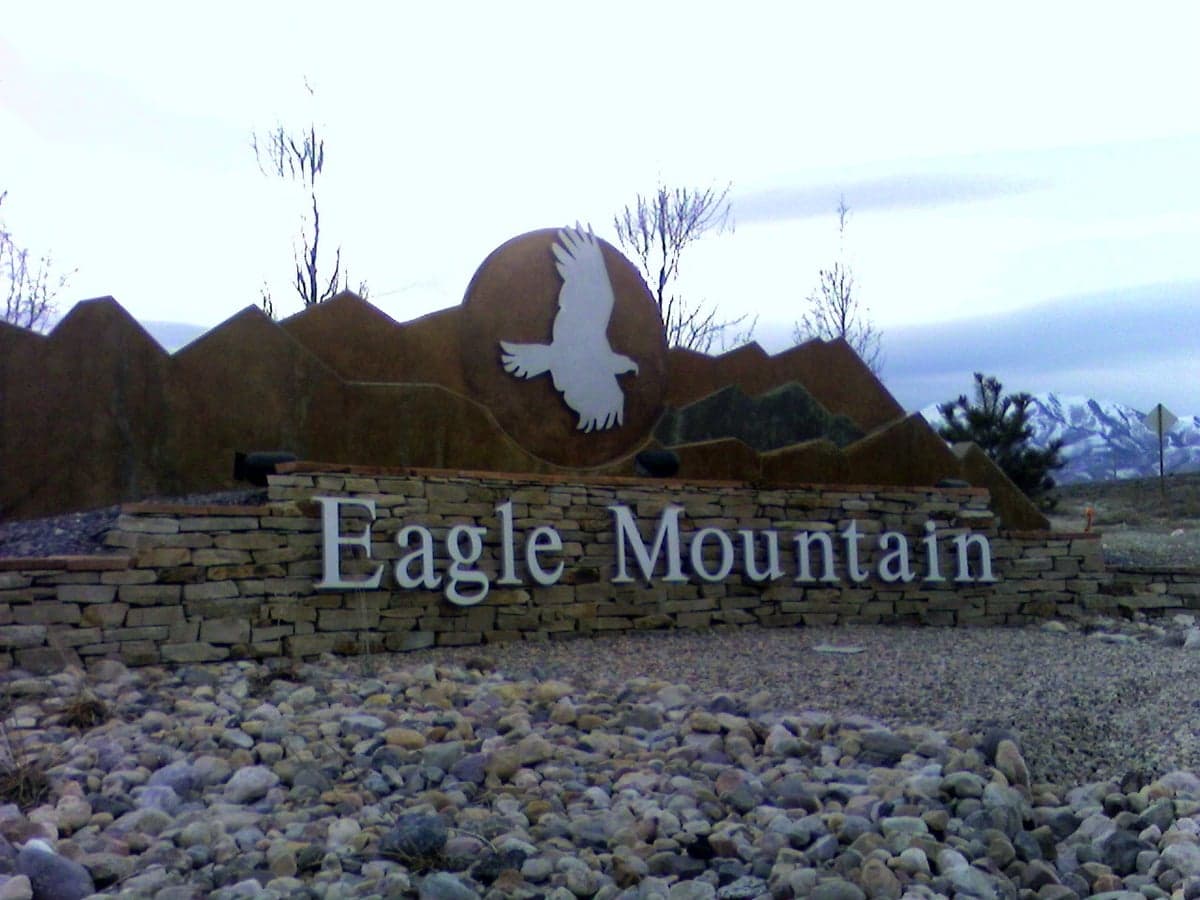
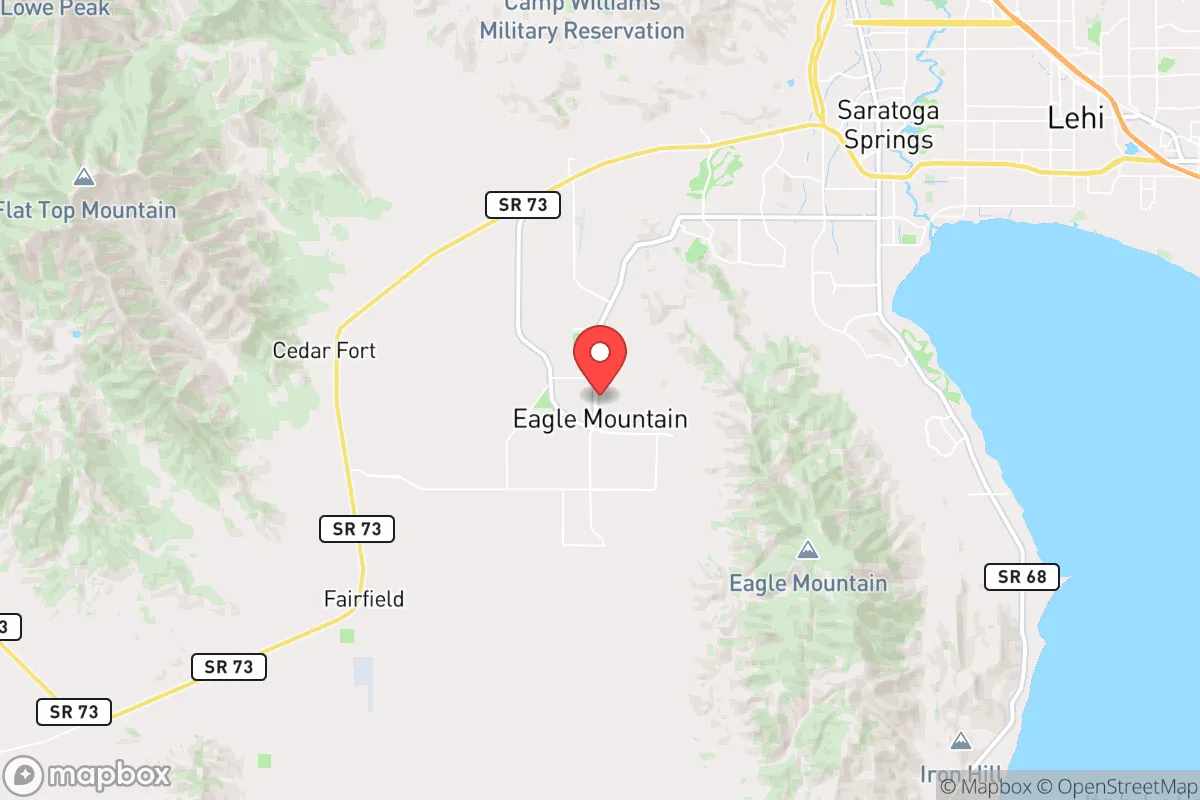
Photo: Wikipedia
Demographics of Eagle Mountain, UT
Affluence Level in Eagle Mountain, UT
An upper-middle-class area. Household wealth, education levels, and homeownership run ahead of national benchmarks.
People of Eagle Mountain, UT
The people of Eagle Mountain, Utah, today number roughly 49,514, forming one of the fastest-growing cities in the state. The population is overwhelmingly White (80.9%) and Latter-day Saint (Mormon), with a significant Hispanic minority (12.9%) and a very small foreign-born share of just 3.2%. The city’s identity is defined by young families, high homeownership rates, and a strong sense of community rooted in religious and civic organizations, with 38.3% of adults holding a college degree.
How the city was settled and grew
Eagle Mountain is a genuinely post-1990 planned community, not a historic pioneer settlement. The land was originally part of the vast Utah Lake basin, used for cattle grazing and dry farming by a handful of ranchers. The modern city was conceived in the mid-1990s by developer Terry Diehl, who envisioned a master-planned suburb for commuters working in Utah County’s tech corridor. The first homes were built in the Eagle Ranch neighborhood, which remains the historic core of the city. Early residents were almost entirely White, Latter-day Saint families from other parts of Utah County, drawn by relatively affordable land prices and the promise of a rural-suburban lifestyle. The city incorporated in 1996 with fewer than 1,000 residents, and growth was slow until the early 2000s, when the Heritage Hills and Ponderosa Hills neighborhoods opened, attracting a second wave of domestic in-migrants from California and the Pacific Northwest seeking lower housing costs and a conservative social environment.
Modern era (post-1965)
Because Eagle Mountain did not exist before 1990, the post-1965 era is essentially the city’s entire history. The Immigration and Nationality Act of 1965 had no direct effect on the city’s founding; instead, domestic migration from other Western states has been the primary driver. The Ranch Estates neighborhood, developed in the mid-2000s, absorbed many of the Hispanic families who began moving to Eagle Mountain for construction and service jobs during the housing boom. Today, the Hispanic population (12.9%) is concentrated in the southern and eastern parts of the city, particularly in Mountain Ranch and the newer sections of Eagle Ranch. The Black population (0.6%) and East/Southeast Asian population (0.3%) are very small and dispersed, with no distinct ethnic enclaves. The Indian-subcontinent population is effectively zero (0.0%). The city’s foreign-born share (3.2%) is far below the national average, reflecting its character as a destination for native-born families rather than immigrants.
The future
Eagle Mountain’s population is projected to continue growing rapidly, potentially reaching 100,000 by 2040 under current zoning plans. The city is homogenizing rather than tribalizing: new developments like Lake Mountain and Pony Express are attracting the same demographic profile—White, Latter-day Saint, married with children—that has dominated since the 1990s. The Hispanic share is likely to grow modestly as second-generation families age into homeownership, but the city shows no signs of becoming a multi-ethnic melting pot. The East/Southeast Asian and Black populations are expected to remain very small, as the city lacks the job diversity, rental housing stock, or cultural infrastructure that attracts these groups. The foreign-born share may plateau around 4-5%, driven by a small number of skilled immigrants in tech and healthcare. The biggest demographic shift will be generational: as the original 1990s settlers age, the city will see a rising share of empty-nesters and a need for more senior services.
For someone moving in now, Eagle Mountain is becoming a stable, culturally homogeneous suburb where the dominant values are family, faith, and fiscal conservatism. It is not a place of ethnic diversity or rapid demographic change, but rather a community where the population is growing in size while remaining remarkably consistent in character. New residents should expect a social environment shaped by the LDS Church, young families, and a strong emphasis on neighborhood schools and local civic life.

* Values derived from national, state, county, city and local statistics and may differ in a specific area. Last updated: 2026-05-03T20:37:11.000Z
Narrative content on this page is AI-generated and may contain mistakes. Verify any details that matter before acting on them.
ReloMaps may earn a commission from affiliate links at no extra cost to you.

