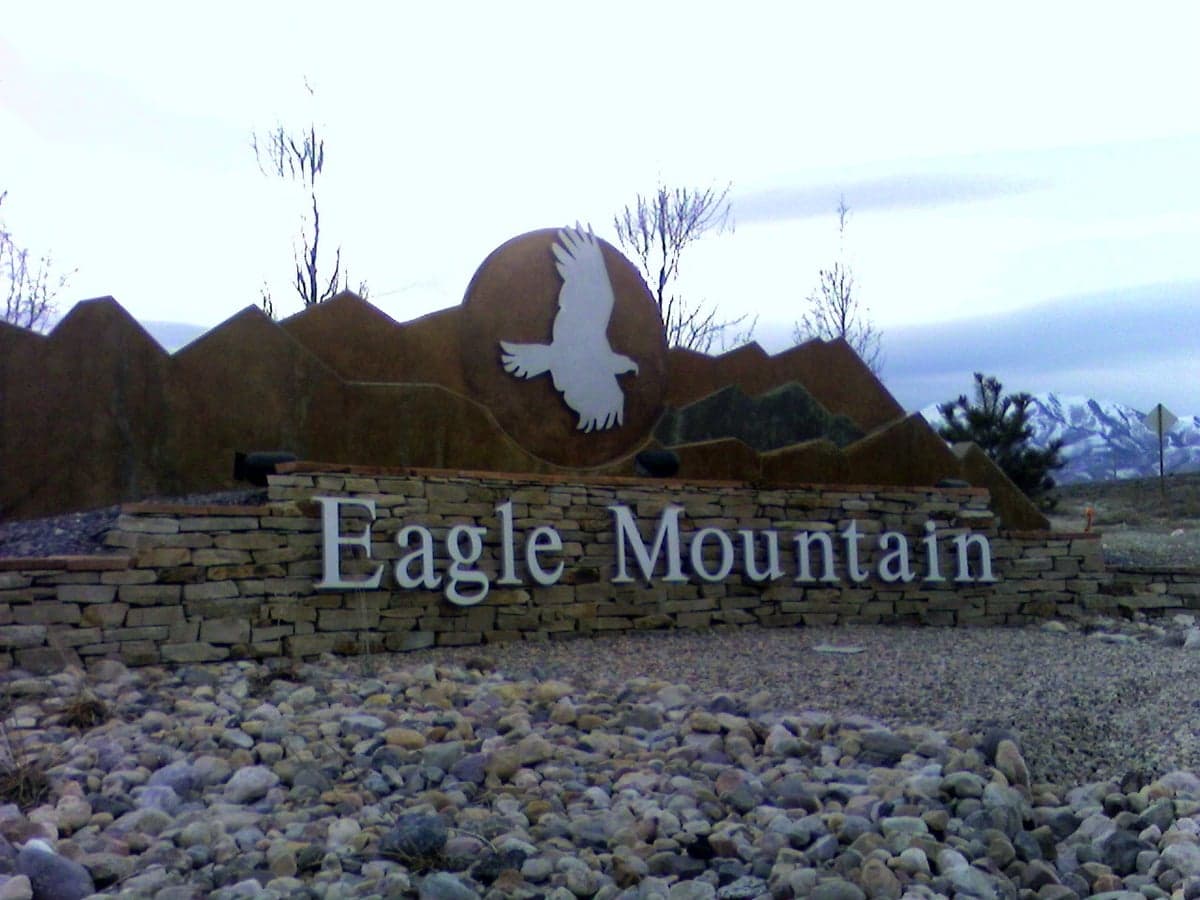
Photo: Wikipedia
Personal Sovereignty in Eagle Mountain, UT
Viable for self-reliance. Generally workable, though some barriers may limit total independence.
What does Personal Sovereignty tell us?
Personal Sovereignty measures your capacity for self-reliance and independence with minimal government friction. Higher scores mean fewer barriers between you and the way you want to live... but it assumes you have the space you need and good neighbors.
What does this tell us?
Personal Sovereignty measures your capacity for self-reliance and independence with minimal government friction. Higher scores mean fewer barriers between you and the way you want to live... but it assumes you have the space you need and good neighbors.
State Policy
Energy independence: Self-sufficient (80% of energy produced in-state)
Personal Liberty
Homesteading

Personal Liberty Analysis
Eagle Mountain, Utah, offers a notably high degree of personal sovereignty relative to most of the United States, largely due to the state’s deep-seated culture of individual liberty and limited government interference. For those with a survivalist or prepper mindset, the area presents a strategic balance: you are close enough to a major metro (Salt Lake City, about 45 minutes north) to access resources, yet far enough to operate with minimal bureaucratic friction. The local and state governments generally view their role as protecting rights rather than managing lives, which translates into fewer restrictions on everything from property use to self-defense. This isn’t a libertarian utopia—there are still zoning codes and taxes—but the baseline assumption here is that you are free to live as you see fit, provided you don’t harm others.
Tax burden and regulatory posture: How much the state and local government takes and controls
Utah’s tax burden is among the lowest in the nation, and Eagle Mountain residents benefit directly. There is no state income tax on wages—a flat 4.85% rate applies to most income, but that’s still far lower than California or New York. Property taxes are moderate, with the effective rate in Utah County hovering around 0.6% of assessed value, though Eagle Mountain’s rapid growth means assessments can climb. More importantly, the regulatory environment is lean. Utah is a “right-to-work” state, meaning you cannot be forced to join a union as a condition of employment. The state also has a strong tradition of preempting local ordinances that would infringe on state-level freedoms—for example, cities cannot ban short-term rentals or impose stricter gun laws than the state allows. For a prepper, this means fewer layers of red tape when building a shed, storing supplies, or running a home-based business. The state’s “business-friendly” posture isn’t just corporate spin; it reflects a genuine reluctance to regulate daily life. That said, Eagle Mountain itself has a municipal code that enforces some suburban norms—like limits on livestock and vehicle storage—so rural-style autonomy is more feasible just outside city limits in unincorporated Utah County.
Self-defense and gun law specifics: What you can carry, where, and how to store
Utah is a constitutional carry state, meaning any law-abiding adult 21 or older can carry a concealed firearm without a permit. This is a bedrock freedom for those concerned about personal security in an uncertain world. Eagle Mountain sits in Utah County, which has a strong gun culture and a sheriff’s office that is generally supportive of Second Amendment rights. There are no state-level magazine capacity bans, no “assault weapon” restrictions, and no waiting periods for purchases from licensed dealers. Stand-your-ground laws are in effect—you have no duty to retreat before using deadly force if you are lawfully present and believe it is necessary to prevent death or great bodily harm. For preppers, this means you can legally maintain a well-stocked armory in your home, and you are not required to store firearms in locked safes unless children are present (and even then, the law is permissive). The only notable restriction: carrying a firearm into a church or private residence without permission is a misdemeanor, and federal law still applies on federal lands like the nearby Uinta-Wasatch-Cache National Forest. Overall, Eagle Mountain offers one of the most permissive legal environments for self-defense in the country, with minimal government overreach into how you choose to protect your family.
Self-reliance and homesteading viability: Lot sizes, zoning, and off-grid feasibility
Eagle Mountain’s residential lots are larger than typical suburban tracts—many newer developments offer half-acre to one-acre parcels, and some older sections have even more space. This is a key advantage for anyone wanting to garden, raise small livestock, or store emergency supplies. The city’s zoning code allows for “urban agriculture,” including chickens, bees, and even goats on lots over 0.25 acres, though pigs and cattle are restricted. For serious homesteading, you’ll want to look at properties just outside city limits in unincorporated Utah County, where zoning is far looser and you can keep horses, build a root cellar, or install a rainwater catchment system without permits. Off-grid living is legally tricky within city limits—Eagle Mountain requires connection to municipal water and sewer where available—but the surrounding rural areas are more permissive. The state of Utah has a “right to dry” law, meaning HOAs cannot ban clotheslines, and solar panels are protected from restrictive covenants. Water rights are a separate issue: Utah follows prior appropriation doctrine, so collecting rainwater on your property is legal but limited to 2,500 gallons of storage without a permit. For a prepper, the key takeaway is that Eagle Mountain offers a middle ground: you can have a substantial degree of self-reliance without being fully off-grid, and the regulatory barriers to expanding that self-reliance are low compared to coastal states.
Personal liberties: Parental rights, medical autonomy, speech, and property
Utah has some of the strongest parental rights laws in the nation. The state’s “Parental Rights in Education” statute ensures that parents have the final say in their children’s medical decisions, education, and upbringing. Schools are required to notify parents of any changes in a student’s emotional or physical health, and there is no state-level mandate for comprehensive sex education that overrides parental opt-outs. Medical autonomy is more complex: Utah has not expanded Medicaid under the ACA, and the state’s medical cannabis program is tightly controlled, but there are no vaccine mandates for adults and no state-level emergency powers that can shut down businesses or churches without legislative approval (a lesson learned from 2020). Free speech is robustly protected under the Utah Constitution, which explicitly guarantees the right to peaceably assemble and petition the government. Property rights are also strong: Utah is a “Dillon’s Rule” state, meaning local governments only have powers explicitly granted by the state, which limits municipal overreach. Eminent domain is rarely used for private development. For a conservative-leaning individual concerned about government overreach, Eagle Mountain sits in a state that consistently ranks among the top five for personal freedom in categories like education choice, gun rights, and occupational licensing.
In the broader context of the United States, Eagle Mountain offers a level of personal sovereignty that is increasingly rare. The combination of low taxes, permissive gun laws, strong parental rights, and a culture of self-reliance makes it a viable destination for those who see the federal government and coastal states as encroaching on individual liberties. It is not a complete escape—you still pay property taxes, follow building codes, and deal with a growing population—but the baseline assumption here is that you are the master of your own life. For a prepper or survivalist, the strategic calculus is clear: Eagle Mountain provides a legal and cultural environment where you can prepare, defend, and live on your own terms, with fewer obstacles than almost anywhere else in the West.

* Values derived from national, state, county, city and local statistics and may differ in a specific area. Last updated: 2026-05-03T20:37:11.000Z
Narrative content on this page is AI-generated and may contain mistakes. Verify any details that matter before acting on them.
ReloMaps may earn a commission from affiliate links at no extra cost to you.

