Photo: Wikipedia
Demographics of East Chicago, IN
Affluence Level in East Chicago, IN
A low-income area with significant economic hardship. Household wealth and educational attainment are well below national averages.
People of East Chicago, IN
The people of East Chicago, Indiana, today form a dense, working-class community of 26,158 residents, overwhelmingly Hispanic (56.5%) and Black (36.4%), with a tiny White population (6.6%) and a foreign-born share of 10.8%. The city is one of the most ethnically concentrated in Northwest Indiana, marked by a low college attainment rate of 9.9% and a strong industrial identity rooted in steel and refining. Distinct neighborhoods—such as Indiana Harbor, Roxana, and the North Harbor area—still reflect the settlement patterns of the immigrant waves that built them, though the city’s population has shrunk by roughly half since its 1960 peak.
How the city was settled and grew
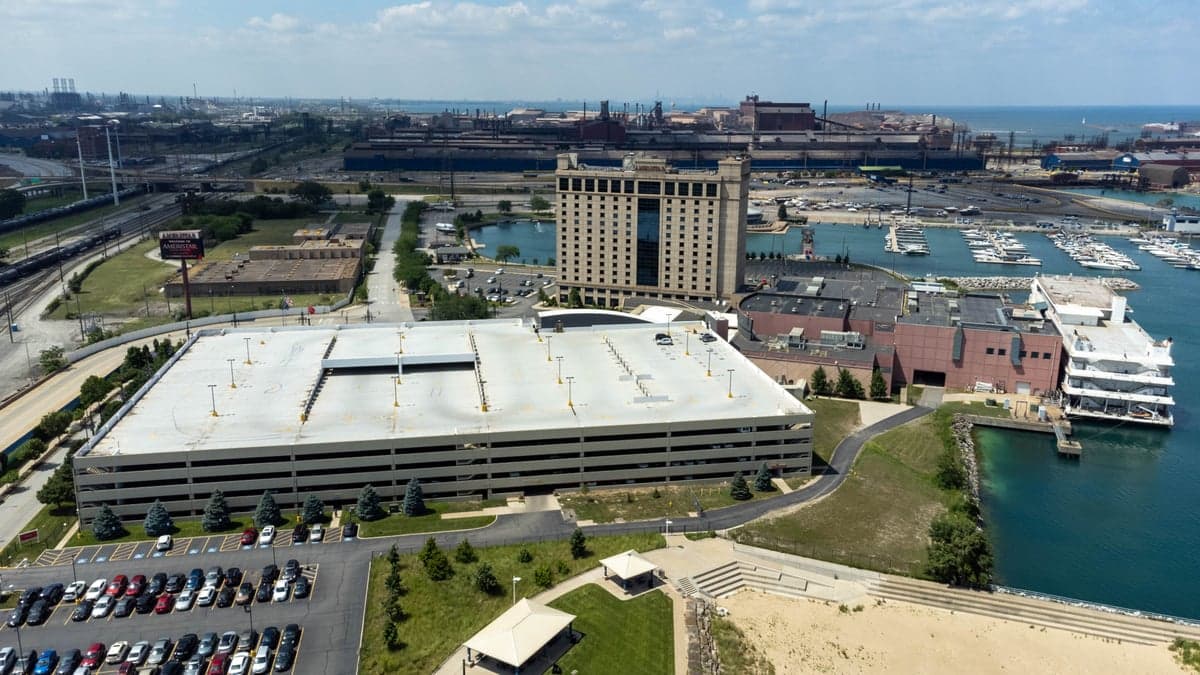
East Chicago was platted in 1889 on marshland along Lake Michigan, its growth driven entirely by heavy industry. The opening of the Inland Steel Company (now part of Cleveland-Cliffs) in 1901 and the Standard Oil (now BP) refinery in 1889 drew the first major wave of immigrants: Eastern and Southern Europeans. Poles, Slovaks, Croatians, and Italians settled in the Indiana Harbor neighborhood, building dense ethnic parishes and social halls near the steel mills. A second wave of Mexican laborers arrived during the 1910s and 1920s, recruited directly by Inland Steel to break strikes and fill unskilled jobs; they formed the core of the Roxana neighborhood, a historically Mexican enclave east of the harbor. By 1930, East Chicago was nearly 50% foreign-born, with a patchwork of ethnic blocks—Polish in the North Harbor area, Italian around Parrish Avenue, and Mexican in Roxana. The city’s Black population grew during the Great Migration, settling primarily in the South Side and Guthrie neighborhoods near the mills, though segregation kept them largely separate from European and Mexican areas until the 1960s.
Modern era (post-1965)
The 1965 Hart-Cellar Act ended national-origin quotas, but East Chicago’s demographic shift was already underway. White ethnic families began leaving for suburbs like Munster and Schererville in the 1970s, accelerated by deindustrialization and white flight. The Hispanic share rose from about 20% in 1970 to 56.5% today, driven by continued Mexican immigration and higher birth rates. The Black population peaked at around 40% in the 1980s and has since declined slightly to 36.4%, as some middle-class Black families also moved to suburbs. The White population collapsed from over 60% in 1960 to just 6.6% today. The Indiana Harbor neighborhood, once Polish and Croatian, is now predominantly Hispanic, while the South Side and Guthrie areas remain heavily Black. The Roxana neighborhood is still a Hispanic stronghold, though its Mexican-American character has blended with newer arrivals from Puerto Rico and Central America. The foreign-born share of 10.8% is lower than in nearby Hammond (14.5%) or Chicago (21%), indicating that most of the Hispanic growth is now U.S.-born second and third generation. East/Southeast Asian communities are negligible at 0.1%, and Indian-subcontinent residents are statistically zero.
The future
East Chicago’s population is likely to continue shrinking slowly, as it has every decade since 1960, though the rate of decline has moderated. The city is becoming more homogenously Hispanic, with the Black share projected to decline gradually as younger Black families leave for more suburban school districts. The tiny White population is aging in place and will likely fall below 5% within a decade. The foreign-born share may plateau or dip slightly, as most Hispanic residents are now native-born. New immigration is minimal—the city lacks the job growth or housing stock to attract significant new arrivals. The North Harbor area, once a Polish enclave, is now mixed Hispanic and Black, while Roxana remains the most solidly Hispanic neighborhood. The city is not tribalizing into new enclaves so much as consolidating into a majority-Hispanic working-class city with a large Black minority. The next 10–20 years will likely see continued population loss, further Hispanicization, and a slow aging of the remaining Black population.
For someone moving in now, East Chicago is a shrinking, heavily industrial city where the population is becoming more uniformly Hispanic and less diverse overall. The low college attainment rate and limited white-collar job base mean most residents work in manufacturing, logistics, or services. The city offers affordable housing and proximity to Chicago, but schools struggle with low graduation rates, and the tax base is constrained by depopulation. It is a place for those who value industrial roots and ethnic community over suburban amenities or upward mobility.

* Values derived from national, state, county, city and local statistics and may differ in a specific area. Last updated: 2026-04-22T08:55:24.000Z
Narrative content on this page is AI-generated and may contain mistakes. Verify any details that matter before acting on them.
ReloMaps may earn a commission from affiliate links at no extra cost to you.

