
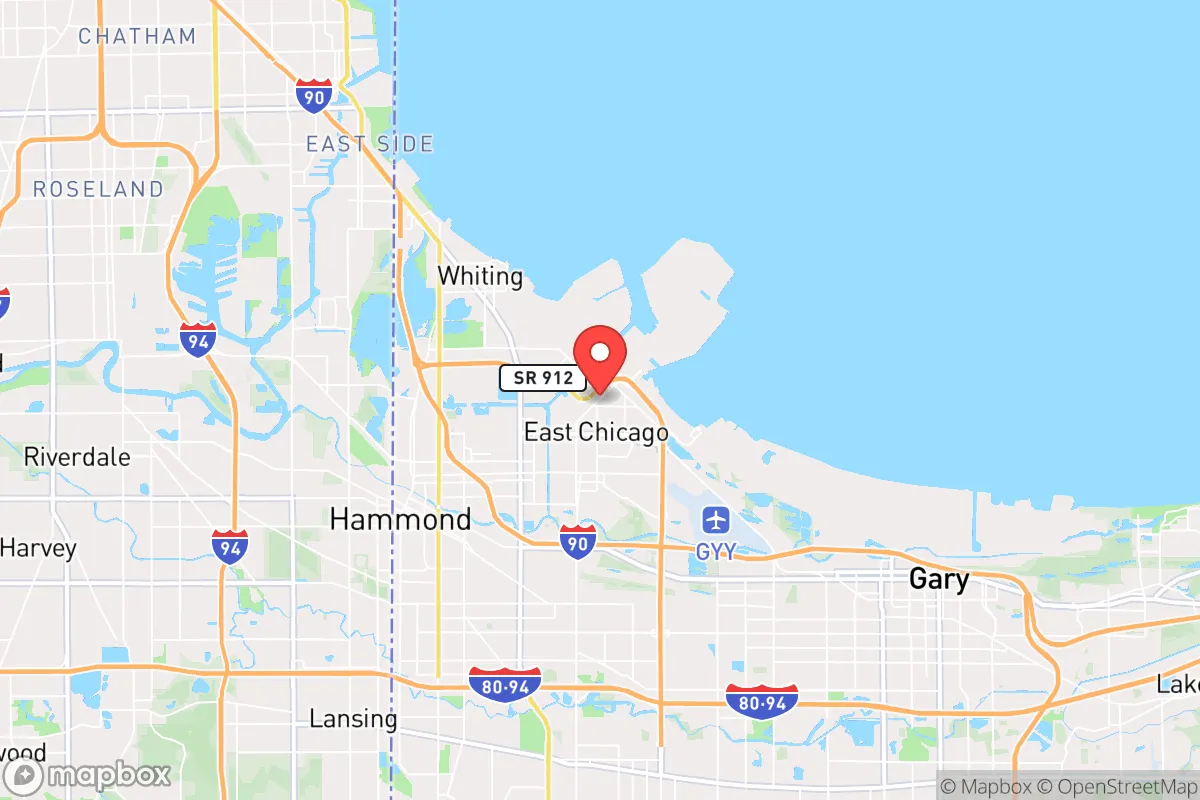
Photo: Wikipedia
Personal Sovereignty in East Chicago, IN
Viable for self-reliance. Generally workable, though some barriers may limit total independence.
What does Personal Sovereignty tell us?
Personal Sovereignty measures your capacity for self-reliance and independence with minimal government friction. Higher scores mean fewer barriers between you and the way you want to live... but it assumes you have the space you need and good neighbors.
What does this tell us?
Personal Sovereignty measures your capacity for self-reliance and independence with minimal government friction. Higher scores mean fewer barriers between you and the way you want to live... but it assumes you have the space you need and good neighbors.
State Policy
Energy independence: Importer (35% of energy produced in-state)
Personal Liberty
Homesteading

Personal Liberty Analysis
East Chicago, Indiana, presents a complex environment for personal sovereignty, where the promise of Midwestern independence is heavily tempered by the realities of a post-industrial, heavily regulated state. While Indiana generally offers a more favorable legal climate for gun owners and a lower tax burden than neighboring Illinois, the city itself is subject to the full weight of state and county regulations that can constrain individual autonomy. For a survivalist or prepper, East Chicago is not a haven of self-reliance; it is a location where you must navigate a dense web of government oversight, particularly in housing, land use, and public health mandates, while leveraging the state’s relatively strong protections for self-defense and parental rights.
Tax burden and regulatory posture in a high-regulation state
Indiana’s tax structure is a mixed bag for those seeking to minimize government extraction. The state levies a flat income tax of 3.15% as of 2026, which is moderate compared to many coastal states, but property taxes in Lake County, where East Chicago sits, are among the highest in Indiana. The effective property tax rate in East Chicago hovers around 2.1% of assessed value, significantly above the state average of 0.85%. This is a direct hit on property ownership—a core pillar of personal sovereignty. The regulatory posture is equally burdensome. Indiana has a state-level building code (the Indiana Building Code) that is uniformly enforced, and East Chicago adds its own zoning ordinances that restrict what you can do on your land. For example, the city’s zoning code prohibits keeping livestock on residential lots under 10,000 square feet, and any “home occupation” (like a small repair business) requires a special permit. The state’s environmental regulations, enforced by the Indiana Department of Environmental Management, also impose strict rules on waste disposal and water usage, making off-grid living legally difficult. The overall message is clear: the state and city are active participants in your daily life, not passive observers.
Self-defense and gun law specifics in Indiana
Indiana is a “shall-issue” state for concealed carry permits, and as of 2022, it became a constitutional carry state, meaning law-abiding adults 18 and older can carry a handgun without a permit. This is a significant win for personal sovereignty. However, East Chicago is a high-crime city—its violent crime rate is roughly 2.5 times the national average—so the right to carry is not theoretical; it is a practical necessity. The state also has a “stand your ground” law (Indiana Code 35-41-3-2), which eliminates the duty to retreat in any place you are lawfully present. This is a strong legal shield for self-defense. On the downside, Indiana has a red flag law (the “Jake Laird Law”) that allows law enforcement to petition for a court order to seize firearms from individuals deemed a danger to themselves or others. This law has been used aggressively in Lake County, with over 200 petitions filed in 2024 alone. For the prepper, this means your firearms are not inviolable; a neighbor’s complaint or a police officer’s judgment can trigger a temporary loss of your Second Amendment rights. The state also bans fully automatic weapons and short-barreled rifles without federal tax stamps, but otherwise, your gun rights are robust—provided you stay off the government’s radar.
Self-reliance and homesteading viability in an urban setting
East Chicago is a dense, urban city with a population density of over 3,000 people per square mile. This makes traditional homesteading—raising chickens, keeping goats, or growing a substantial garden—nearly impossible. The typical residential lot is a narrow 40x100 feet, and the city’s zoning code explicitly prohibits “agricultural uses” in residential zones. You cannot legally keep bees, chickens, or any livestock on a standard lot. Off-grid feasibility is even worse. The city requires connection to municipal water and sewer systems; there is no legal pathway for a private well or septic system within city limits. Solar panels are allowed, but the city’s building code requires them to be installed by a licensed contractor and connected to the grid—no battery-only setups are permitted. For the survivalist seeking true self-reliance, East Chicago is a dead end. The only viable option is to look at unincorporated areas of Lake County, such as rural sections near Lowell or Cedar Lake, where lot sizes are larger (1-5 acres) and zoning is more permissive. In those areas, you can legally keep livestock, drill a well, and install a septic system, though you still must comply with state environmental regulations.
Personal liberties: parental rights, medical autonomy, speech, and property
Indiana has strong protections for parental rights. The state’s “Parental Bill of Rights” (Indiana Code 20-33-2) gives parents the explicit right to direct the education and upbringing of their children, including the right to opt out of any school curriculum or activity they find objectionable. This is a powerful tool against government overreach in education. Medical autonomy is more constrained. Indiana has a vaccine mandate for schoolchildren (though exemptions are available for medical and religious reasons), and the state’s public health code gives local health departments broad authority to issue quarantine orders during disease outbreaks. The COVID-19 era saw Lake County impose mask mandates and business closures, which were enforced by local police. Free speech is protected under the First Amendment, but East Chicago has a noise ordinance that can be used to shut down political gatherings or protests if they exceed 65 decibels after 10 PM. Property rights are the weakest link. The city has an aggressive code enforcement department that issues fines for overgrown grass, unregistered vehicles, and “junk” on your property. In 2024, the city filed over 300 liens against homeowners for code violations. This is a direct assault on the principle that your property is your castle. The state’s eminent domain laws are also broad, allowing the city to seize property for “economic development” projects, as seen in the controversial redevelopment of the former Indiana Harbor area.
Overall, East Chicago offers a low-to-moderate level of personal sovereignty compared to other areas in the Midwest. It is a significant step up from Illinois, where gun laws are far more restrictive and taxes are higher, but it falls well short of states like Texas or Wyoming, where property rights are stronger and regulatory burdens are lighter. For the conservative-leaning prepper, the city’s main appeal is its proximity to Chicago (for work or supply runs) and Indiana’s favorable self-defense laws. But the high property taxes, restrictive zoning, and aggressive code enforcement make it a place where you must constantly fight to maintain your autonomy. If you are serious about self-reliance, look to the rural fringes of Lake County or consider moving further south to areas like Jasper County, where the regulatory climate is more forgiving and the land is cheaper. East Chicago is a place to pass through, not to dig in.

* Values derived from national, state, county, city and local statistics and may differ in a specific area. Last updated: 2026-04-22T08:55:24.000Z
Narrative content on this page is AI-generated and may contain mistakes. Verify any details that matter before acting on them.
ReloMaps may earn a commission from affiliate links at no extra cost to you.

