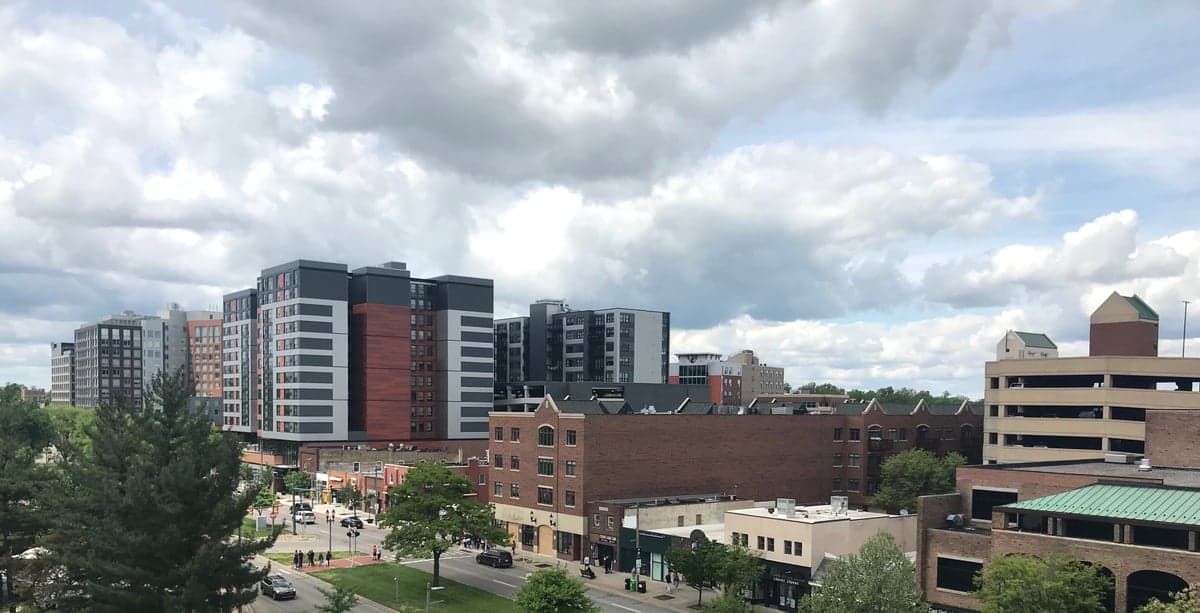
Photo: Wikipedia
Political ClimatePolitical Climate in East Lansing, MI
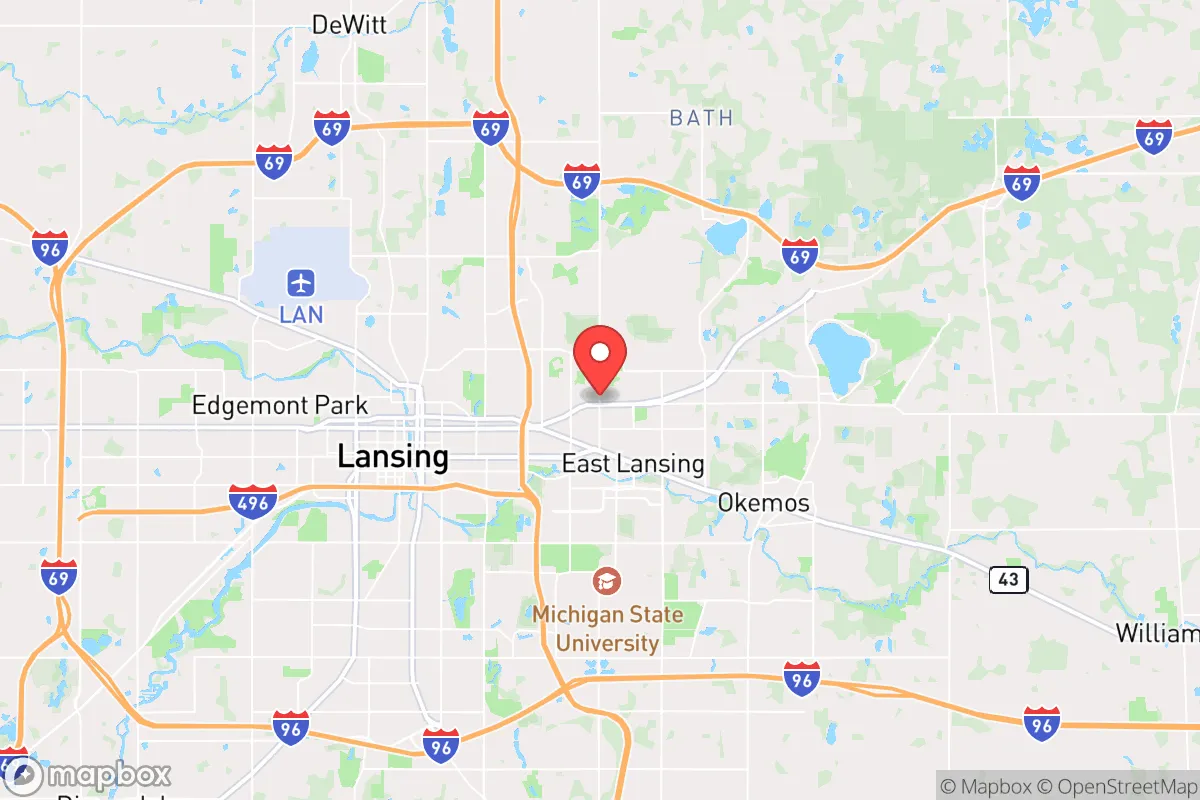
District shown is the primary district for this city’s centroid. Cities may span multiple districts.
Local Political AnalysisPolitical Analysis of East Lansing, MI
East Lansing leans solidly left, and it’s been that way for a while. The city itself is a deep blue island in a sea of red, with a Cook PVI of EVEN that masks just how lopsided local politics have become. In the 2024 presidential election, Ingham County went for the Democratic candidate by about 20 points, but East Lansing itself likely pushed that margin even higher. The surrounding towns—like Okemos, Haslett, and especially Williamston—tend to vote more conservatively, but they’re increasingly feeling the pressure of policies that start here and ripple outward.
How it compares
Drive ten minutes east to Williamston, and you’ll find a town that still votes red by a solid 10-15 points. Meridian Township, just north of East Lansing, is a bit more purple but has been trending left over the last decade. The real contrast is with the rural townships south of I-96, like Delhi or Alaiedon, where conservative values are still the norm. East Lansing, though, is the epicenter of progressive policy in the region—think rent control experiments, sanctuary city resolutions, and a city council that’s openly hostile to any talk of fiscal restraint. It wasn’t always this way. Twenty years ago, you could have a reasonable conversation about property taxes or zoning without being labeled a bigot. Now, it feels like every public meeting is a lecture on social justice, with little room for dissent.
What this means for residents
For long-time residents, the biggest concern is government overreach. The city has been aggressive with its rental inspection program, requiring landlords to jump through hoops that drive up costs—costs that get passed right back to tenants. There’s a push for a local income tax, which would hit everyone, not just the students. And the school board has embraced critical race theory and gender ideology curricula that many parents find intrusive. If you value personal freedom—like the right to choose your own healthcare, send your kids to school without ideological indoctrination, or run a small business without a dozen new regulations—East Lansing is becoming a tough place to live. The city council seems to think they know better than you how to raise your kids, spend your money, and run your life.
On the cultural side, East Lansing is a college town through and through, so you get the usual mix of coffee shops, bike lanes, and farmers markets. But the political climate has a way of seeping into everything. The annual East Lansing Art Festival is now a platform for activist groups. The public library hosts drag queen story hours. And the city’s official social media accounts are more likely to post about climate activism or racial equity than pothole repairs. If you’re a conservative or even a moderate, you’ll feel like an outsider in your own community. The trajectory is clear: more regulation, more taxes, and less tolerance for anyone who doesn’t get with the program. It’s a shame, because the bones of this town are good—great parks, a walkable downtown, and Michigan State University right there. But the politics are driving people away, and that’s not going to change anytime soon.

State Political ClimatePolitical Climate in Michigan
State Political AnalysisPolitical Environment in the State
Michigan has shifted from a reliably purple battleground to a state where Democrats now hold unified control of the governor’s office, state House, and state Senate for the first time in four decades, driven largely by the explosive growth of the Detroit metro area and the collapse of Republican performance in the suburban “collar counties” around it. The 2022 midterms saw Governor Gretchen Whitmer win re-election by nearly 11 points, while Democrats flipped both chambers of the legislature, a feat they hadn’t accomplished since 1984. Over the past 20 years, the state has moved leftward by about 8 points in presidential elections, from a 3-point Bush win in 2004 to a 3-point Biden win in 2020, and the trendline shows no sign of reversing as the urban core continues to dominate the state’s political machinery.
Urban vs. rural divide
The political map of Michigan is a tale of two states. The southeastern corner, anchored by Detroit, Ann Arbor, and the inner-ring suburbs of Oakland County, produces roughly 40% of the state’s vote and leans heavily Democratic. Wayne County alone gave Biden 68% of its vote in 2020, while Washtenaw County (home to Ann Arbor and the University of Michigan) hit 72%. The real story, though, is the suburban shift: Oakland County, once a Republican stronghold, has voted Democratic in every presidential election since 1992 and now delivers margins of 10-15 points for statewide Democrats. Kent County, home to Grand Rapids, flipped from red to blue in 2020 and has stayed there, driven by a growing professional class and a shrinking manufacturing base. Meanwhile, the rest of the state—the Upper Peninsula, the northern Lower Peninsula, and the rural thumb region—votes overwhelmingly Republican, but those areas are losing population. Mackinac County and Oscoda County routinely vote 65-70% Republican, but their combined population is smaller than a single Detroit ward. The divide isn’t just cultural; it’s demographic, with urban and suburban growth outpacing rural decline, and that math is remaking the state’s politics.
Policy environment
Michigan’s policy environment has shifted dramatically since Democrats took full control in 2023. The state now has a progressive income tax structure with a flat rate of 4.25%, but the legislature has repeatedly rejected efforts to lower it, and a 2024 ballot proposal to raise the rate on high earners failed narrowly. Property taxes are relatively high, with an average effective rate of 1.5%, and the state’s Headlee Amendment caps annual assessment increases at 5% or inflation, whichever is lower, which helps long-term homeowners but creates a tax burden disparity for new buyers. On education, Michigan has eliminated the “Read by Grade Three” retention law and expanded universal school choice through charter schools and inter-district open enrollment, though the state’s per-pupil funding remains below the national average. Healthcare policy is dominated by the Healthy Michigan Plan, a Medicaid expansion that covers over 700,000 residents, and the state recently enacted a paid family leave mandate and a minimum wage hike to $15/hour by 2027. Election laws have been loosened significantly: Michigan now has no-excuse absentee voting, early voting for nine days before elections, and automatic voter registration at the DMV, all passed via a 2018 ballot initiative and subsequent legislation. The state also banned private school vouchers in 2024, a move that limits educational freedom for families seeking alternatives to public schools.
Trajectory & freedom
On the freedom front, Michigan is moving in a decidedly mixed direction, but the overall trend is toward more government control in areas that matter most to conservatives. Gun rights took a major hit in 2023 when the legislature passed universal background checks, a red flag law (extreme risk protection orders), and a safe storage requirement for firearms left unattended in vehicles or around minors. These laws were signed by Governor Whitmer and represent the most significant gun control expansion in state history. Parental rights have been under pressure: the state’s sex education standards now include LGBTQ+ content from kindergarten, and a 2024 law prohibits school districts from notifying parents when a child changes their gender identity or pronouns at school, overriding parental authority. On medical freedom, Michigan has maintained its medical marijuana program and legalized recreational cannabis in 2018, but the state imposed a COVID-19 vaccine mandate for healthcare workers that remains in effect, and the legislature has not passed any ban on vaccine passports or mandates. Property rights are relatively strong, with no statewide rent control and a right-to-farm act that protects agricultural operations from nuisance lawsuits, though local governments in Ann Arbor and Detroit have imposed strict zoning and rental registration schemes. The state’s tax burden is moderate but rising, with the corporate income tax rate set to increase from 6% to 7.5% in 2025, and the state has not adopted any form of right-to-work legislation—in fact, Michigan repealed its right-to-work law in 2023, a major blow to worker freedom and union choice.
Civil unrest & political movements
Michigan has been a flashpoint for political activism on both sides. The Wolverine Watchmen militia plot to kidnap Governor Whitmer in 2020 exposed a deep vein of anti-government sentiment in the state’s rural areas, particularly in the Upper Peninsula and northern Lower Peninsula. The “Operation Gridlock” protests in Lansing in 2020, where thousands of armed protesters surrounded the state capitol to oppose COVID-19 lockdowns, remain a defining image of the state’s political divide. On the left, Black Lives Matter protests in Detroit and Grand Rapids in 2020 were large and occasionally violent, with property damage in downtown Grand Rapids. Immigration politics are less heated than in border states, but Detroit and Ann Arbor have declared themselves sanctuary cities, limiting cooperation with federal immigration enforcement. Election integrity remains a live issue: the 2020 election in Michigan saw widespread use of ballot drop boxes and absentee voting, and a 2023 audit found no evidence of widespread fraud, but the state’s voter rolls have been criticized for including thousands of inactive or duplicate registrations. The “Michigan Election Integrity Fund” lawsuit, filed by conservative groups, continues to challenge the state’s voting procedures. Visible flashpoints include the “People’s Flag” movement in the Upper Peninsula, which advocates for secession from the rest of Michigan, and the ongoing “Mackinac Center” legal battles over union dues and school choice.
Projection
Over the next 5-10 years, Michigan is likely to become more Democratic and more progressive, driven by demographic trends that favor the urban and suburban core. The state’s population is aging and shrinking in rural areas, while Detroit and Grand Rapids are seeing modest growth from domestic migration and immigration. The 2024 census showed Michigan losing a congressional seat, further diluting rural influence. The Democratic trifecta is likely to hold through at least 2026, and if the party maintains control, expect more gun control, higher taxes, and expanded government healthcare. The Michigan Democratic Party has become more activist, with the “Progressive Caucus” pushing for a single-payer healthcare system and a wealth tax. On the Republican side, the party is fractured between the “Mackinac Center” libertarian wing and the “America First” populist faction, and it has not won a statewide race since 2014. The 2026 gubernatorial election will be a key test: if Republicans can’t win back the governor’s office, the state will likely enact a carbon tax and rent control by 2030. For someone moving in now, expect a state where the political climate is increasingly hostile to conservative values, with fewer protections for gun owners, parents, and taxpayers.
For a conservative considering a move to Michigan, the bottom line is that the state’s political trajectory is unfavorable, and the window for influence is closing. The urban and suburban areas that control the legislature and the governor’s office are becoming more progressive with each election cycle, while rural conservatives are losing population and political power. If you value gun rights, parental authority, and low taxes, you’ll find yourself swimming against a strong current in Lansing. The best bet for a conservative-friendly enclave is the Grand Rapids suburbs or the Upper Peninsula, but even those areas are shifting. Michigan is no longer a place where a conservative can feel politically at home—it’s a state where you’ll need to be prepared to fight for your values at the ballot box and in the courtroom, and the odds are getting longer every year.
* Values derived from national, state, county, city and local statistics and may differ in a specific area. Last updated: 2026-05-03T06:45:08.000Z
Narrative content on this page is AI-generated and may contain mistakes. Verify any details that matter before acting on them.
ReloMaps may earn a commission from affiliate links at no extra cost to you.

