Photo: Wikipedia
Demographics of El Dorado, KS
Affluence Level in El Dorado, KS
A below-average socioeconomic profile. Incomes, home values, and educational attainment trail the U.S., with higher poverty and unemployment.
People of El Dorado, KS
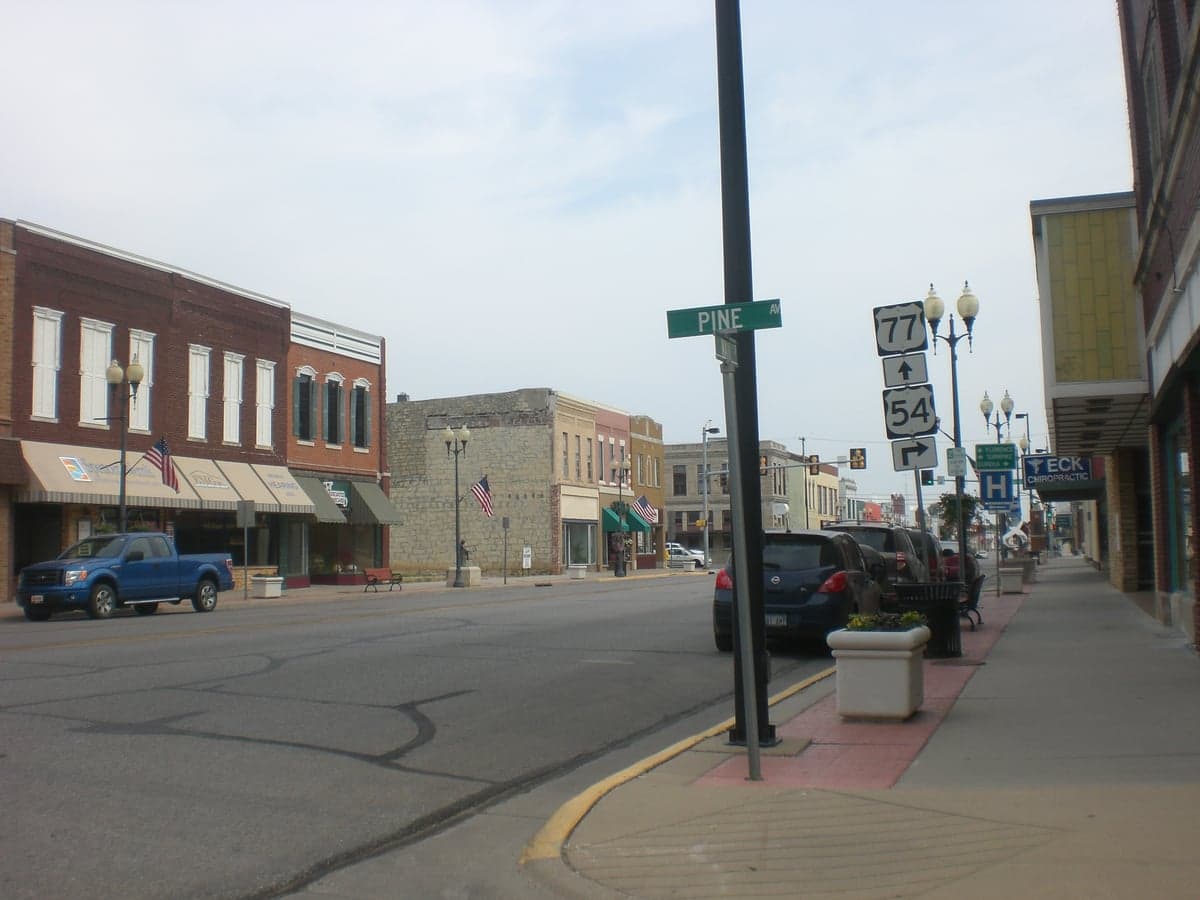
Today, El Dorado, Kansas, is a small, predominantly white community of 12,882 residents, shaped by a history of boom-and-bust resource extraction and resource extraction. The city’s character is distinctly Midwestern and conservative, with a population density of roughly 1,200 people per square mile and a strong sense of local identity tied to the oil industry and the nearby El Dorado Lake. The city’s demographic profile is notably low foreign-born share of 1.5% and high white share (88.6%) mark it as one of the less diverse small cities in Kansas, a demographic profile that has remained remarkably stable over the past several decades.
How the city was settled and grew
El Dorado was founded in 1857 by a group of settlers from the East, primarily of English and German descent, who were drawn by the promise of fertile land along the Walnut River. The original town site, now the Downtown Historic District, was platted around the Butler County Courthouse and quickly became a trading hub for area farmers. The first major population wave came with the discovery of oil in 1915, which transformed El Dorado into a classic Kansas oil boomtown. Thousands of workers—mostly white native-born Americans from the Midwest—flooded in, and the Oil Hill neighborhood was built by the Empire Oil & Refining Company to house them. This area, with its distinctive bungalows and company-built infrastructure, remains a historic anchor of the city’s working-class identity. A second, smaller wave arrived during the Great Depression, when the Civilian Conservation Corps built the El Dorado State Park and Lake, drawing laborers who settled in the Lakeview Addition area. By 1950, the population had stabilized around 11,000, and the city’s demographic character—overwhelmingly white, native-born, and Protestant—was firmly set.
Modern era (post-1965)
After the 1965 Hart-Cellar Act, El Dorado saw very little change in El Dorado’s population composition. The city did not experience the large-scale immigration from Asia or Latin America that reshaped many Kansas cities. Instead, the post-1965 period was marked by domestic out-migration, as younger residents left for Wichita (30 miles south) or Kansas City for college and jobs. The West Central neighborhood, developed in the 1970s and 1980s, absorbed most of the new housing construction, attracting white middle-class families moving from older parts of town. The Hispanic population, now stands at 5.0%, concentrated in the largest minority group, but this is a relatively recent development—most Hispanic residents arrived in the 1990s and 2000s, primarily working in agriculture and oilfield services, and they tend to concentrate in the South El Dorado area near the industrial corridor. The Indian subcontinent population (1.2%) is small but notable, largely consisting mainly professionals employed at the local hospital or at Butler Community College, and they are dispersed rather than clustered in any single neighborhood. The East/Southeast Asian community (0.2%) is negligible, and the Black population (1.1%) has remained flat since the 1970s, concentrated in a legacy of the city’s limited industrial diversification.
The future
El Dorado’s population is slowly aging and shrinking, with a median age of 39, slightly above the Kansas average. The city is not homogenizing so much as much as it is stabilizing—the white share is projected to rise modestly to around 7-8% by 2040, driven by natural increase and continued labor demand in the oil and gas sector, but the overall white share will likely remain above 85%. The Indian and East/Southeast Asian communities are expected to plateau, as there are no major employers or universities attracting new waves. The Prairie Hills subdivision, developed in the 2010s, has drawn some younger families from Wichita seeking lower housing costs, but this is a trickle, not a flood. The city’s future demographic trajectory is one of slow decline and modest diversification, with no major enclave formation—the small Hispanic population is assimilating residentially, and the Indian professionals are fully integrated. The next 10-20 years will likely see El Dorado remain a predominantly white, conservative, blue-collar community, with a slightly more Hispanic complexion but no fundamental shift in its cultural or political character.
For a conservative-leaning individual or family considering relocation, El Dorado offers a stable, low-crime environment with a population that is overwhelmingly native-born and English-speaking. The city is becoming slightly more diverse, but at a pace so gradual pace that it will not alter the existing social fabric. The bottom line: El Dorado is a place where the past still shapes the present, and where newcomers will find a community that values continuity over change.

* Values derived from national, state, county, city and local statistics and may differ in a specific area. Last updated: 2026-10-10T16:27:24.000Z
Narrative content on this page is AI-generated and may contain mistakes. Verify any details that matter before acting on them.
ReloMaps may earn a commission from affiliate links at no extra cost to you.

