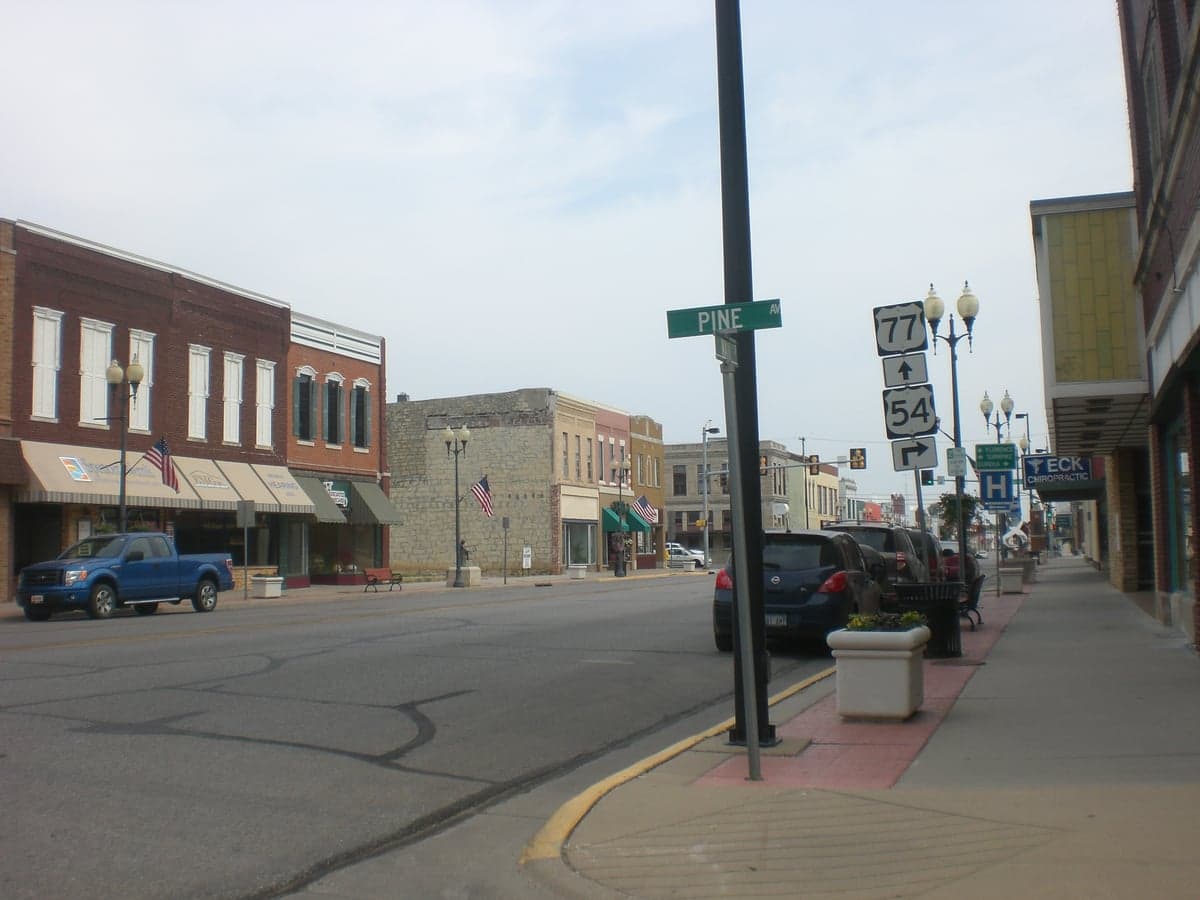
Photo: Wikipedia
Political ClimatePolitical Climate in El Dorado, KS
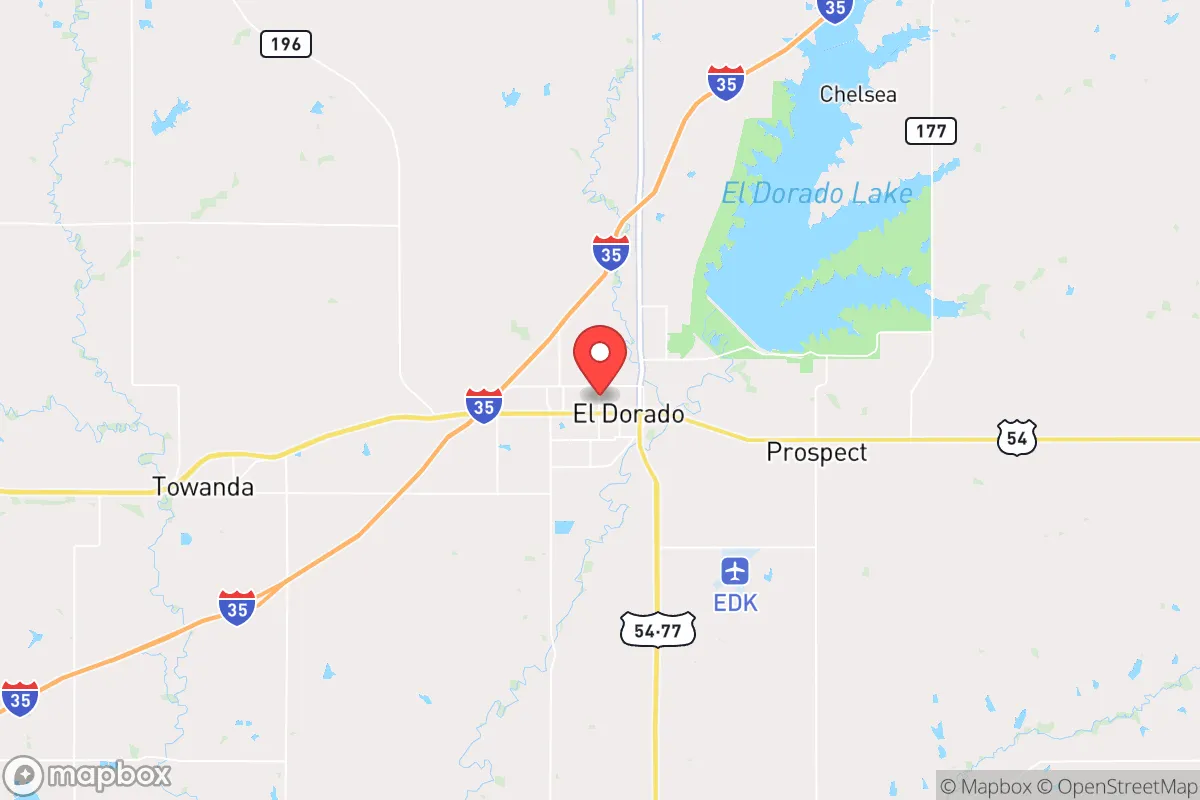
District shown is the primary district for this city’s centroid. Cities may span multiple districts.
Local Political AnalysisPolitical Analysis of El Dorado, KS
El Dorado, Kansas, has long been a rock-ribbed conservative community, and the numbers back that up. The Cook Partisan Voting Index (PVI) for the area sits at R+12, meaning it votes a full 12 points more Republican than the national average. That’s a solid three points redder than the state of Kansas as a whole, which clocks in at R+9. If you’ve lived here a while, you’ve felt that shift firsthand—not just in election results, but in the way folks talk about taxes, property rights, and the role of government. The trajectory, if anything, is holding steady or even hardening, as more people move out from Wichita and Topeka looking for a place where the county commission still believes in limited interference.
How it compares
Statewide, Kansas has seen some purple creep in places like Johnson County and Lawrence, but El Dorado sits in Butler County, which is a different animal entirely. While the state’s R+9 PVI reflects a mix of deep-red rural areas and suburban swing districts, El Dorado’s R+12 shows a community that hasn’t budged much. Drive 30 minutes west to Wichita, and you’ll find a city council that’s flirted with progressive policies on housing and policing. Head north to Emporia, and the local politics are more moderate. But here in El Dorado, the county commission and school board elections are still decided by folks who remember when the biggest government overreach was a zoning ordinance that tried to tell a farmer what he could do with his own land. That’s the kind of skepticism that keeps the area from drifting toward the state’s occasional progressive experiments.
What this means for residents
For someone living in El Dorado, the political climate translates directly into daily life. Property taxes are kept in check by a commission that views every new dollar of spending as a potential infringement on personal freedom. The local school board has resisted state mandates on curriculum and health policies, preferring to let parents have the final say. You won’t see the kind of government overreach that’s become common in larger Kansas cities—no mask mandates that last for months, no business closures ordered by a mayor who thinks he knows better than the shop owner. The long-term concern, though, is that as the state legislature in Topeka occasionally flirts with moderate or even progressive bills—like expanding Medicaid or loosening gun laws—El Dorado residents have to stay vigilant. The community’s strength is its willingness to push back, but that takes energy and organization. If you’re the kind of person who values local control and hates being told what to do by a distant bureaucracy, this is still one of the best spots in Kansas to call home.
Culturally, El Dorado stands apart from the state’s more liberal enclaves. You won’t find the same push for bike lanes, density zoning, or public art projects that dominate conversations in Lawrence or Manhattan. Instead, the policy focus stays on keeping the oil and gas industry humming, supporting the local airport and the El Dorado Correctional Facility as stable employers, and maintaining a low regulatory touch. The biggest distinction is a deep-seated belief that the government that governs least governs best—a principle that’s getting harder to hold onto as state and federal agencies keep reaching further into local affairs. For now, El Dorado remains a place where a handshake still means something, and where the county sheriff is more trusted than any state official. That’s the kind of political climate that keeps people here, even when the jobs or the weather might tempt them elsewhere.

State Political ClimatePolitical Climate in Kansas
State Political AnalysisPolitical Environment in the State
Kansas has been a reliably Republican state for decades, carrying a Cook PVI of R+9, but don’t let that number fool you into thinking it’s a monolith. The state’s political landscape here has shifted noticeably over the last 10-20 years, with the conservative stronghold in rural areas and small towns increasingly pitted against a growing, more progressive influence in the eastern urban corridor. While the state legislature and governor’s office have generally held the line on fiscal conservatism and limited government, recent cycles have seen real battles over education funding, tax policy, and social issues that make Kansas a fascinating, and sometimes frustrating, place for a conservative-leaning family or individual to call home.
Urban vs. rural divide
The political map of Kansas is a textbook case of the urban-rural split. The eastern third of the state, anchored by Kansas City (Wyandotte County) and Lawrence (Douglas County), is the Democratic stronghold. Johnson County, the affluent suburban ring around Kansas City, was once reliably red but has been trending purple for a decade, with its more moderate voters often swinging statewide races. In contrast, the rest of the state—from the Flint Hills to the High Plains—is deeply conservative. Wichita (Sedgwick County) is the largest city and a key battleground; its outskirts and suburbs lean Republican, while the urban core has become more competitive. Topeka (Shawnee County) is a mixed bag, with state government employees and union households creating a more moderate-to-liberaligned voting bloc. The real red meat of the GOP votes come from places like Garden City, Dodge City, and Hays, where agriculture, oil, and a strong sense of traditional values drive the vote. The 2022 governor’s race saw Democrat Laura Kelly win re-election by running up the score in Johnson County and the KC metro, while Republicans swept every other statewide office, highlighting the deep divide.
Policy environment
Kansas’s policy environment is a mixed bag for conservatives. On the plus side, the state has no income tax on Social Security benefits and a flat state income tax that was dramatically cut significantly under the 2012 “Brownback tax cuts,” though those were partially reversed in 2017 after revenue shortfalls. The current flat tax rate is now 5.7% for individuals, with a standard deduction that helps families. Property taxes are a sore spot, especially in growing suburbs like Olathelathe and Lenexa, where school bond issues and local levies can push effective rates above 1.5% of home value. On education, the state has been under a decades-long court order to adequately fund K-12 schools, leading to annual battles in the legislature over school choice and charter schools. The state has a strong parental rights law (HB 2416, passed in 2023) that requires schools to notify parents to notify parents of any curriculum involving sexuality, and it bans transgender athletes from birth to 3rd grade. Election integrity is solid: Voter ID is required, and the state has a secure, paper-based voting system. No widespread fraud has been documented, but the legislature has tightened absentee ballot rules. The state has a “constitutional carry” law for firearms, no permit needed to carry concealed, and a strong preemption law that stops cities from passing their own gun control.
Trajectory & freedom
On the freedom front, Kansas has been a net positive over the last five years, but there are warning signs. The biggest win for personal liberty was the 2022 “Value Them Both” amendment, which would have removed any state constitutional right to abortion. It was soundly defeated by voters, a shock to the conservative base. That vote showed that even in a red state, there is a strong libertarian streak that resists government overreach on medical decisions. On gun rights, the state has expanded: in 2021, the legislature passed a law prohibiting local governments from banning firearms in public buildings, and in 2023, they passed a “Second Amendment Preservation Act” that attempts to nullify federal gun laws. On property. On parental rights, the downside, the state has seen a creep of government mandates in the name of “public health,” including a 2021 law that gave the governor broad emergency powers, which were used to impose mask mandates and business closures. The legislature has since reined in those powers, but the memory of that overreach still stings. On property rights, Kansas has a strong “right-to-farm laws that protect agricultural operations from nuisance lawsuits, but there’s no statewide ban on rent control, and local zoning battles in Johnson County can be fierce. The biggest concern for conservatives is the growing influence of the Kansas City metro’s progressive politics, which are seeping into state lines and are starting to bleed into state policy debates.
Civil unrest & political movements
Kansas has not seen the kind of violent civil unrest seen in coastal cities, say, Portland or Seattle, but there have been flashpoints. The 2020 Black Lives Matter protests in Kansas City, Kansas and Lawrence were large but mostly peaceful, though there were isolated incidents of property damage. The state has a small but vocal progressive activist network, centered around the University of Kansas in Lawrence and the Kansas City metro, that pushes for things like defunding the police and sanctuary city policies. On the right, the “Kansas Republican Assembly” and local “Moms for Liberty” chapters are active, particularly in Johnson County, where school board meetings have become battlegrounds over critical race theory and library books. Immigration politics are a hot-button issue in western Kansas, where meatpacking plants in Garden City and Dodge City have drawn large immigrant populations. The state has no sanctuary city ban (SB 169, passed in 2021) that prohibits local governments from adopting policies that limit cooperation with federal immigration enforcement. Election integrity remains a top concern for conservatives, with the legislature has passed laws requiring signature verification on-time ballot receipt by Election Day and banning ballot harvesting. No major scandals have emerged, but the distrust persists. The most visible political movement in recent years has been the “No” vote on the Value Them Both amendment, which energized a coalition of moderates, libertarians, and Democrats that could be a blueprint for future progressive wins.
Projection
Over the next 5-10 years, Kansas is likely to become more politically competitive, but not necessarily more not necessarily more conservative. The demographic trends are clear: Johnson County is growing fast-growing, diversifying, and trending left. The Kansas City metro’s influence will only grow, and with it, pressure for more progressive policies on education, taxes, and social issues. Meanwhile, rural counties are shrinking, losing population and political clout. The state legislature will likely remain Republican-controlled, but the margins will narrow, and the governor’s office could flip back and forth. The biggest wildcard is the state Supreme Court, which has been a thorn in the side of conservatives on school funding and abortion. If the court flips to a more conservative majority, it could unlock more conservative policies. But if the court stays left, expect continued battles. For a conservative moving in now, the bottom line is that Kansas is still a good bet for limited government and traditional values, but you’ll need to be engaged. The state is not Texas or Texas, but it’s not California either. The fight for freedom here is real, and it’s happening at the local level—school boards, county commissions, and city councils. If you’re willing to get involved, you can make a difference. If you sit back, you might find your suburb voting for tax hikes and CRT curriculum before you know it.
Bottom line for a new resident: Kansas offers a relatively low-tax, gun-friendly, and family-oriented environment, but the political winds are shifting ground. The eastern urban corridor is becoming a progressive beachhead, while the rest of the state holds the line. If you’re a conservative looking for a place where your vote still matters and your voice can be heard, Kansas is a solid choice—just don’t expect it to stay the same without your active participation. The state is a battleground, and the next decade will determine whether it remains a beacon of Midwestern conservatism or drifts toward the center-left.
* Values derived from national, state, county, city and local statistics and may differ in a specific area. Last updated: 2026-10-10T16:27:24.000Z
Narrative content on this page is AI-generated and may contain mistakes. Verify any details that matter before acting on them.
ReloMaps may earn a commission from affiliate links at no extra cost to you.

