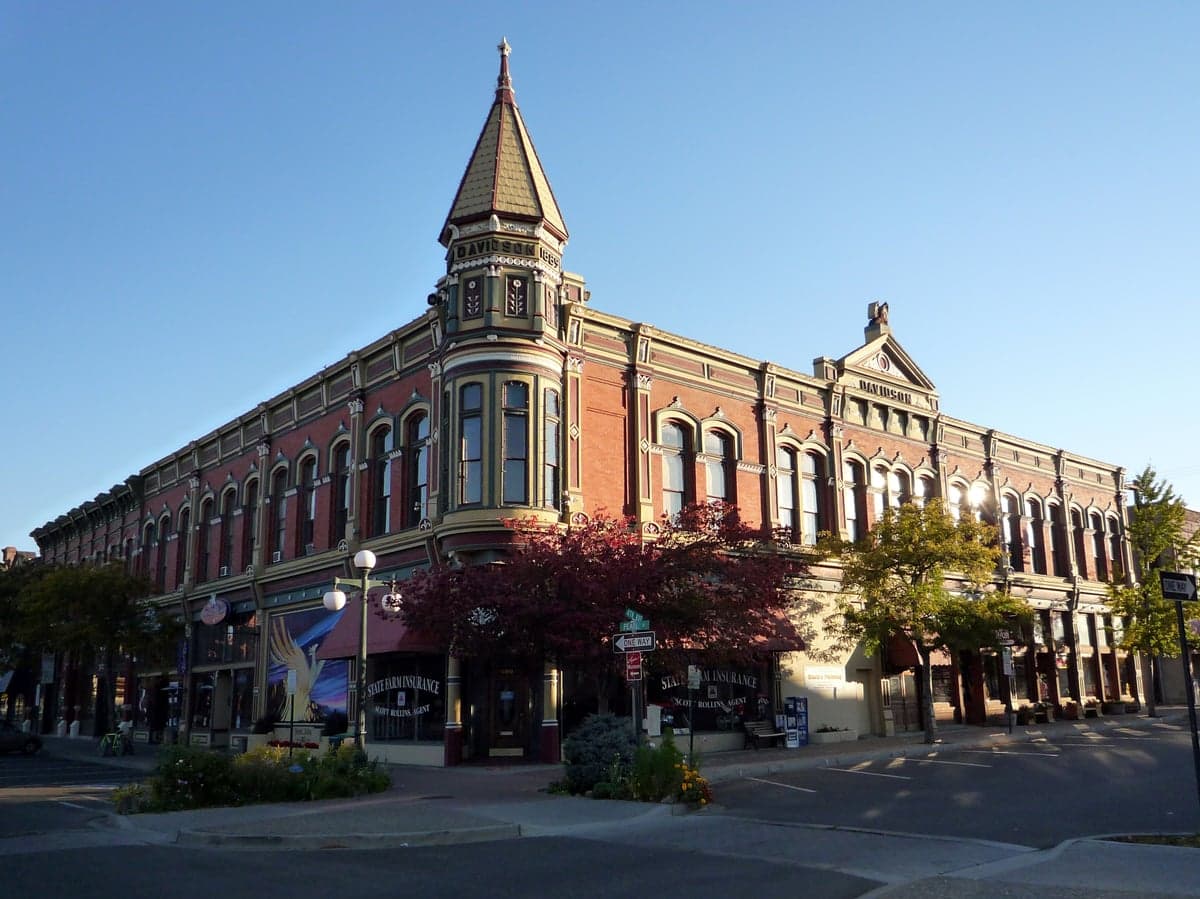
Photo: Wikipedia
Strategic Assessment of Ellensburg, WA
Workable tactical position. Some exposure to population density or targets, but generally defensible in a crisis.
What does the Strategic Assessment tell us?
Our Strategic Assessment grades tactical survivability of an area. Major population centers, military targets, fallout zones, natural disasters, and border exposure all drive risk — lower exposure means a more defensible position in a crisis.
This is heavily inspired by Joel Skousen's Strategic Relocation book. Highly recommended you checkout the book ($)What does this tell us?
Our Strategic Assessment grades tactical survivability of an area. Major population centers, military targets, fallout zones, natural disasters, and border exposure all drive risk — lower exposure means a more defensible position in a crisis.
This is heavily inspired by Joel Skousen's Strategic Relocation book. Highly recommended you checkout the book ($)Strategic Pillars

Key Distances
Regional Safe Places
Below is our recommended "safe zones" in Washington and the surrounding area based on our strategic heuristics. For most people, it's unrealistic to live in a “safe zone” full-time due to work, family or other personal reasons. They tend to be more rural. However, many of these areas are perfect for second homes and retreat properties that double as a vacation home or even a short-term rental.
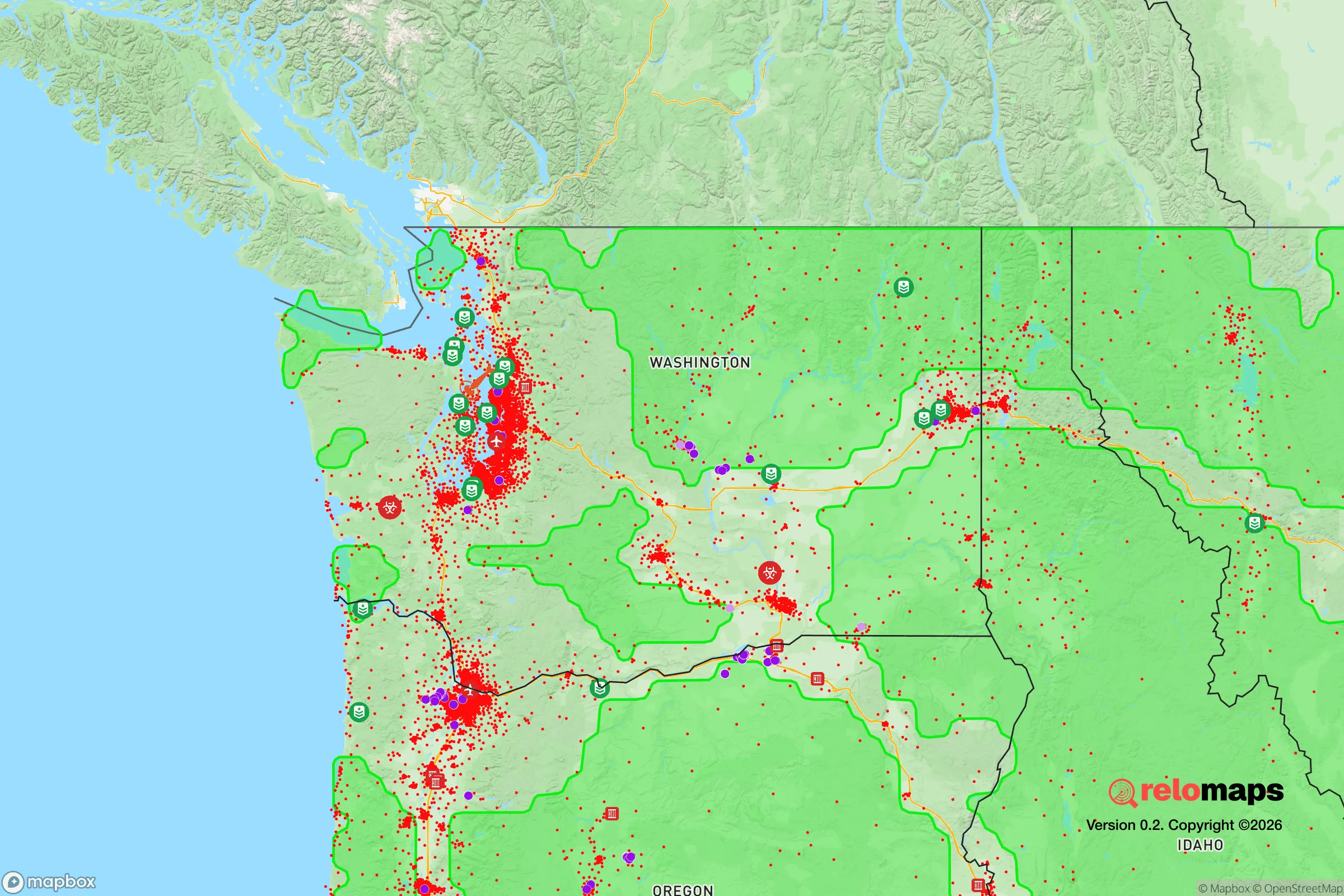
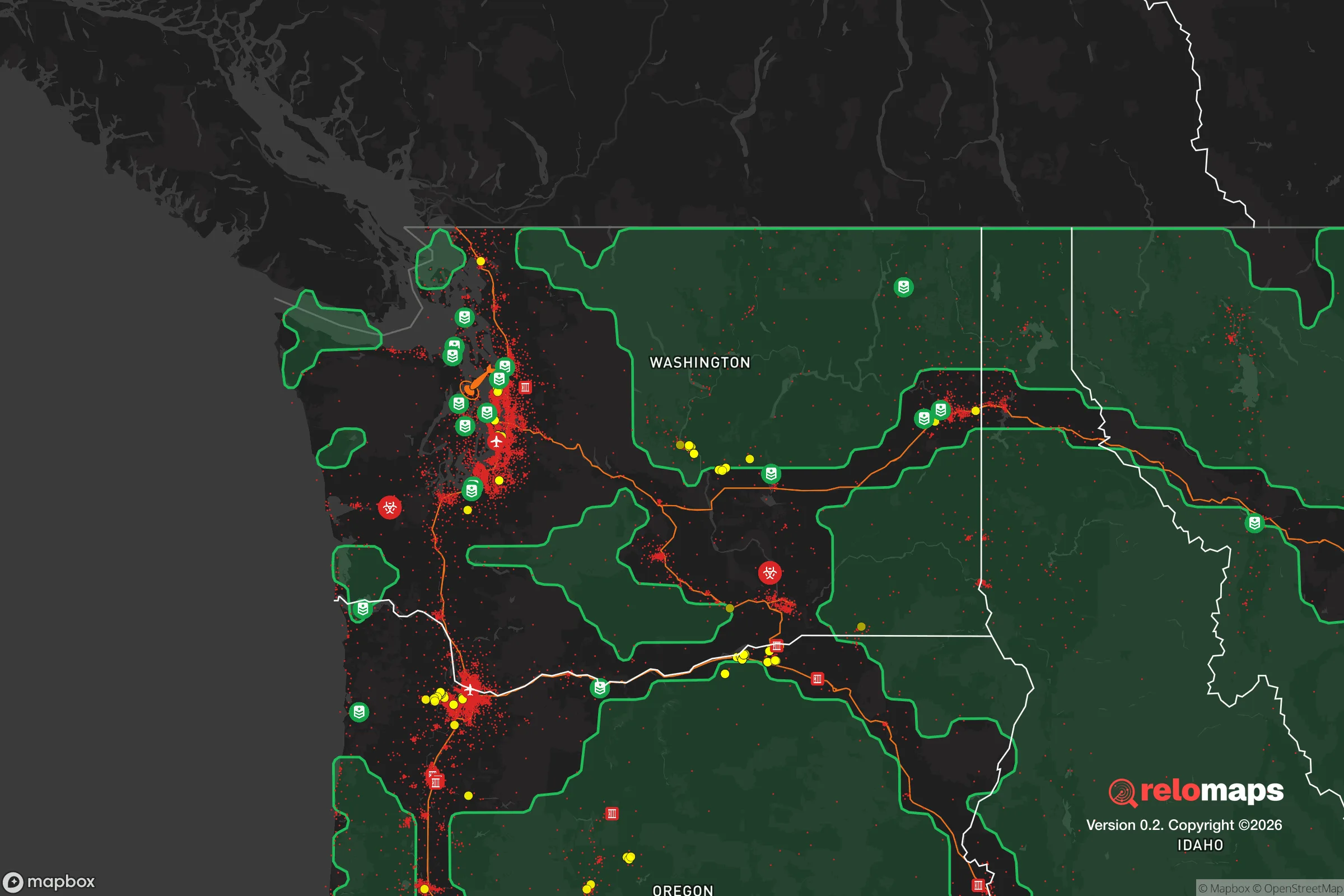


Important Note: For informational purposes only. This does not mean nothing bad ever happens in the green zones. Please use common sense. This is based on public data and modeled with AI. We tried to take a conservative approach but mistakes happen. We update this regularly as new information becomes available.
Solar Generator Recommendations
Backup power matters more here than in safer locations. We've picked three solar generators across budgets and capacity tiers — start with the budget unit if you only need a few essentials, or step up if you want to run a fridge and HVAC for days at a time.

Jackery Portable Power Station Explorer 300
Budget OptionPower on the Go: Weighing only 11 lbs, it's convenient to set up and store with book-sized foldable solar panels

BLUETTI Portable Power Station AC180
Designed for both indoor and outdoor scenarios, AC180 is highly capable as it has a robost capacity and continuous output power.

EF ECOFLOW DELTA Pro Ultra Power Station
Upgraded PickEcoFlow DELTA Pro Ultra is a whole-home energy system designed to grow with your family. Integrated with the Smart Home Panel 2, it scales to meet your evolving energy needs — keeping your home powered, intelligent, and secure through every stage of life.
We earn a commission, at no additional cost to you.
Strategic Assessment Analysis
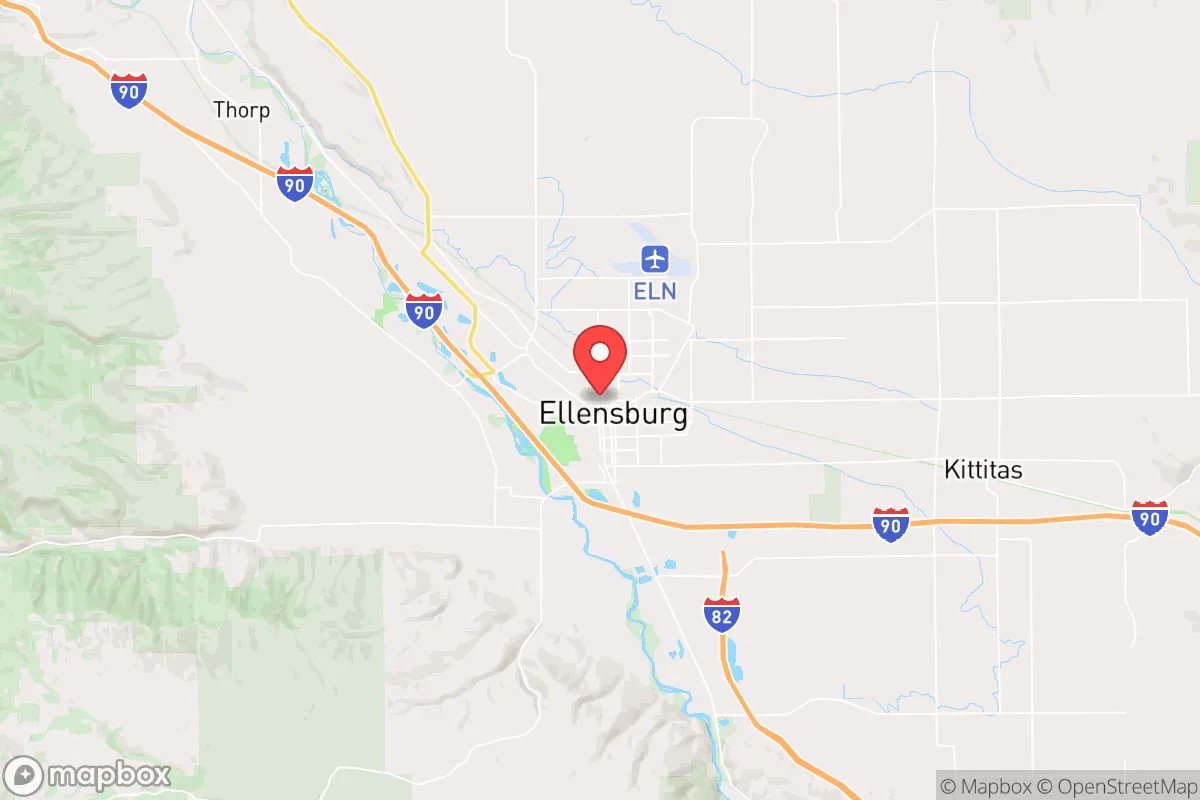
Ellensburg, Washington, occupies a strategic position in the central part of the state that offers a compelling mix of geographic insulation and practical self-sufficiency potential, making it a serious contender for those prioritizing disaster readiness and long-term resilience. Situated in Kittitas County, roughly 100 miles east of Seattle and 30 miles north of Yakima, the city sits in a broad, fertile valley along the Yakima River, shielded from the immediate fallout zones of major metropolitan areas while still being within a manageable distance for supply runs or family visits. For a relocator thinking about preparedness, Ellensburg provides a rare combination: a low-key, agricultural community with a strong sense of local identity, a relatively stable climate, and a location that avoids the worst of the Pacific Northwest’s seismic and volcanic hazards, all while being far enough from the I-5 corridor to reduce exposure to cascading infrastructure failures.
Geographic position and natural advantages for long-term stability
Ellensburg’s geography is its first and most important asset for resilience. The city sits in the Kittitas Valley, a high desert basin at roughly 1,500 feet elevation, which gives it a semi-arid climate with only about 9 inches of annual precipitation—a stark contrast to the rain-soaked western side of the Cascades. This means less risk of flooding, landslides, and the chronic mold and infrastructure degradation that plague wetter areas. The surrounding landscape is open, with the Cascade Range to the west and the Columbia River Plateau to the east, providing natural barriers that slow the spread of wildfire and limit the reach of tsunami or coastal storm surge. The valley’s agricultural base—hay, cattle, and increasingly, tree fruit and vineyards—means local food production is not just possible but already established. For a relocator, this translates to a built-in network of farms, feed stores, and equipment suppliers that are rare in more suburban or exurban settings. The area is also well outside the 50-mile blast radius of any major military or nuclear target in the state, such as Joint Base Lewis-McChord or the Hanford Site, which are both over 70 miles away. The Cascade Range acts as a physical and meteorological buffer, reducing the risk of airborne fallout from a Hanford incident or a Cascadia subduction zone earthquake triggering a tsunami on the coast.
Risks, exposures, and proximity to fallout-relevant landmarks
No location is without vulnerabilities, and Ellensburg has a few that a serious prepper should weigh. The most immediate natural risk is wildfire. The valley’s dry summers and frequent high winds—especially the famous Kittitas winds that can gust over 50 mph—create conditions for fast-moving grass and brush fires. The 2018 Jolly Mountain Fire and the 2020 Labor Day fires burned close to the city, forcing evacuations and filling the valley with smoke for weeks. While the city itself has a defensible space advantage due to its irrigated agricultural buffer, rural properties on the valley’s edges are more exposed. Another risk is earthquake. Ellensburg sits near the Yakima Fold Belt, a zone of active faulting, and while it’s not on the Cascadia subduction zone, a major quake on the Seattle Fault or a deep intraplate event could still cause significant shaking. The city’s older building stock—including many brick structures downtown—would be vulnerable. On the man-made side, the Hanford Nuclear Reservation is about 70 miles southeast. While that distance provides a substantial safety margin, a major accident or terrorist event at Hanford could release radioactive material that, depending on wind patterns, might drift over the Kittitas Valley. The prevailing winds are from the west, which offers some protection, but a shift during a release event would be a serious concern. Additionally, Ellensburg is a transportation hub for I-90 and several state highways, meaning that in a crisis, the city could see a surge of evacuees from Seattle or the Puget Sound region, potentially overwhelming local resources. The city’s population of roughly 9,000 (with the county at 50,000) is small enough to be manageable, but a mass influx would strain food, fuel, and medical capacity.
Practical resilience for a relocator: food, water, energy, and defensibility
For a relocator focused on self-sufficiency, Ellensburg offers several practical advantages that are hard to find in more populated parts of the state. Water is the strongest asset. The Yakima River runs through town, and the Kittitas Valley is part of a major irrigation district that provides reliable surface water rights for agricultural use. For a homesteader, this means the potential to dig a well or secure a water right for a small farm is realistic, unlike in many arid Western towns where water is already over-allocated. The city’s municipal water supply comes from groundwater wells, which are less vulnerable to surface contamination than reservoirs. Food production is robust. The valley is one of Washington’s top hay-producing regions, and there are dozens of small farms, orchards, and ranches within a 20-minute drive. The Ellensburg Farmers Market runs from May to October, and local food co-ops and CSAs are well-established. For a family looking to grow their own food, the growing season is short (about 120 frost-free days) but productive, with crops like potatoes, carrots, apples, and hardy greens doing well. Energy is a mixed picture. The area is served by Puget Sound Energy, with electricity coming from a mix of hydro, natural gas, and wind. The nearby Wild Horse Wind and Solar Facility provides some local renewable generation, but the grid is still tied to the larger Pacific Northwest system, which could be vulnerable to a Cascadia event. For off-grid energy, the valley has good solar potential—about 200 sunny days per year—though winter cloud cover can reduce output. Wind is abundant, making small-scale wind turbines a viable supplement. Defensibility is moderate. The valley is open and flat, which makes it hard to defend a large perimeter, but the city itself is compact and surrounded by agricultural land, creating a natural buffer. For a rural property, the key is choosing a location with good road access and a defensible position—like a hillside with a single access road—rather than a valley-floor farm that could be approached from multiple directions. The local culture is generally self-reliant and community-oriented, with a strong ranching and farming tradition that values neighborly cooperation. The Kittitas County Sheriff’s Office is professional but small, so in a prolonged crisis, residents would largely be on their own for security.
Overall, Ellensburg presents a strong strategic picture for the disaster-conscious relocator, particularly for those who value a balance between isolation and access. It avoids the worst of the Pacific Northwest’s seismic and volcanic hazards, sits far from major military and industrial targets, and has a built-in agricultural base that supports long-term self-sufficiency. The main trade-offs are the wildfire risk, the potential for a Hanford-related incident, and the reality that the city lies along a major evacuation route from Seattle. For a family or individual willing to invest in fire-resistant construction, a well, and a modest solar setup, Ellensburg offers a realistic and defensible base of operations. It’s not a bunker—it’s a working agricultural town with a college (Central Washington University) and a decent hospital (Kittitas Valley Healthcare), which means it has the social and institutional infrastructure to function in a crisis. The key is to be prepared for the specific risks of the area—wildfire, wind, and the possibility of a sudden population surge—while leveraging its natural advantages in water, food, and geographic separation from the state’s major vulnerabilities. For the serious prepper, Ellensburg is worth a hard look, not as a fantasy retreat, but as a real-world location where resilience is both possible and practical.

* Values derived from national, state, county, city and local statistics and may differ in a specific area. Last updated: 2026-08-15T00:45:23.000Z
Narrative content on this page is AI-generated and may contain mistakes. Verify any details that matter before acting on them.
ReloMaps may earn a commission from affiliate links at no extra cost to you.

