Photo: Wikipedia
Demographics of Ellsworth, ME
Affluence Level in Ellsworth, ME
A middle-class area roughly in line with national averages across income, home values, education, and employment.
People of Ellsworth, ME
The people of Ellsworth, ME today number 8,550, forming a predominantly white (91.1%) and older-than-state-average population with a notably high college attainment rate of 41.1%. The city’s character is shaped by its role as a regional commercial and medical hub for Hancock County, drawing in professionals and retirees from smaller surrounding towns while retaining a distinctly small-city, rural-New England identity. Foreign-born residents make up just 1.2% of the population, and the city’s racial and ethnic diversity is minimal, with Black (1.2%), East/Southeast Asian (0.8%), Indian subcontinent (0.7%), and Hispanic (0.9%) communities each representing tiny shares. Ellsworth is not a melting pot; it is a stable, largely homogeneous community whose demographic story is one of slow, selective in-migration rather than transformative diversity.
How the city was settled and grew
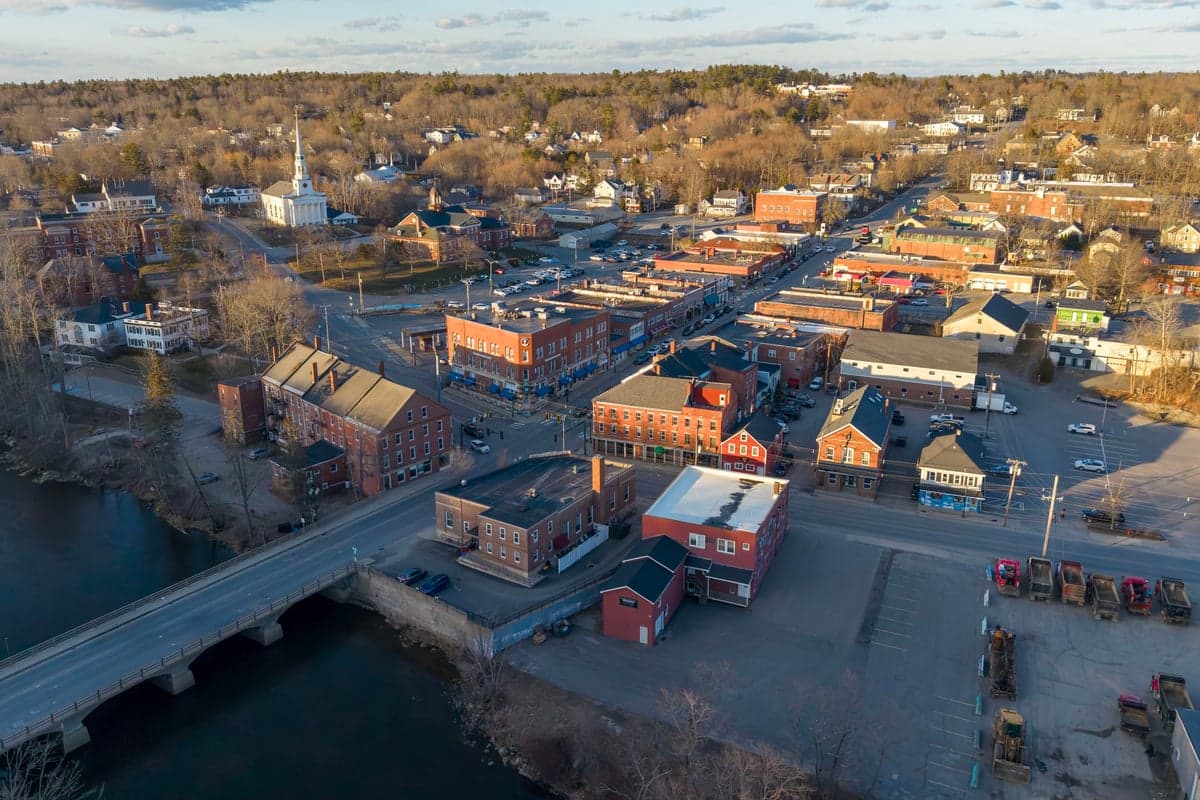
Ellsworth’s original population was drawn by land grants and water power. Chartered in 1763 as part of the Bingham Purchase, the area was settled primarily by English-descended farmers and millwrights from Massachusetts and New Hampshire. The Union River provided the industrial backbone, and by the early 1800s, the Water Street district (the historic downtown along the river) became the commercial core, built by Yankee merchants and shipbuilders who exported lumber and granite. A second wave arrived in the mid-19th century: Irish immigrants who dug the railroad and built the city’s granite infrastructure, settling in the Lower Main Street area near the rail depot. A smaller group of French-Canadian mill workers came from Quebec in the 1880s–1910s, clustering in the Bridge Hill neighborhood, just north of the river, where modest worker housing still stands. These groups largely assimilated into the Yankee mainstream by the mid-20th century, leaving Ellsworth overwhelmingly native-born white.
Modern era (post-1965)
After the 1965 Hart-Cellar Act, Ellsworth saw virtually no new immigration. The city’s foreign-born share (1.2%) is a fraction of the national average, and the tiny East/Southeast Asian community (0.8%) is mostly composed of medical professionals recruited to Maine Coast Memorial Hospital (now part of Northern Light Health) and their families, concentrated in the High Street corridor near the hospital campus. The Indian subcontinent community (0.7%) is similarly small and professional, with no distinct ethnic enclave. Domestic in-migration has been the real driver: since the 1990s, retirees and remote workers from southern New England and the Mid-Atlantic have moved into new subdivisions like Bayside Landing (off Route 1A) and the Branch Pond area, drawn by lower property taxes and proximity to Acadia National Park. This influx has raised the college-educated share to 41.1%, well above the Maine average, and has shifted the city’s political leanings slightly leftward, though Ellsworth remains more conservative than coastal towns like Bar Harbor. The Black population (1.2%) is largely composed of military-affiliated families stationed at the nearby Bangor Air National Guard Base, living in scattered rental units rather than a defined neighborhood.
The future
Ellsworth’s population is heading toward further homogenization, not diversification. The foreign-born share is likely to remain below 2% for the foreseeable future, as the city lacks the industrial or agricultural jobs that attract immigrants elsewhere. The East/Southeast Asian and Indian communities are small, professional, and stable—neither growing nor shrinking significantly—and are assimilating into the broader white-collar class. The Hispanic share (0.9%) is plateauing, driven by a few seasonal service workers in the hospitality sector. The real demographic story is domestic: continued in-migration of affluent retirees and remote workers from out of state, who are buying up single-family homes in East Ellsworth (the rural eastern side of town) and the Union River Valley, pushing home prices up and accelerating a generational turnover. This is not tribalization into ethnic enclaves; it is a slow replacement of older, lower-income locals by wealthier newcomers, creating a more educated, more politically moderate, but still overwhelmingly white population. The city’s youth are leaving for college and not returning, so the median age (around 45) will continue to rise.
For someone moving in now, Ellsworth is becoming a stable, affluent, and culturally homogeneous regional hub—a place where newcomers are welcomed but expected to fit into an existing Yankee-New England social fabric. The city offers excellent schools and low crime, but those seeking racial or ethnic diversity will not find it here. The population is not changing in kind; it is simply becoming older, richer, and more professional, with the same core demographic identity it has held for two centuries.

* Values derived from national, state, county, city and local statistics and may differ in a specific area. Last updated: 2026-05-01T04:57:29.000Z
Narrative content on this page is AI-generated and may contain mistakes. Verify any details that matter before acting on them.
ReloMaps may earn a commission from affiliate links at no extra cost to you.

