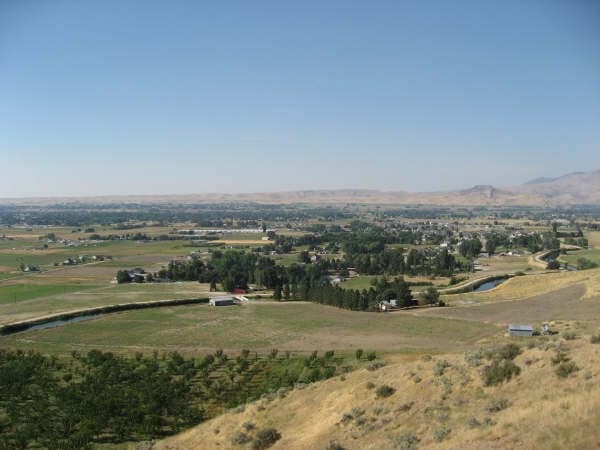
Photo: Wikipedia
Demographics of Emmett, ID
Affluence Level in Emmett, ID
A middle-class area roughly in line with national averages across income, home values, education, and employment.
People of Emmett, ID
The people of Emmett, Idaho today number 7,948, forming a predominantly white (79.0%) community with a significant Hispanic minority (15.9%) and a very small foreign-born population (6.5%). The city retains a working-class, agricultural character, with only 17.1% of adults holding a college degree, and its population is notably younger and more family-oriented than the national average. Emmett’s identity is rooted in its history as a farming and orchard town, and its residents today are a mix of multi-generational Anglo families, Hispanic agricultural workers, and a modest influx of retirees and remote workers drawn by lower housing costs.
How the city was settled and grew
Emmett’s settlement began in the 1860s with the arrival of Mormon pioneers from Utah, who established farms along the Payette River. The town was formally platted in 1900 after the Oregon Short Line Railroad extended a branch line, transforming the area into a shipping hub for fruit orchards and timber. The original Anglo settlers clustered around what is now Downtown Emmett, building the first homes, churches, and businesses along Main Street. By the 1910s, a wave of Basque sheepherders and Italian orchard workers arrived, settling in the Mill District near the old flour mill and along South Johns Avenue. These groups were followed by Dust Bowl refugees from Oklahoma and Arkansas in the 1930s, who took up farm labor and established small homesteads in the West Emmett area, near the present-day fairgrounds. The population remained overwhelmingly white and native-born through the mid-20th century, with the 1950 census recording fewer than 50 non-white residents.
Modern era (post-1965)
The post-1965 era brought the most significant demographic shift: the growth of Emmett’s Hispanic community. Beginning in the 1970s, Mexican and Central American farmworkers arrived to work in the region’s apple, cherry, and onion fields. Many settled in South Emmett, a neighborhood south of the railroad tracks along Idaho Highway 16, where modest single-family homes and mobile home parks provided affordable housing. By 2000, the Hispanic share of the population had risen to roughly 12%, and it has since grown to 15.9%. Unlike many Western towns where Hispanic growth has sparked tension, Emmett’s agricultural economy has long depended on this labor, and the community has integrated relatively quietly. The white population, meanwhile, has aged in place in North Emmett and the Emmett Bench area (the elevated plateau east of town), where larger lots and newer subdivisions have attracted retirees from Boise and California. The Asian population remains negligible at 0.1%, and the Black population is effectively zero, reflecting the area’s lack of industrial or military employment that typically draws those groups.
The future
Emmett’s population is likely to grow modestly over the next decade, driven by spillover from the Boise metro area, which is 30 miles southwest. The city’s housing stock—still relatively affordable compared to Boise—is attracting young families and remote workers, many of whom are white and college-educated, though the overall education level remains low. The Hispanic population is expected to continue growing slowly, primarily through natural increase rather than new immigration, as the agricultural sector mechanizes and labor demand stabilizes. The city is not tribalizing into distinct ethnic enclaves; rather, Hispanic families are dispersing across South Emmett and into the Orchard Avenue corridor, while newer white arrivals favor the Bench subdivisions east of town. The key risk is that Emmett’s low educational attainment and limited job diversity could constrain upward mobility, potentially leading to a bifurcated community of older retirees and lower-income service workers.
For someone moving in now, Emmett offers a quiet, family-oriented environment with a strong agricultural heritage and a growing but still small Hispanic presence. The city is becoming a bedroom community for Boise, but it retains a distinct, slower-paced identity. New residents should expect a predominantly white, conservative social fabric, with limited ethnic diversity and a community that values self-reliance and neighborly ties over urban amenities.

* Values derived from national, state, county, city and local statistics and may differ in a specific area. Last updated: 2026-05-03T20:23:59.000Z
Narrative content on this page is AI-generated and may contain mistakes. Verify any details that matter before acting on them.
ReloMaps may earn a commission from affiliate links at no extra cost to you.

