Photo: Wikipedia
Demographics of Emporia, KS
Affluence Level in Emporia, KS
A middle-class area roughly in line with national averages across income, home values, education, and employment.
People of Emporia, KS
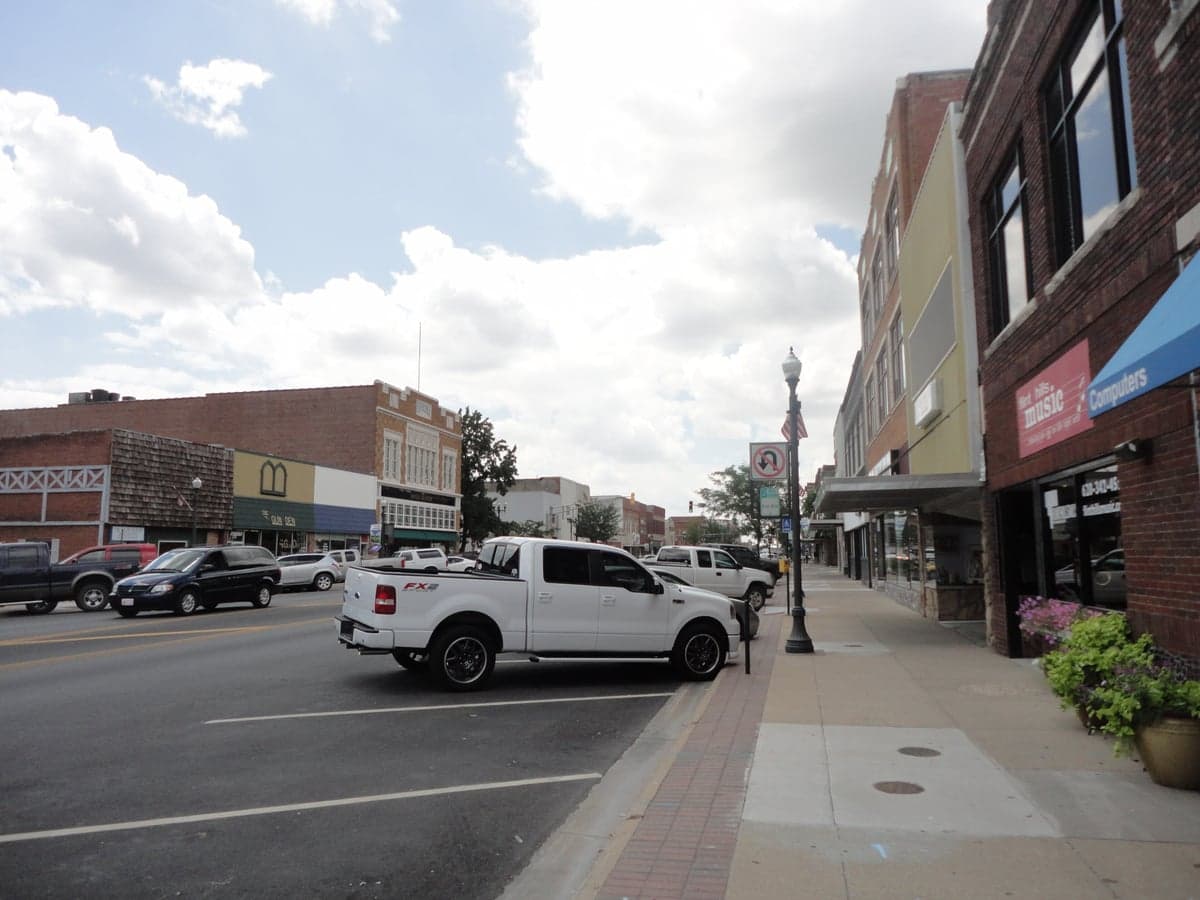
Emporia, Kansas, is a city of 24,098 residents defined by its role as a regional trade and education hub, anchored by Emporia State University and a strong manufacturing base. The population is notably diverse for a Great Plains city of its size, with a white population of 61.5%, a Hispanic or Latino population of 29.7%, and smaller Black (2.1%), East/Southeast Asian (1.6%), and Indian subcontinent (0.4%) communities. The city’s character blends a historic, walkable core with newer suburban-style subdivisions, and its identity is shaped by a long history of successive immigrant waves, each leaving a distinct mark on specific neighborhoods.
How the city was settled and grew
Emporia was founded in 1857 by a group of settlers from the New England Emigrant Aid Company, who sought to establish a free-state stronghold in the Kansas Territory. The original townsite was platted near the Cottonwood River, and the arrival of the Atchison, Topeka and Santa Fe Railway in the 1870s transformed it into a major shipping point for cattle and grain. The first major population wave came from German and Irish immigrants, who built the city’s early infrastructure and settled in the Old Town district near the railroad depot. By the early 1900s, a significant community of German-Russian Mennonites arrived, drawn by the region’s wheat-growing potential; they established farms and a distinct cultural presence in the West Emporia area, where their descendants still live today. The city’s growth was further fueled by the founding of the Kansas State Normal School (now Emporia State University) in 1863, which attracted faculty and students from across the Midwest and created a professional class concentrated in the College Hill neighborhood, a historic district of Victorian and Craftsman homes.
Modern era (post-1965)
The post-1965 era brought the most significant demographic shift to Emporia. The Immigration and Nationality Act of 1965 opened doors for new arrivals, and Emporia’s meatpacking and manufacturing plants—particularly the IBP (now Tyson Foods) plant and the Emporia Foundry—became major employers. The first large wave of Hispanic immigrants, primarily from Mexico, arrived in the 1970s and 1980s to fill labor shortages, settling in the East Emporia neighborhood along East 6th Avenue, which remains the heart of the Hispanic community with its tiendas, taquerias, and Spanish-language churches. A smaller but notable wave of East/Southeast Asian immigrants, including Vietnamese and Filipino families, arrived in the 1980s and 1990s, many also employed in manufacturing; they concentrated in the South Emporia area near the industrial parks. The Indian subcontinent community, though small at 0.4%, grew primarily through professionals and students connected to Emporia State University, and its members are scattered across the city rather than forming a single enclave. Domestic in-migration during this period came from rural Kansas and the Midwest, with many white families moving to newer subdivisions like Prairie Hills in the northwest, a suburban-style development that began in the 1990s. The city’s college-educated share stands at 25.8%, reflecting the university’s influence, though this is below the national average.
The future
Emporia’s population is trending toward greater diversity, with the Hispanic share projected to continue growing as younger families and new arrivals from Central America join the established community. The white population, while still a majority, is aging and declining slightly, as younger white residents often leave for larger cities after college. The East/Southeast Asian and Indian communities are small but stable, sustained by university ties and niche employment. The city is not homogenizing; instead, distinct enclaves are persisting, with East Emporia remaining heavily Hispanic, College Hill and Prairie Hills predominantly white, and Old Town seeing a mix of longtime residents and new businesses catering to a broader audience. The next 10-20 years will likely see the Hispanic share approach or exceed one-third of the population, while the university continues to attract a small but steady stream of international students. For a newcomer, this means moving into a city where cultural boundaries are visible but not rigid, and where the economy remains tied to manufacturing, education, and healthcare.
Emporia is becoming a more diverse, working-class city with a strong Hispanic identity, a stable white middle class, and a small but active university community. For a conservative-leaning individual or family, this means a place where traditional values of hard work and community are evident, but where cultural change is real and ongoing—a city that rewards engagement with its neighborhoods rather than retreat from them.

* Values derived from national, state, county, city and local statistics and may differ in a specific area. Last updated: 2026-05-01T01:51:47.000Z
Narrative content on this page is AI-generated and may contain mistakes. Verify any details that matter before acting on them.
ReloMaps may earn a commission from affiliate links at no extra cost to you.

