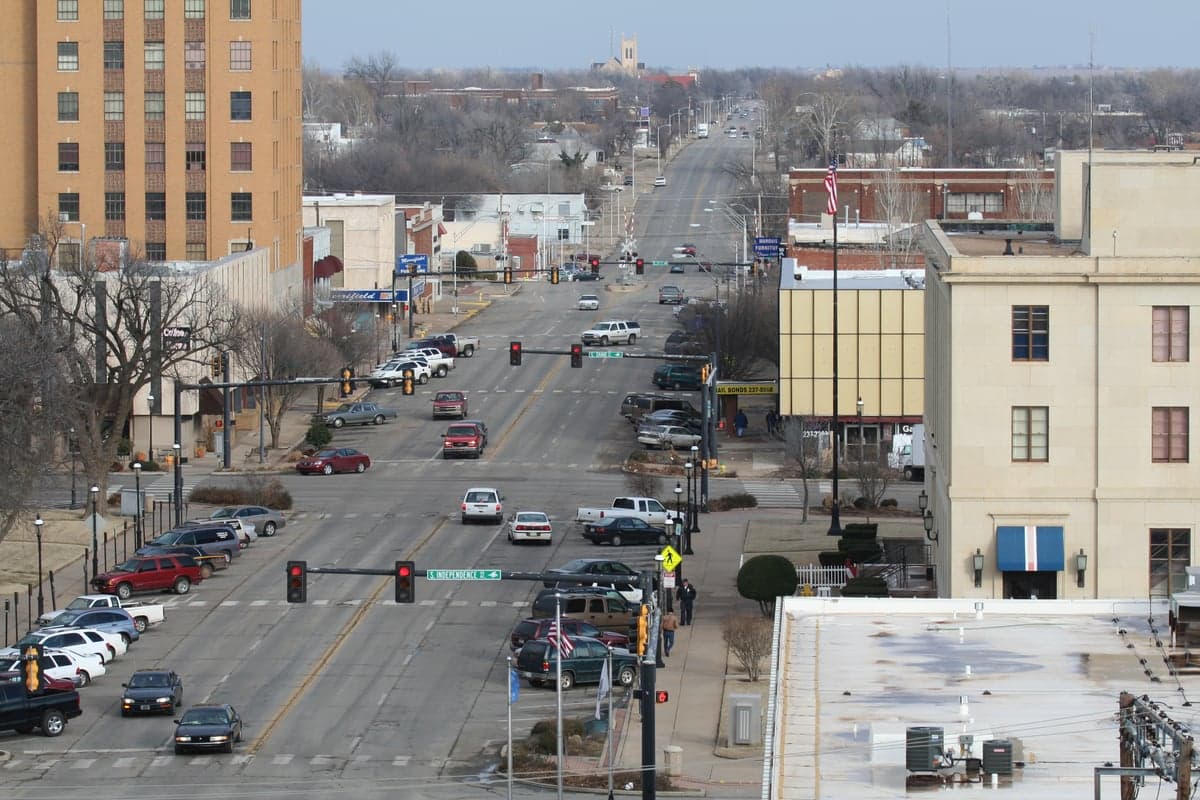
Photo: Wikipedia
Demographics of Enid, OK
Affluence Level in Enid, OK
A middle-class area roughly in line with national averages across income, home values, education, and employment.
People of Enid, OK
The people of Enid, Oklahoma today number 50,821, forming a community that is notably more Hispanic and less college-educated than the state average, with a strong conservative and family-oriented character. The city’s identity is rooted in its agricultural and energy heritage, with a population density of roughly 1,100 people per square mile that gives it a small-town feel despite being the ninth-largest city in the state. Distinctive markers include a large Mennonite and Evangelical Protestant presence, a growing Hispanic workforce tied to the meatpacking and agriculture industries, and a white population that remains the majority at 67.7% but is slowly declining in share. The foreign-born population stands at 4.8%, with the largest immigrant groups being Hispanic (16.3% of the total population) and smaller East/Southeast Asian (1.4%) and Indian subcontinent (0.1%) communities.
How the city was settled and grew
Enid was founded in 1893 during the Cherokee Outlet Land Run, when thousands of settlers rushed to claim 160-acre plots in what had been Native American territory. The initial population was overwhelmingly white and native-born, drawn from the Midwest and Upper South by the promise of free land and the arrival of the Rock Island Railroad. The city’s first neighborhoods—North Enid and South Enid—grew up around the railroad depot and grain elevators, housing the merchants, farmers, and railroad workers who built the early economy. By the 1910s, oil discoveries in the nearby Garber Field brought a second wave of white migrants, many settling in the Waverly and East Park neighborhoods near the refineries and tank farms. A small African American community formed in the Southgate area, but it never exceeded a few hundred people due to Oklahoma’s Jim Crow laws and the city’s agricultural focus. The 1920s and 1930s saw the arrival of German Mennonite families fleeing persecution in the Soviet Union; they established the Mennonite Brethren Church and settled in the West Enid farming district, where their descendants remain active in the city’s religious and business life today.
Modern era (post-1965)
The post-1965 period brought the most significant demographic shift to Enid: the growth of its Hispanic population. The Immigration and Nationality Act of 1965 opened the door for labor migration, and by the 1980s, meatpacking plants like the Excel (now Cargill) beef processing facility began recruiting workers from Mexico and Central America. These new arrivals concentrated in the Southgate and West Enid neighborhoods, where affordable housing and proximity to the plant made settlement practical. Today, the Hispanic share of Enid’s population is 16.3%, up from roughly 5% in 1990, and the community is largely Mexican-American with smaller numbers of Guatemalan and Salvadoran families. The white population, while still the majority at 67.7%, has aged and suburbanized, with many families moving to newer subdivisions like Oakwood Estates and Willow Creek on the city’s northern and eastern edges. The East/Southeast Asian community (1.4%) is small but visible, with Vietnamese and Filipino families often working in healthcare and engineering at the Vance Air Force Base or the local hospital. The Indian subcontinent population (0.1%) is negligible, consisting of a handful of professionals at the base or in the oil industry. The Black population (2.2%) has remained stable and is concentrated in the Southgate and East Park areas, with little recent in-migration.
The future
Enid’s population is heading toward a slow but steady diversification, driven primarily by Hispanic natural increase and continued labor migration to the meatpacking and agriculture sectors. The white population is projected to decline from 67.7% to roughly 60% by 2040, while the Hispanic share could reach 22-25% if current trends hold. The city is not tribalizing into distinct enclaves—Hispanic and white families increasingly live in the same neighborhoods, especially in West Enid and Southgate—but economic segregation is visible, with newer subdivisions like Oakwood Estates remaining overwhelmingly white and affluent. The East/Southeast Asian and Indian communities are likely to remain small, as Enid lacks the tech or university sectors that attract larger Asian populations. The foreign-born share (4.8%) is below the national average and is unlikely to rise dramatically, as Oklahoma’s restrictive immigration climate and the city’s limited economic diversity discourage new arrivals. The college-educated share (22.2%) is low and may decline further as younger, educated residents move to Oklahoma City or Tulsa for professional opportunities.
For someone moving to Enid now, the city is becoming a more Hispanic-influenced, working-class community with a stable conservative culture and a shrinking white majority. The neighborhoods to watch are West Enid for its growing Hispanic and Mennonite mix, Southgate for its affordability and diversity, and Oakwood Estates for families seeking newer, homogeneous subdivisions. The city’s future is not one of rapid change but of gradual demographic evolution, where the core identity—rooted in agriculture, energy, and faith—remains intact even as the faces of its people slowly shift.

* Values derived from national, state, county, city and local statistics and may differ in a specific area. Last updated: 2026-04-21T11:41:21.000Z
Narrative content on this page is AI-generated and may contain mistakes. Verify any details that matter before acting on them.
ReloMaps may earn a commission from affiliate links at no extra cost to you.

