Photo: Wikipedia
Demographics of Erie, CO
Affluence Level in Erie, CO
An upper-middle-class area. Household wealth, education levels, and homeownership run ahead of national benchmarks.
People of Erie, CO
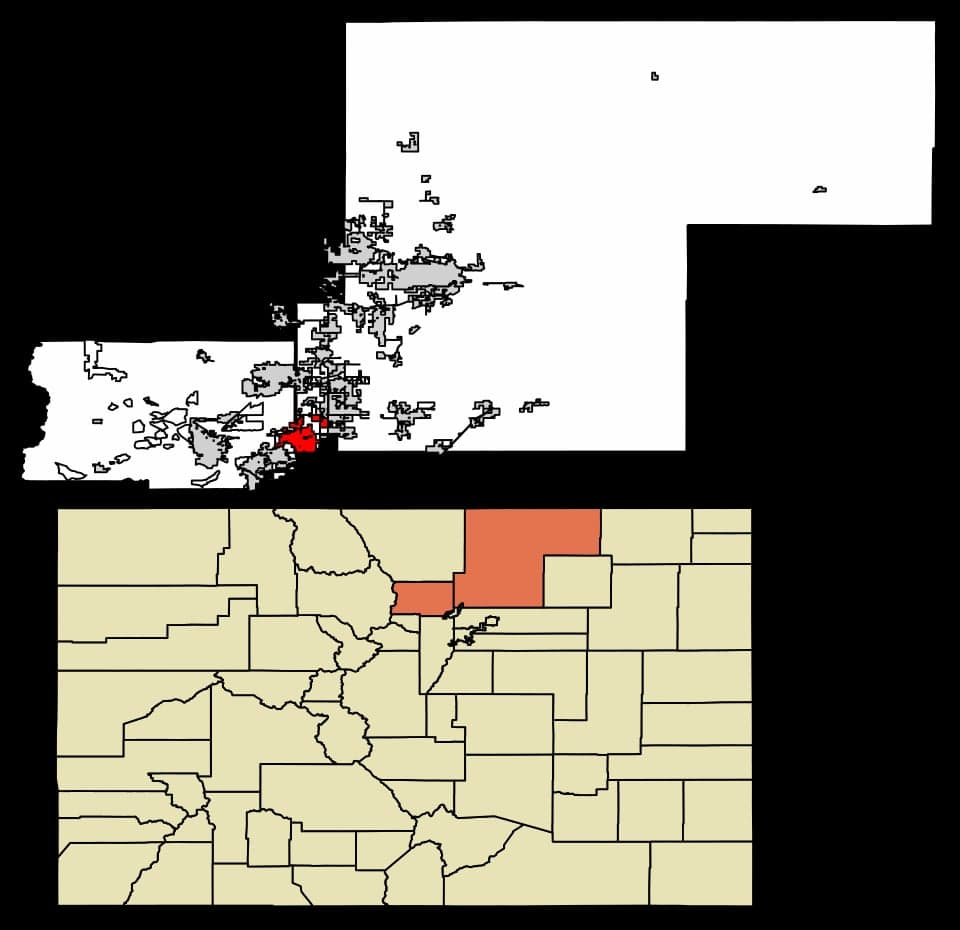
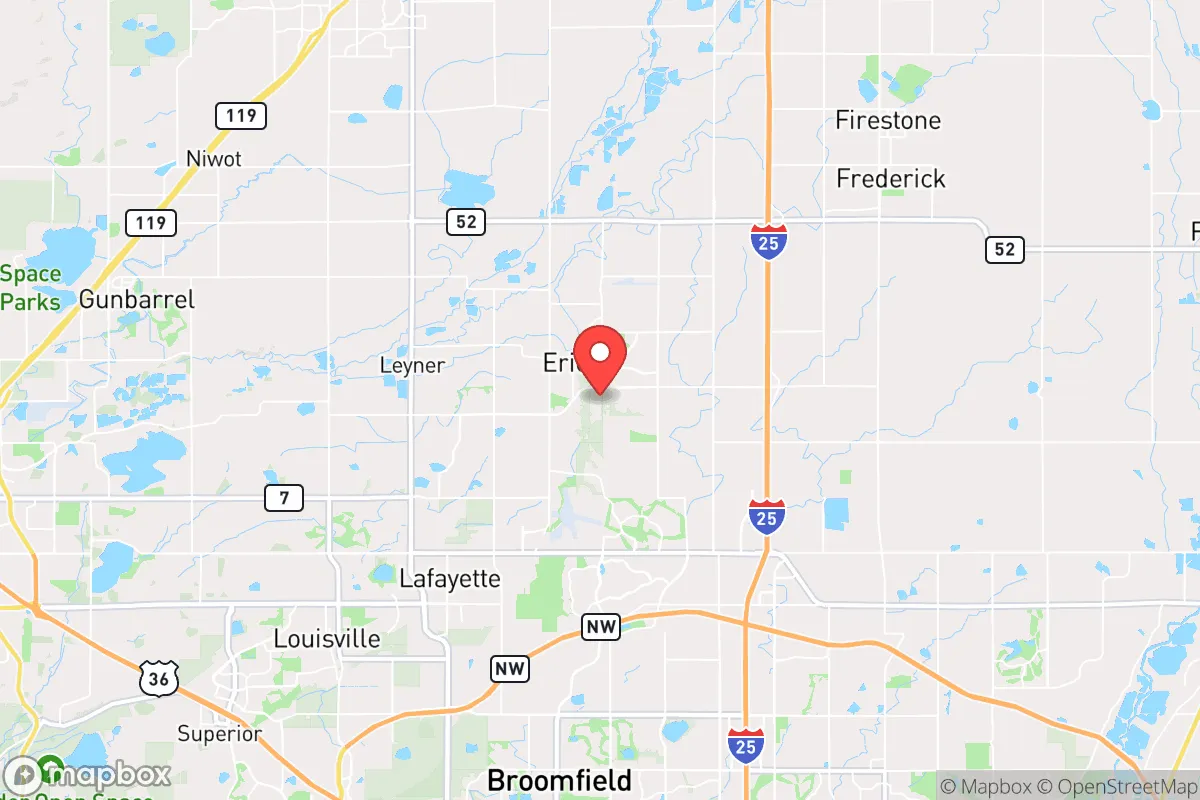
The people of Erie, Colorado today number roughly 31,927, forming a predominantly white (78.1%), highly educated (66.5% college degree) community that blends small-town roots with commuter-suburb ambition. The city’s character is defined by its rapid transformation from a quiet coal-mining and farming hamlet into a sought-after bedroom community for Boulder and Denver professionals, creating a distinct identity that is both family-oriented and increasingly affluent. With a foreign-born population of just 4.0% and a Hispanic share of 10.4%, Erie remains less diverse than neighboring communities like Longmont or Lafayette, but its demographic story is one of steady, selective in-migration rather than historic ethnic layering.
How the city was settled and grew
Erie’s original population was drawn not by gold or land grants, but by coal. Incorporated in 1885, the town was a company mining settlement for the Northern Coal and Coke Company, attracting a wave of European immigrant miners—primarily from Italy, Slovenia, and Austria-Hungary—who built the first homes in what is now Old Town Erie. These families clustered along Briggs Street and the surrounding blocks, establishing a tight-knit, Catholic, working-class community that remained the town’s demographic core for nearly a century. The coal mines closed by the 1920s, and Erie settled into a quiet agricultural period, with the population hovering around 1,000 residents through the mid-20th century. The Historic Downtown district still bears the architectural imprint of this era, with modest miner cottages and brick storefronts that contrast sharply with the newer subdivisions to the east and south.
Modern era (post-1965)
Erie’s modern population boom began in earnest after 2000, driven by the expansion of the Denver-Boulder tech corridor and the construction of master-planned communities. The post-1965 immigration reforms had little direct effect on Erie—the town remained overwhelmingly white and native-born through the 1990s. Instead, the major demographic shift came from domestic in-migration: young families and professionals priced out of Boulder and central Denver began moving to Erie for larger lots and newer homes. The Vista Ridge subdivision, developed in the early 2000s, became the primary landing zone for these newcomers, attracting a wave of college-educated, white-collar households. This was followed by Erie Highlands and Colliers Hill, which drew a slightly more diverse mix, including a small but growing number of East/Southeast Asian (4.3%) and Indian-subcontinent (2.0%) families, many of whom work in Boulder’s tech sector or Denver’s healthcare industry. The Hispanic population (10.4%) is concentrated in older neighborhoods like Old Town Erie and the Erie Village area, reflecting a mix of long-standing families and newer arrivals working in construction, landscaping, and service industries. The Black population remains negligible at 0.1%, and there is no significant Arab community.
The future
Erie’s population trajectory points toward continued growth and gradual homogenization, not tribalization into distinct ethnic enclaves. The city’s build-out is nearing completion, with most available land in the Colliers Hill and Erie Highlands phases already sold. Future growth will likely come from infill development and the aging-in-place of current residents, rather than new waves of immigration. The foreign-born share (4.0%) is low and stable, suggesting that Erie is not becoming a destination for immigrant communities. The East/Southeast Asian and Indian-subcontinent populations are small but growing, driven by professional recruitment to nearby tech employers, and they are dispersing across newer subdivisions rather than clustering. The Hispanic share is expected to hold steady or rise slightly, but the overall trend is toward a more uniformly affluent, white, and college-educated population. Erie is becoming a place where demographic diversity is present but muted, and where the dominant identity is that of a high-amenity, family-oriented suburb.
For someone moving to Erie now, the bottom line is this: you are joining a community that is overwhelmingly white, well-educated, and financially comfortable, with a strong sense of local identity rooted in its mining past but increasingly defined by its role as a Boulder-Denver bedroom suburb. The city is not a melting pot of distinct ethnic neighborhoods, but rather a place where demographic differences are smoothed over by shared lifestyle and income levels. If you value a safe, high-performing school district and a community that leans conservative but is not politically extreme, Erie offers a stable and predictable environment. If you are seeking deep ethnic diversity or a vibrant immigrant culture, you will find more of that in nearby Longmont or Thornton.

* Values derived from national, state, county, city and local statistics and may differ in a specific area. Last updated: 2026-05-01T03:13:22.000Z
Narrative content on this page is AI-generated and may contain mistakes. Verify any details that matter before acting on them.
ReloMaps may earn a commission from affiliate links at no extra cost to you.

