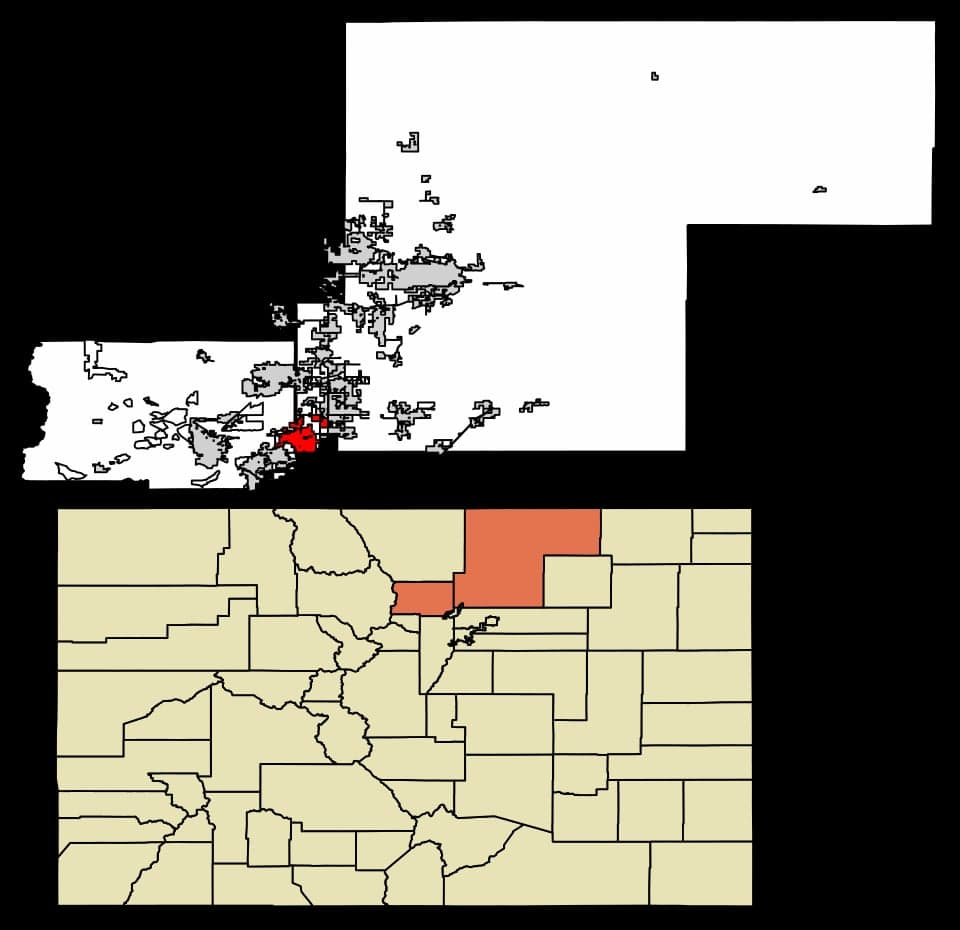
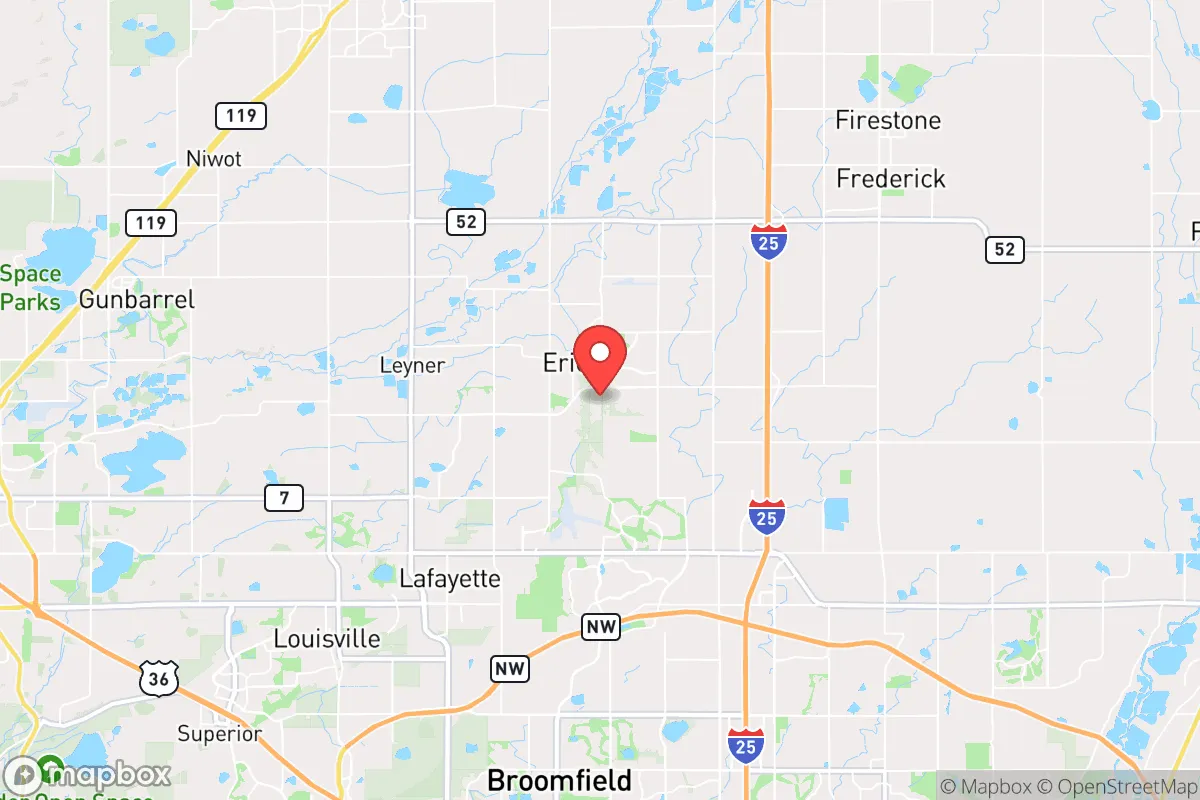
Photo: Wikipedia
Political ClimatePolitical Climate in Erie, CO
District shown is the primary district for this city’s centroid. Cities may span multiple districts.
Local Political AnalysisPolitical Analysis of Erie, CO
Erie, Colorado, has undergone a dramatic political transformation over the past decade, shifting from a quiet, rural-leaning community into a solidly progressive stronghold. The Cook PVI of D+20 tells you everything you need to know about the current trajectory: this town now votes about 20 points more Democratic than the national average, a stark contrast to the more balanced or conservative-leaning areas that surround it. If you’ve lived here as long as I have, you’ve watched the old farm stands and open spaces get replaced by master-planned subdivisions and a steady influx of folks from Boulder and Denver, bringing their politics with them. The local government has followed suit, and the shift feels less like organic change and more like a coordinated push toward policies that prioritize collective goals over individual freedoms.
How it compares
To really understand Erie’s political climate, you have to look at the neighbors. Drive ten minutes north to Longmont, and you’ll find a similar D+ lean, but it’s a different flavor—more working-class, more rooted in local industry. Head east to Frederick or Firestone, and the vibe shifts noticeably: those towns still have a strong libertarian streak, with residents who are skeptical of new taxes and zoning overreach. Even closer, the unincorporated areas of Weld County, which Erie technically borders, vote reliably red and are known for pushing back against state mandates. Erie, by contrast, has become a satellite of Boulder County’s progressive machine, even though it sits mostly in Weld. The town council and school board elections here are increasingly dominated by candidates who see government as a tool for social engineering, not just basic services. It’s a real contrast to the “live and let live” attitude you still find in places like Mead or Dacono.
What this means for residents
For the average family, the political shift translates into a growing list of local regulations that can feel intrusive. The town has aggressively pursued “climate action” plans that include strict building codes, EV-ready requirements for new homes, and water-use restrictions that go beyond what the state mandates. There’s a push for more density and transit-oriented development, which sounds good on paper but often means less parking, more traffic, and a loss of that small-town feel. Property taxes have crept up to fund these initiatives, and there’s a palpable sense that the local government is more interested in checking progressive boxes than listening to longtime residents who just want to be left alone. The school district, too, has embraced curriculum changes that prioritize social-emotional learning and equity initiatives over academic rigor, which has some parents looking at private or charter options.
Looking ahead, I don’t see this trend reversing. The demographics are locked in: new arrivals are overwhelmingly from blue areas, and they bring their voting habits with them. The town’s comprehensive plan, updated in 2024, explicitly calls for more “inclusive” policies that will likely mean higher fees, more permitting hurdles, and a continued erosion of property rights. If you value personal autonomy—whether it’s in how you build a fence, what car you drive, or how you educate your kids—Erie is becoming a harder place to call home. The cultural distinction here is that the old “rural meets suburban” compromise is gone; it’s now a progressive enclave that tolerates dissent but doesn’t reward it. For those of us who remember when the biggest political fight was over a new stoplight, it’s a sobering change.

State Political ClimatePolitical Climate in Colorado
State Political AnalysisPolitical Environment in the State
Colorado has shifted from a classic purple swing state to a solidly blue-leaning one over the past two decades, with Democrats now controlling the governorship, both state legislative chambers, and all statewide offices. The state voted for Hillary Clinton by 5 points in 2016, Joe Biden by 13 points in 2020, and Kamala Harris by roughly 11 points in 2024, reflecting a steady leftward drift driven primarily by explosive growth in the Denver-Boulder-Aurora metro corridor. For a conservative considering relocation, the state’s political trajectory is a cautionary tale of how rapid in-migration from blue states, combined with aggressive progressive policymaking, has transformed a once-balanced state into a laboratory for left-wing governance.
Urban vs. rural divide
The political map of Colorado is a stark study in contrast. The Denver metro area, including Denver County, Boulder County, and the inner-ring suburbs of Jefferson and Arapahoe counties, is the engine of Democratic dominance. Denver County routinely votes 80%+ Democratic, while Boulder County is even more lopsided. The I-25 corridor from Fort Collins down through Denver to Colorado Springs is the state’s population spine, and it’s where elections are won and lost. Colorado Springs, home to the Air Force Academy and a large military and evangelical population, remains a conservative stronghold — El Paso County voted for Trump by 12 points in 2024 — but its influence is diluted by the sheer population weight of the Denver metro. The Western Slope, including conservative-leaning Mesa County (Grand Junction) and the San Luis Valley, votes reliably red, as do the Eastern Plains counties like Yuma and Kit Carson, which are sparsely populated agricultural areas. The key shift has been in suburban counties like Douglas County, once a GOP bastion, which has moved from +18 Republican in 2012 to nearly even in 2024, driven by an influx of tech workers and remote professionals from California and the Northeast. The rural-urban divide is as sharp as anywhere in the country, but the urban centers are growing faster and younger, cementing the state’s blue tilt.
Policy environment
Colorado’s policy environment has become increasingly hostile to conservative values. The state has a flat income tax rate of 4.4% (reduced from 4.55% via Proposition 116 in 2020), but property taxes are moderate and sales taxes vary widely by locality. The Taxpayer’s Bill of Rights (TABOR), passed in 1992, still limits revenue growth and requires voter approval for tax increases, but Democrats have learned to work around it through fee increases and ballot measures. Education policy is dominated by the teachers’ unions, with school choice limited compared to states like Florida or Arizona — there is no universal school voucher program, and charter school growth has stalled. Healthcare is heavily regulated, with the state running its own insurance exchange (Connect for Health Colorado) and expanding Medicaid under the Affordable Care Act. Election laws are among the most progressive in the nation: Colorado has universal mail-in voting, same-day voter registration, and automatic voter registration, which critics argue erodes election integrity. The state also has a “red flag” law (Extreme Risk Protection Orders) passed in 2019, allowing courts to temporarily confiscate firearms from individuals deemed a risk, and in 2024, the legislature passed a ban on the sale of certain semi-automatic firearms (HB24-1292), which is currently tied up in litigation. For a conservative, the regulatory posture is suffocating — the state has a robust environmental agenda, including a 2024 law requiring 100% renewable energy by 2040, which drives up energy costs and restricts property rights for landowners near proposed wind and solar projects.
Trajectory & freedom
Colorado is unequivocally becoming less free, particularly in the realms of gun rights, parental rights, and medical autonomy. The 2024 semi-automatic firearm ban, signed by Governor Jared Polis, is the most aggressive gun control measure in state history, and it follows a 2023 law raising the minimum age to purchase any firearm to 21. On parental rights, the state passed a 2023 law (HB23-1106) that prohibits school districts from notifying parents if a student changes their gender identity or pronouns, effectively overriding parental authority in the classroom. Medical autonomy has been curtailed by vaccine mandates for healthcare workers and school staff, though these have been partially rolled back. Property rights are under assault from the state’s renewable energy mandates, which allow for eminent domain-like powers for transmission lines and solar farms. On the positive side for conservatives, Colorado is a “right-to-work” state (though unions remain powerful in the public sector), and there is no state-level rent control. However, the trajectory is clear: every legislative session brings new restrictions on firearms, new mandates on businesses, and new encroachments on local control. The state’s “blue shift” is accelerating, not slowing.
Civil unrest & political movements
Colorado has seen its share of political flashpoints. The 2020 George Floyd protests in Denver turned violent, with property damage and clashes with police, and the city’s “defund the police” movement led to a temporary reduction in the police budget, though it was later restored. The state is a sanctuary state for illegal immigrants, with a 2019 law (HB19-1124) limiting cooperation between local law enforcement and federal immigration authorities, and Denver has been a destination for busloads of migrants sent from Texas, straining city resources. On the right, the “Colorado Project” and local GOP activists have organized around election integrity, with some counties (like El Paso and Mesa) conducting audits and pushing for hand-counting of ballots, though these efforts have been largely symbolic. There is a small but vocal secession movement in the Eastern Plains and Western Slope, with some counties voting to explore seceding from Colorado to form a new state (the “51st state” movement), but it has no realistic path to success. Immigration politics are a constant source of tension, with the state’s sanctuary policies clashing with federal enforcement and creating visible strains in communities like Aurora, where a Venezuelan gang (Tren de Aragua) has been linked to crime in apartment complexes. Election integrity remains a hot-button issue, with many conservatives skeptical of the state’s mail-in voting system, despite no evidence of widespread fraud.
Projection
Over the next 5-10 years, Colorado will likely continue its leftward drift, driven by demographic trends. The Denver metro area is growing faster than the rest of the state, and the new arrivals are disproportionately young, college-educated, and left-leaning. The rural counties will continue to lose population and political influence. Expect more gun control, more environmental mandates, and more progressive social policies. The state’s housing crisis — driven by restrictive zoning in Denver and Boulder — will push some conservatives to the exurbs or out of state entirely, accelerating the political sorting. The 2026 gubernatorial race will be a key test: if a moderate Democrat wins, the pace of change might slow, but if a progressive like Secretary of State Jena Griswold runs and wins, expect an even more aggressive agenda. For a conservative moving in now, the state will be noticeably more blue in a decade, with fewer checks on government overreach.
For a conservative considering relocation, Colorado offers stunning natural beauty and a strong economy, but the political climate is increasingly hostile to traditional values of limited government, gun rights, and parental authority. The state’s trajectory is clear: more regulation, higher costs, and less personal freedom. If you value low taxes, school choice, and the right to self-defense, Colorado may not be your best bet. If you’re willing to fight for your values in a blue state, the Western Slope or Colorado Springs offer like-minded communities, but you’ll be swimming against a strong tide. Bottom line: Colorado is a beautiful place to visit, but a challenging place to live for a conservative who values freedom.
* Values derived from national, state, county, city and local statistics and may differ in a specific area. Last updated: 2026-05-01T03:13:22.000Z
Narrative content on this page is AI-generated and may contain mistakes. Verify any details that matter before acting on them.
ReloMaps may earn a commission from affiliate links at no extra cost to you.

