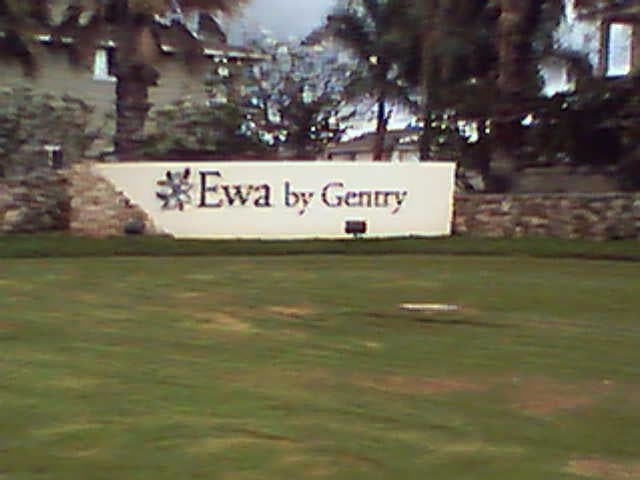
Photo: Wikipedia
Personal Sovereignty in Ewa Gentry, HI
Moderate friction. Expect trade-offs in some aspect of personal liberty and independence.
What does Personal Sovereignty tell us?
Personal Sovereignty measures your capacity for self-reliance and independence with minimal government friction. Higher scores mean fewer barriers between you and the way you want to live... but it assumes you have the space you need and good neighbors.
What does this tell us?
Personal Sovereignty measures your capacity for self-reliance and independence with minimal government friction. Higher scores mean fewer barriers between you and the way you want to live... but it assumes you have the space you need and good neighbors.
State Policy
Energy independence: Importer (2% of energy produced in-state)
Personal Liberty
Homesteading

Personal Liberty Analysis
Ewa Gentry, a master-planned community on Oahu's leeward coast, presents a paradox for the sovereignty-minded individual: it offers a high degree of physical security and community stability, but operates within a state framework that is among the most restrictive in the nation regarding personal autonomy. For the prepper or conservative strategist, the trade-off is stark. You gain a safe, family-oriented enclave with strong neighborhood cohesion, but you surrender significant control over your property, your self-defense options, and your ability to live off-grid. The fundamental question is whether the community's benefits outweigh the state's heavy hand in your daily life.
Tax burden and regulatory posture in Hawaii: what it means for your autonomy
Hawaii's state-level regulatory posture is a primary concern for anyone prioritizing personal sovereignty. The state's tax burden is among the highest in the nation, with a combined state and local tax rate that can exceed 11% for top earners. For a prepper, this means less capital for self-reliance investments—land, supplies, training. The regulatory environment is equally dense. Building permits, land use changes, and even minor home improvements require navigating a bureaucracy that can take months. This directly impacts your ability to fortify a property, build a root cellar, or install a rainwater catchment system without government oversight. The state's general excise tax (GET) applies to nearly all transactions, including services like gunsmithing or survival gear purchases, adding a hidden 4% to 4.5% cost to everything. For the sovereignty-minded, this is a constant, low-grade erosion of economic freedom that is baked into the cost of living in paradise.
Self-defense and gun law specifics: can you protect your family in Ewa Gentry?
This is the single most critical sovereignty issue in Hawaii. The state has some of the strictest gun laws in the United States, and Ewa Gentry residents are subject to them fully. Hawaii is a "may issue" state for concealed carry, and as of 2024, permits are extremely rare and difficult to obtain, requiring a demonstrated "exceptional case" that goes beyond general self-defense. Open carry is effectively banned. For home defense, you can own a handgun or long gun, but the process is arduous: you must register each firearm with the county police, pass a background check, and wait up to 14 days. Magazine capacity is limited to 10 rounds, and "assault weapons" (defined broadly) are banned. This means your home defense options are legally constrained. For a prepper, this is a major vulnerability. You cannot legally maintain a standard-capacity rifle for defense against multiple threats. The state's stance is clear: the government, not the individual, controls the means of self-defense. If you value the Second Amendment as a core liberty, Ewa Gentry—and all of Hawaii—will feel like a cage.
Self-reliance and homesteading viability: lot sizes, zoning, and off-grid feasibility
Ewa Gentry is a suburban, master-planned community, not a homesteading zone. Typical lot sizes range from 4,000 to 7,000 square feet, which is generous for a Hawaiian suburb but far too small for serious self-sufficiency. Zoning is strictly residential, with homeowners' associations (HOAs) that enforce rules on landscaping, vehicle storage, and even the color of your house. Off-grid living is effectively impossible within the community. The HOA and county codes require connection to municipal water, sewer, and electricity. Rainwater catchment is not permitted as a primary water source. Raising livestock—chickens, goats, or pigs—is typically banned or severely restricted by both the HOA and county zoning. For a prepper seeking food sovereignty, you are limited to a small vegetable garden and perhaps a few fruit trees. The community's design prioritizes order and aesthetics over self-reliance. If your plan involves a bug-out location, Ewa Gentry is a comfortable base, but it is not a sustainable retreat. You would need to look to the rural North Shore or Big Island for actual homesteading potential.
Personal liberties: parental rights, medical autonomy, speech, and property
Hawaii's state government has a strong progressive tilt that directly impacts personal liberties. Parental rights are significantly curtailed. The state mandates comprehensive sex education in public schools, and parents cannot opt their children out of lessons on gender identity or sexual orientation. Medical autonomy is also limited: Hawaii has strict vaccine mandates for school attendance, and during the pandemic, it maintained some of the longest-lasting emergency orders in the nation. For the sovereignty-minded, this signals a government that views itself as the ultimate arbiter of your family's health decisions. Property rights are similarly constrained. The state's strong tenant protections make it difficult to evict problematic renters, and the county's building codes can force you to spend thousands on permits for even minor structural changes. Free speech is constitutionally protected, but the state's "Hawaii Revised Statutes" include broad prohibitions on "harassment" and "disorderly conduct" that can be used to chill political speech, particularly around controversial topics like vaccine mandates or land use. In practice, you can speak your mind, but you must be careful about how you do it. The overall environment is one of managed consent, not rugged individualism.
For the conservative prepper or sovereignty-focused individual, Ewa Gentry offers a clean, safe, and family-friendly community with excellent schools and low crime. But it does so within a state that actively limits your ability to defend yourself, control your property, and raise your family without government interference. Compared to a place like rural Texas or Montana, Ewa Gentry is a net loss in personal sovereignty. The trade-off is security and convenience for autonomy. If your primary concern is building a self-reliant, armed, and independent life, Hawaii is one of the worst states in the union to attempt it. Ewa Gentry is a comfortable cage, not a fortress of solitude. The decision to relocate here requires a clear-eyed acceptance that you are trading personal freedom for a beautiful, regulated, and heavily taxed environment. For the survivalist, it is a strategic compromise—one that may work if your plan is to integrate into a stable community, but one that will frustrate you if you value the right to be left alone above all else.

* Values derived from national, state, county, city and local statistics and may differ in a specific area. Last updated: 2026-04-24T13:43:31.000Z
Narrative content on this page is AI-generated and may contain mistakes. Verify any details that matter before acting on them.
ReloMaps may earn a commission from affiliate links at no extra cost to you.

