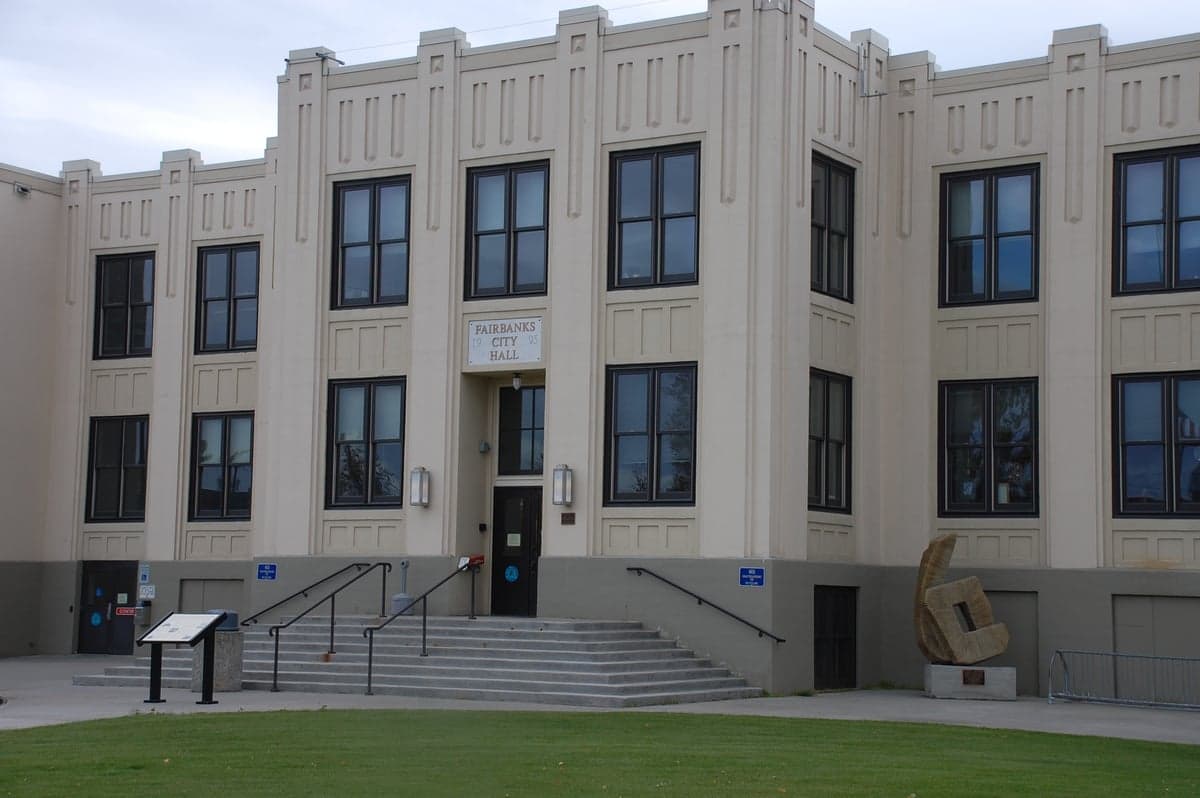
Photo: Wikipedia
Personal Sovereignty in Fairbanks, AK
Strong independent fundamentals that actively favor personal liberty and low regulation.
What does Personal Sovereignty tell us?
Personal Sovereignty measures your capacity for self-reliance and independence with minimal government friction. Higher scores mean fewer barriers between you and the way you want to live... but it assumes you have the space you need and good neighbors.
What does this tell us?
Personal Sovereignty measures your capacity for self-reliance and independence with minimal government friction. Higher scores mean fewer barriers between you and the way you want to live... but it assumes you have the space you need and good neighbors.
State Policy
Energy independence: Net exporter (350% of energy produced in-state)
Personal Liberty
Homesteading

Personal Liberty Analysis
Fairbanks, Alaska, offers one of the most robust personal sovereignty environments in the United States, largely because the state’s constitution and remote geography create a natural buffer against the kind of government overreach that increasingly chokes freedom in the Lower 48. For the conservative-leaning individual or parent who views self-reliance as a core value, this Interior city provides a rare combination of low regulatory pressure, strong property rights, and a culture that expects you to handle your own problems. While no place is a libertarian utopia, Fairbanks comes closer than most urban centers to letting you live by your own rules, provided you can handle the extreme climate and logistical realities of life 200 miles south of the Arctic Circle.
Tax burden and regulatory posture: how Alaska’s fiscal model protects your wallet and choices
Alaska’s tax structure is the single biggest advantage for anyone seeking to minimize government extraction from their income. There is no state income tax and no statewide sales tax, a fact that immediately puts thousands of dollars back in your pocket compared to living in states like California or New York. The Fairbanks North Star Borough does levy a modest property tax—typically around 1.5% of assessed value—but the absence of state-level income and sales taxes means your earnings and purchases are largely untouched by the government. This fiscal posture is not accidental; it reflects a political culture that distrusts centralized revenue collection. For a survivalist or prepper, this means more capital for land, gear, and supplies, and less funding for programs you may oppose. The regulatory environment mirrors this restraint: Alaska has no building codes in many unincorporated areas, and even within Fairbanks city limits, permitting is far less onerous than in the Lower 48. You can build a cabin, install a wood stove, or dig a well without layers of bureaucratic approval, as long as you meet basic health and safety standards. This hands-off approach extends to business licensing and land use, making it feasible to operate a home-based enterprise or maintain a private shooting range on your property without constant government interference.
Self-defense and gun law specifics: what the Second Amendment looks like in practice
Fairbanks sits in a state that treats the right to keep and bear arms as a fundamental, nearly unrestricted liberty. Alaska is a constitutional carry state: no permit is required to carry a concealed firearm, whether you are in town or out on the trail. Open carry is also fully legal without a license. The state does not maintain a gun registry, does not require waiting periods for purchases, and has no magazine capacity restrictions. For the prepper mindset, this means you can legally stockpile ammunition, own suppressors (with federal paperwork), and keep a defensive rifle in your vehicle without worrying about local ordinances that might criminalize that in other states. The practical reality in Fairbanks is that firearms are a daily tool, not a political statement—many households own multiple guns for hunting, predator defense, and personal protection against both two-legged and four-legged threats. The local sheriff’s office and state troopers generally support these rights, and there is no political momentum for restrictive gun laws. However, note that federal laws still apply, and the state’s remote location means you cannot rely on immediate police response in a crisis—self-defense is not just a right but a necessity. For parents, this environment allows you to teach firearm safety and marksmanship to your children without fear of legal overreach, a freedom increasingly rare in other parts of the country.
Self-reliance and homesteading viability: lot sizes, zoning, and off-grid feasibility
The ability to live off-grid or semi-off-grid in Fairbanks is unmatched among U.S. cities of comparable size. Within the borough, you can find undeveloped lots as small as one acre and as large as 40 acres in areas like Goldstream, Ester, and Fox, where zoning is minimal. Many of these parcels have no requirement for municipal water, sewer, or electricity connections. Off-grid living is not just tolerated; it is the norm for a significant portion of the population. You can install solar panels, wind turbines, or a diesel generator without permits, and you can drill a well or haul water from a community spigot. The borough does have some building setback and sanitation rules, but they are far less restrictive than in the Lower 48. For a family wanting to raise chickens, keep a milk goat, or grow a garden in a high tunnel, the growing season is short but productive, and there are no homeowner association covenants dictating what you can do with your land. The catch is that self-reliance here demands serious preparation: winter temperatures can drop to -40°F for weeks, requiring a reliable heat source (usually wood or heating oil), a backup power system, and the ability to store months of food. The trade-off is that you are largely free from the grid and the government’s ability to control your utilities. For the survivalist, this is as close to a prepper-friendly environment as you will find in a city with hospitals, schools, and an airport.
Personal liberties: parental rights, medical autonomy, speech, and property
Alaska’s legal framework strongly favors individual liberty across several domains that matter to conservative families. Parental rights are explicitly protected under state law, meaning you have broad authority to make decisions about your child’s education, healthcare, and upbringing without state interference. Homeschooling is common and lightly regulated—you do not need to register with the district or follow a state-mandated curriculum, though you can access correspondence programs if you want support. Medical autonomy is similarly robust: there is no state vaccine mandate for adults or children, and you can decline medical treatments for yourself or your child without facing government intervention, as long as it does not meet the high bar for child neglect. The state’s health department generally takes a hands-off approach to alternative medicine and dietary supplements. On speech and property, Alaska’s constitution provides strong protections. There is no state-level hate speech law, and your property rights include the ability to post “no trespassing” signs and enforce them with force if necessary under the state’s castle doctrine and stand-your-ground laws. The borough does have some land-use restrictions near military bases and airports, but these are narrow. The one area where government overreach is more visible is in federal land management—about 60% of Alaska is federally owned, and the Bureau of Land Management and National Park Service can impose restrictions on access and resource use. But within the Fairbanks area, most private land is genuinely yours to control.
Overall, Fairbanks ranks among the top U.S. cities for personal sovereignty, especially when measured against the regulatory creep and tax burdens of the Lower 48. The combination of no income tax, constitutional carry, minimal zoning, strong parental rights, and a culture of self-reliance creates an environment where government is a background presence rather than a daily obstacle. For the conservative individual or parent who views the current trajectory of the country with concern, this Interior Alaska city offers a tangible alternative—a place where you can live largely on your own terms, provided you respect the harsh realities of the climate. It is not a perfect refuge, but it is one of the few remaining places where the state has not yet learned to micromanage your life.

* Values derived from national, state, county, city and local statistics and may differ in a specific area. Last updated: 2026-04-19T19:19:58.000Z
Narrative content on this page is AI-generated and may contain mistakes. Verify any details that matter before acting on them.
ReloMaps may earn a commission from affiliate links at no extra cost to you.

