Photo: Wikipedia
Demographics of Fairbanks, AK
Affluence Level in Fairbanks, AK
A middle-class area roughly in line with national averages across income, home values, education, and employment.
People of Fairbanks, AK
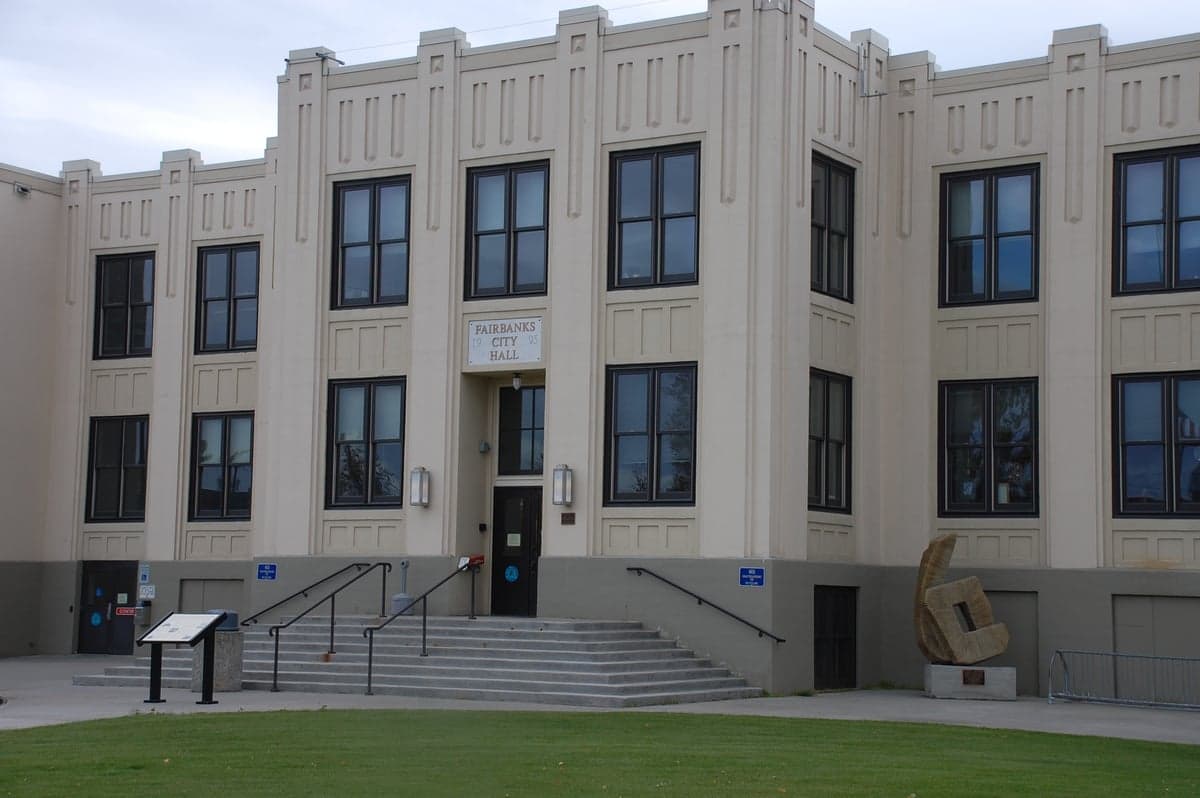
The people of Fairbanks, Alaska, today number 32,242, forming a population that is notably younger and more transient than the national average, with a strong military and resource-extraction character. The city is 57.4% White, 10.6% Hispanic, 7.3% Black, and 4.0% East/Southeast Asian, with a foreign-born share of just 2.6%—well below the U.S. average. Fairbanks retains a distinct frontier identity, shaped by its subarctic location, the presence of Fort Wainwright and Eielson Air Force Base, and a history of boom-and-bust cycles tied to gold, oil, and defense spending. The population is less diverse than Anchorage and more politically conservative, with a practical, self-reliant ethos that appeals to those seeking opportunity in a challenging environment.
How the city was settled and grew
Fairbanks was founded in 1901 as a gold-mining camp along the Chena River, named after Indiana Senator Charles W. Fairbanks. The initial population was overwhelmingly male, White, and American-born, drawn by the Tanana Valley gold rush. The construction of the Alaska Railroad in the 1910s and 1920s solidified Fairbanks as a regional supply hub, bringing a wave of Scandinavian and Northern European immigrants who settled in the Downtown and Chena River neighborhoods, building the city's first permanent homes and businesses. World War II and the Cold War transformed Fairbanks: the construction of Ladd Field (now Fort Wainwright) and Eielson Air Force Base brought thousands of military personnel and civilian contractors, many of whom stayed after service. The Hamilton Acres and Slaterville neighborhoods were developed in the 1940s and 1950s to house these military families, creating a suburban-style grid of single-family homes that remains the city's residential backbone. The 1968 discovery of oil at Prudhoe Bay triggered another boom, with pipeline workers and support staff settling in University West and College (the area around the University of Alaska Fairbanks campus), adding a more transient, single-adult population.
Modern era (post-1965)
After the 1965 Immigration Act, Fairbanks saw only modest diversification compared to the Lower 48. The foreign-born share remains low at 2.6%, with the largest immigrant groups being Filipino and Korean communities—many connected to military service or healthcare—who concentrated in Slaterville and South Fairbanks. The Hispanic population, now 10.6%, grew primarily through domestic in-migration from the Southwest and California, drawn by construction and service jobs during the Trans-Alaska Pipeline era (1974–1977) and subsequent oil-price booms. These families settled in Badger (an unincorporated suburb) and the Airport Way corridor. The Black population, at 7.3%, is overwhelmingly tied to Fort Wainwright and Eielson, with most families living on-base or in the Hamilton Acres and Slaterville rental stock. The East/Southeast Asian community (4.0%) includes a long-established Filipino population from the 1950s and 1960s, plus a smaller Korean cohort from the 1980s, both concentrated in University West near the university and the hospitals. There is no measurable Indian-subcontinent population (0.0%). The White population, while still the majority at 57.4%, has declined from over 80% in 1980, driven by out-migration of long-term residents to warmer climates and the influx of military and oil workers from more diverse backgrounds.
The future
Fairbanks' population is projected to remain stable or decline slightly over the next decade, as the military presence plateaus and the oil industry automates. The city is not homogenizing into a single identity; rather, it is tribalizing into distinct enclaves: military families in Hamilton Acres and Slaterville, university-affiliated residents in College and University West, and a growing Hispanic working class in Badger and the Airport Way area. The immigrant communities—Filipino and Korean—are plateauing, with second-generation members often leaving for Anchorage or the Lower 48 for education and jobs. The foreign-born share is unlikely to rise significantly, as Fairbanks lacks the service-economy pull of Anchorage or the refugee resettlement programs of the Lower 48. The most notable demographic trend is the aging of the White population: many baby-boomer retirees are selling homes and moving south, replaced by younger, more transient military and oil workers who are slightly more diverse but less rooted.
For someone moving to Fairbanks now, the city offers a stable, conservative-leaning community with a strong military and resource-industry base, but one that is slowly diversifying along class and occupational lines rather than through immigration. The neighborhoods are clearly defined by who lives there and why, and newcomers will find a place where self-reliance and practical skills matter more than pedigree or origin. The population is not growing, but it is resilient—a characteristic that has defined Fairbanks since the gold rush.

* Values derived from national, state, county, city and local statistics and may differ in a specific area. Last updated: 2026-04-19T19:19:58.000Z
Narrative content on this page is AI-generated and may contain mistakes. Verify any details that matter before acting on them.
ReloMaps may earn a commission from affiliate links at no extra cost to you.

