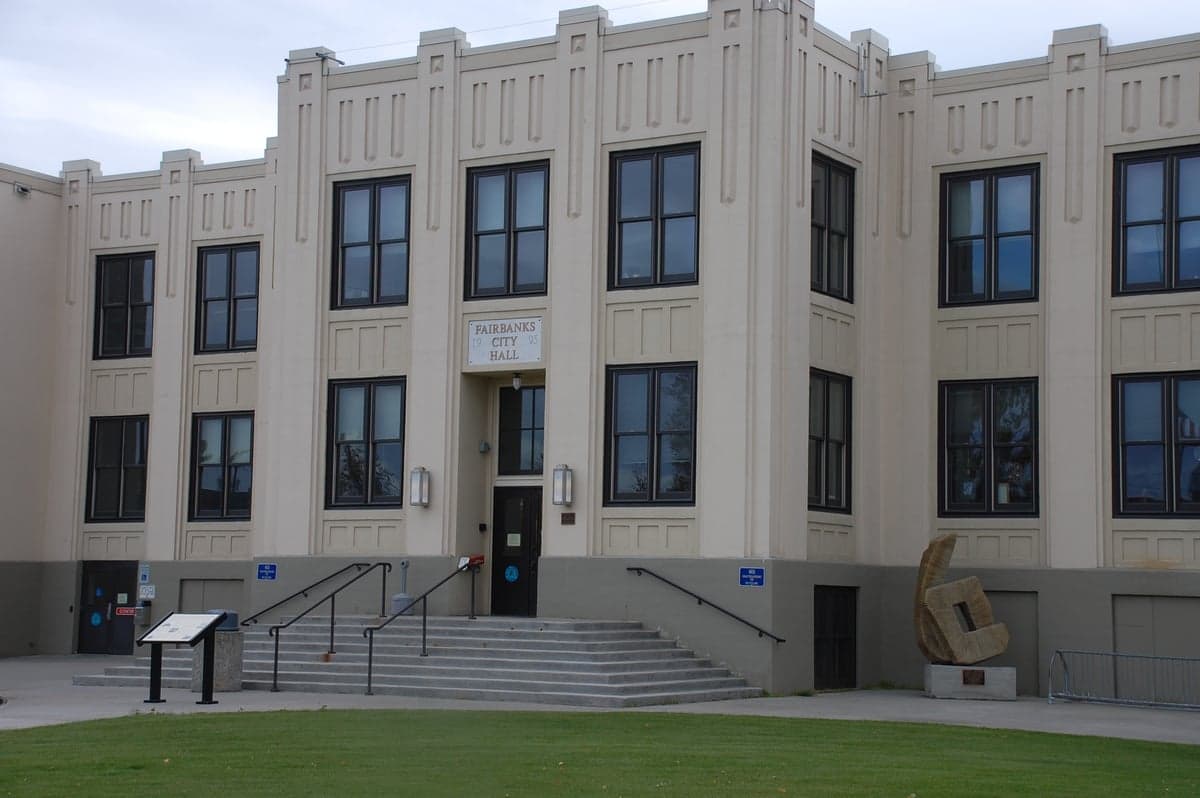
Photo: Wikipedia
Political ClimatePolitical Climate in Fairbanks, AK
District shown is the primary district for this city’s centroid. Cities may span multiple districts.
Inherited from parent state — no local data available.
Local Political AnalysisPolitical Analysis of Fairbanks, AK
Fairbanks has long been a solidly conservative stronghold in Alaska, with a Cook PVI of R+6 that reflects its consistent Republican lean in federal elections. But if you’ve lived here as long as I have, you know the political climate isn’t quite as simple as that number suggests. The city itself—especially around the university and downtown—has seen a slow but noticeable shift toward progressive activism over the past decade, while the surrounding rural areas and nearby towns like North Pole and Eielson Air Force Base remain deeply red. That tension between the old-school, freedom-loving Fairbanks and the newer, more ideologically driven crowd is where the real story lies.
How it compares
Compared to Anchorage, which has drifted leftward in recent years with a more diverse economy and population, Fairbanks feels like a different country. Anchorage’s mayor is a Democrat, and the city council has pushed things like sanctuary city policies and higher minimum wages—stuff that would never fly here. Then there’s Juneau, the state capital, which is practically a progressive island surrounded by conservative Southeast Alaska. Fairbanks sits in the middle of the Interior, where the culture is still built around hunting, mining, and military service. The contrast with nearby Delta Junction or Tok is less dramatic—those areas are even more conservative—but the real divide is between the city limits and the borough. The Fairbanks North Star Borough as a whole votes reliably Republican, but the city council races have gotten tighter, with a few progressive candidates slipping in by narrow margins. That’s a red flag for anyone who values limited government and personal freedom.
What this means for residents
For folks who’ve been here a while, the biggest concern is government overreach creeping into daily life. We’ve seen it in the push for stricter land-use regulations, noise ordinances that target snowmachine use, and even debates over mask mandates that lasted longer than they should have. The progressive faction tends to favor more zoning controls and environmental restrictions that can feel like a direct attack on the self-reliant lifestyle that defines Interior Alaska. On the flip side, the conservative majority has held the line on property taxes—they’re still among the lowest in the state—and kept the borough from adopting a sales tax. But the worry is that as more people move up from the Lower 48, especially retirees and remote workers, they bring big-government habits with them. If you value being left alone to live your life without a bunch of red tape, Fairbanks is still a good bet, but you’ve got to keep an eye on those local elections.
Culturally, Fairbanks is a place where the Second Amendment isn’t debated—it’s a given. Gun shops outnumber coffee shops in some parts of town, and the annual winter fur rondy is a celebration of trapping and outdoor skills that would make a coastal progressive cringe. The university, University of Alaska Fairbanks, does bring a more liberal flavor, especially in the arts and sciences departments, but it’s nowhere near as dominant as in places like Boulder or Eugene. The real policy distinction here is the borough’s hands-off approach to property rights—no county-level building codes outside the city limits, no noise complaints that actually get enforced, and a general attitude that your land is your business. That’s the Fairbanks I grew up in, and I hope it stays that way. But the trend lines are worth watching, because once those freedoms start getting nibbled away, they’re hard to get back.

State Political ClimatePolitical Climate in Alaska
State Political AnalysisPolitical Environment in the State
Alaska has long been a unique political outlier, with a strong libertarian streak and a Republican lean that has softened in recent cycles. The state voted for Donald Trump by 10 points in 2020 and 13 points in 2024, but its independent streak is real—it elected a Democratic U.S. House member, Mary Peltola, in a 2022 special election before flipping back to Republican Nick Begich in 2024. Over the last 20 years, the state has shifted from reliably red to a more volatile mix, driven by a growing urban-liberal bloc in Anchorage and a shrinking but deeply conservative rural and exurban base. For a conservative considering relocation, the key takeaway is that Alaska still offers a low-tax, gun-friendly, and resource-focused environment, but the political winds are shifting in ways that demand attention.
Urban vs. rural divide
The political map of Alaska is starkly divided between a few population centers and the vast, sparsely populated bush. Anchorage, home to about 40% of the state’s population, is the swing region—its municipal elections and state legislative races often decide statewide outcomes. The city’s liberal core, concentrated in downtown and the Hillside neighborhoods, has pushed for progressive policies like a 2021 mask mandate and sanctuary city rhetoric, but the surrounding suburbs—Eagle River, Chugiak, and the Mat-Su Borough—are deeply conservative. Wasilla and Palmer in the Mat-Su Valley are the state’s most reliably red strongholds, consistently delivering 65-70% Republican votes. Fairbanks, the second-largest city, leans conservative but has a notable university-driven liberal pocket near the University of Alaska campus. Juneau, the capital, is a Democratic bastion, driven by state government employees and a strong environmentalist presence. The rural bush—villages like Bethel, Nome, and Barrow—votes overwhelmingly Democratic due to heavy reliance on federal subsidies and tribal governance, but turnout is low. The divide is simple: the more you rely on government checks or live in a dense urban core, the more liberal the vote; the more you live off the land or work in resource extraction, the more conservative.
Policy environment
Alaska’s policy environment is a mixed bag for conservatives. On the plus side, there is no state income tax and no statewide sales tax, funded by the Permanent Fund oil revenue—a massive freedom advantage. Property taxes are low, with most boroughs capping rates. Gun rights are strong: Alaska has constitutional carry (no permit needed for concealed carry), no magazine bans, and a 2013 law preempting local gun ordinances. However, the state has a progressive streak on social issues: recreational marijuana has been legal since 2014, and the state has a robust Medicaid expansion under the Affordable Care Act. Education policy is a flashpoint—the state’s per-pupil spending is among the highest in the nation, but results are middling, and a 2023 parental rights bill (HB 105) that would have required schools to notify parents of curriculum changes died in committee. Election laws are relatively open: Alaska uses a top-four primary system and ranked-choice voting for general elections, passed by ballot initiative in 2020. This system has been criticized by conservatives for diluting party power and enabling moderate Democrats to win, as seen in Peltola’s 2022 victory. For a freedom-minded resident, the tax and gun policies are excellent, but the ranked-choice voting and marijuana laws may feel like government overreach in other areas.
Trajectory & freedom
Alaska is in a tug-of-war between expanding and contracting personal liberty. On the freedom-positive side, the state has resisted federal overreach on land use—the 1980 Alaska National Interest Lands Conservation Act (ANILCA) still sparks debate, but the state has fought for resource development in the Arctic National Wildlife Refuge (ANWR). In 2023, Governor Mike Dunleavy signed a bill expanding school choice through charter schools and correspondence programs, a win for parental rights. However, the 2020 ranked-choice voting initiative was a clear contraction of electoral freedom, making it harder for conservatives to win without moderate crossovers. On medical freedom, Alaska had a 2021 mandate for healthcare workers to get the COVID vaccine, which was later rescinded, but the state still has a centralized vaccine registry that privacy advocates oppose. Gun rights remain strong, with no red flag law passed despite repeated attempts. The trajectory is concerning: the urban population in Anchorage is growing younger and more liberal, and the state’s reliance on oil revenue makes it vulnerable to green energy policies from Washington. A new resident should expect more fights over election integrity and school curriculum in the next decade.
Civil unrest & political movements
Alaska has seen relatively little civil unrest compared to the Lower 48, but there are notable flashpoints. The 2020 Black Lives Matter protests in Anchorage were large for the state—several hundred people—and led to a push to remove a statue of a Russian explorer. On the right, the Alaska Independence Party, which advocates for secession from the U.S., remains a fringe but vocal presence, particularly in the Mat-Su Valley. Immigration politics are muted because the state has a small foreign-born population (about 8%), but there have been sanctuary city debates in Anchorage, where the city council voted in 2019 to limit cooperation with ICE—a move that was later partially reversed. Election integrity is a hot topic: the 2022 ranked-choice voting system led to a recount in the U.S. House race, and conservative groups have launched a ballot initiative to repeal ranked-choice voting, which will be on the 2026 ballot. The most visible political movement is the fight over resource extraction—environmental activists from Outside have clashed with pro-development locals in places like the North Slope and the proposed Pebble Mine site near Iliamna. A new resident will notice the tension between the “live off the land” ethos and the growing progressive activism in the cities.
Projection
Over the next 5-10 years, Alaska is likely to become more politically competitive, but not necessarily more liberal. The in-migration pattern is key: people moving to Alaska tend to be conservative-leaning, drawn by low taxes and outdoor lifestyle, but they are settling in the Mat-Su Valley and Fairbanks, not Anchorage. The Mat-Su Borough is the fastest-growing region in the state, and its conservative voting bloc will grow in influence. However, the urban core of Anchorage is also growing, driven by military families and service-sector workers, and its liberal tilt will intensify. The ranked-choice voting system is likely to be repealed in 2026, which would restore a more traditional partisan dynamic. The biggest wild card is the state’s economy: if oil prices stay high, the Permanent Fund will continue to fund low taxes, but if green energy policies from the federal government cut into oil revenue, the state may be forced to consider an income tax—a red line for conservatives. A new resident moving in now should expect a state that remains broadly conservative on fiscal and gun issues, but with a growing cultural battle over education and election rules. The rural-urban divide will widen, and the Mat-Su Valley will become the state’s conservative anchor.
For a conservative individual or family, Alaska offers a rare combination of low taxes, strong gun rights, and a frontier ethos that values personal responsibility. The political climate is not as reliably red as Texas or Florida, but it is far more free than California or New York. The key is to choose your location carefully: the Mat-Su Valley (Wasilla, Palmer) or Fairbanks will give you a conservative community and good schools, while Anchorage and Juneau will expose you to more progressive policies and higher costs. The ranked-choice voting system is a real concern, but it is likely temporary. Bottom line: Alaska is a good bet for a freedom-loving family, but you need to be engaged in local politics to keep it that way. The state’s independence is its greatest asset—don’t let the urbanites take it away.
* Values derived from national, state, county, city and local statistics and may differ in a specific area. Last updated: 2026-04-19T19:19:58.000Z
Narrative content on this page is AI-generated and may contain mistakes. Verify any details that matter before acting on them.
ReloMaps may earn a commission from affiliate links at no extra cost to you.

