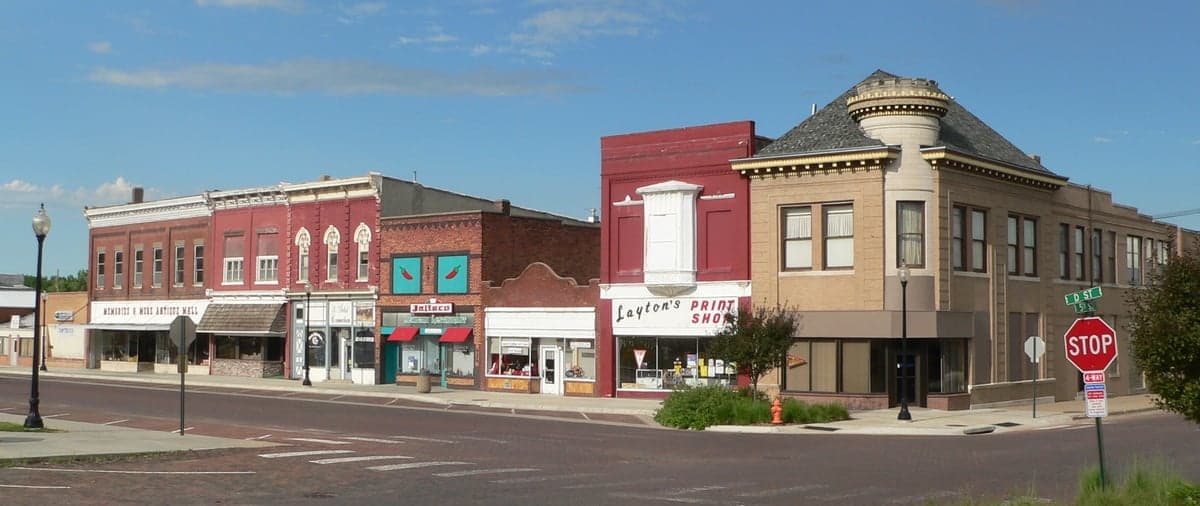
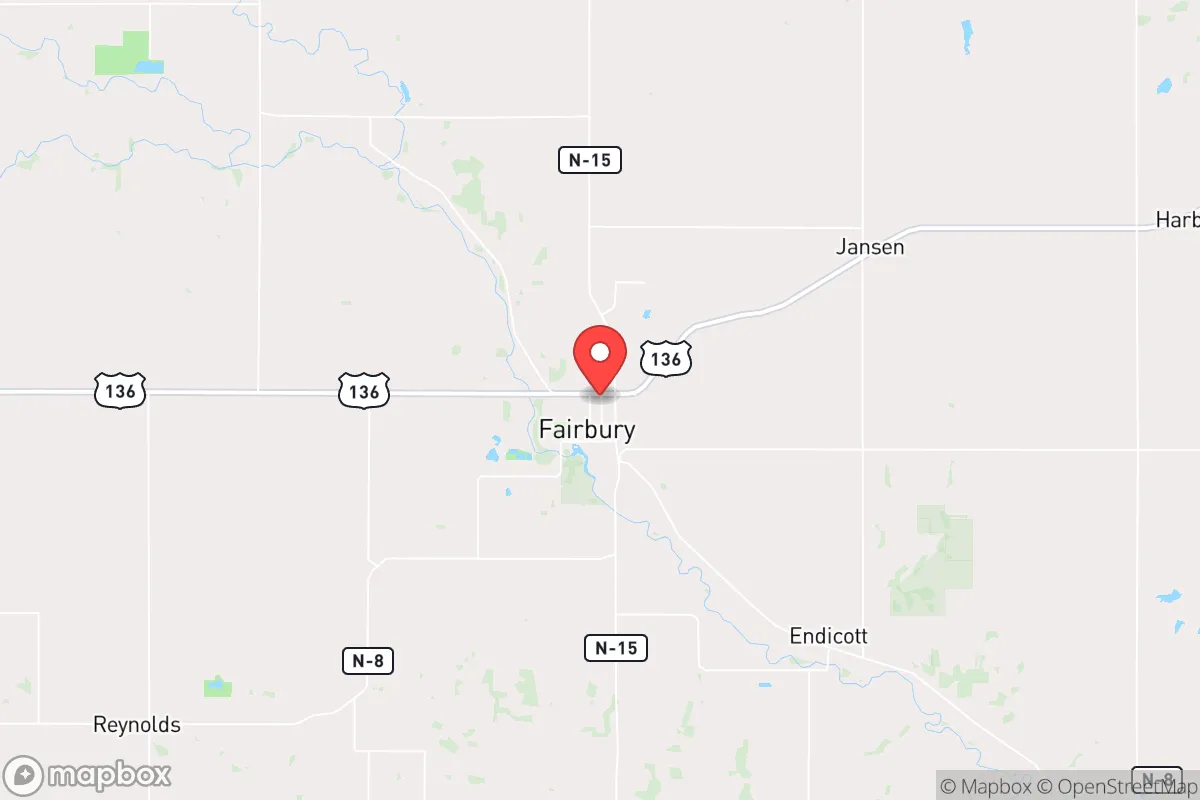
Photo: Wikipedia
Demographics of Fairbury, NE
Affluence Level in Fairbury, NE
A middle-class area roughly in line with national averages across income, home values, education, and employment.
People of Fairbury, NE
Fairbury, Nebraska, is a predominantly white, working-class community of 3,905 residents, shaped by waves of European immigration and agricultural settlement. With 87.2% of the population identifying as white and a Hispanic share of 8.7%, the city retains a strong rural character, though its foreign-born population is minimal at just 1.6%. The city’s identity is rooted in its railroad and farming heritage, with a modest college-educated rate of 17.1% reflecting its blue-collar, family-oriented base.
How the city was settled and grew
Fairbury was founded in 1869 as a railroad town along the St. Joseph and Denver City Railroad, drawing its first settlers from Midwestern states like Illinois, Indiana, and Ohio. These early arrivals—mostly of English, German, and Irish descent—built the original Downtown Fairbury district around the depot, establishing grain elevators, banks, and mercantile stores. By the 1880s, a second wave of German and Czech immigrants arrived, drawn by the Homestead Act and the promise of cheap farmland. They settled in the North Fairbury neighborhood, building St. Paul’s Lutheran Church and the Czech Hall, which still anchors the area. A third wave of Swedish and Danish immigrants followed in the 1890s, clustering in the South Fairbury district near the Rock Island Railroad line, where they established creameries and blacksmith shops. The city’s population peaked at 5,294 in 1900, driven by these European groups, and remained stable through the 1920s as agriculture and the Rock Island Railroad sustained the local economy.
Modern era (post-1965)
After the 1965 Immigration and Nationality Act, Fairbury saw little demographic change, as the city’s agricultural economy and remote location did not attract the new waves of Asian or Indian immigrants that reshaped larger Nebraska cities. The Hispanic population grew slowly from the 1980s onward, primarily through domestic migration from Texas and the Southwest, as Mexican-American families moved in to work at the Fairbury Processing Center (a meatpacking plant) and local farms. These families concentrated in the East Fairbury neighborhood, near the plant and along Highway 136, where a small cluster of Hispanic-owned businesses and a Catholic mission church emerged. The white population, meanwhile, began a gradual decline as younger residents left for college or jobs in Lincoln (60 miles north) and Omaha. The Black population remained negligible at 1.2%, with no significant enclave forming. The Asian and Indian populations are effectively zero, reflecting the city’s lack of professional or tech-sector employment that might attract those groups. The West Fairbury district, originally settled by railroad workers, became a stable, older white neighborhood with larger lots and a quieter, retiree character.
The future
Fairbury’s population is projected to continue a slow decline, from 3,905 today toward 3,500–3,600 by 2040, as outmigration of young adults persists and births among the aging white population fall below replacement. The Hispanic share is likely to grow modestly, reaching 12–14% by 2040, as existing families have children and a trickle of new arrivals from the Southwest fill labor gaps in meatpacking and agriculture. However, the city is not tribalizing into distinct enclaves—Hispanic families are dispersing across East Fairbury and into parts of North Fairbury, while the white population remains dominant citywide. The foreign-born share will likely stay below 3%, as Fairbury lacks the economic magnets (universities, tech hubs, refugee resettlement programs) that drive international migration. The college-educated rate may inch up to 20% if remote work grows, but the city’s character will remain working-class and agricultural.
For someone moving in now, Fairbury is becoming a quieter, older, and slightly more Hispanic version of its 20th-century self—a stable, low-cost community where the population is slowly homogenizing around a white and Hispanic majority, with little ethnic or racial diversity beyond those two groups. The city offers a predictable, family-oriented environment with strong church and school ties, but it is not a place of rapid demographic change or new immigrant integration.

* Values derived from national, state, county, city and local statistics and may differ in a specific area. Last updated: 2026-05-03T20:31:07.000Z
Narrative content on this page is AI-generated and may contain mistakes. Verify any details that matter before acting on them.
ReloMaps may earn a commission from affiliate links at no extra cost to you.

