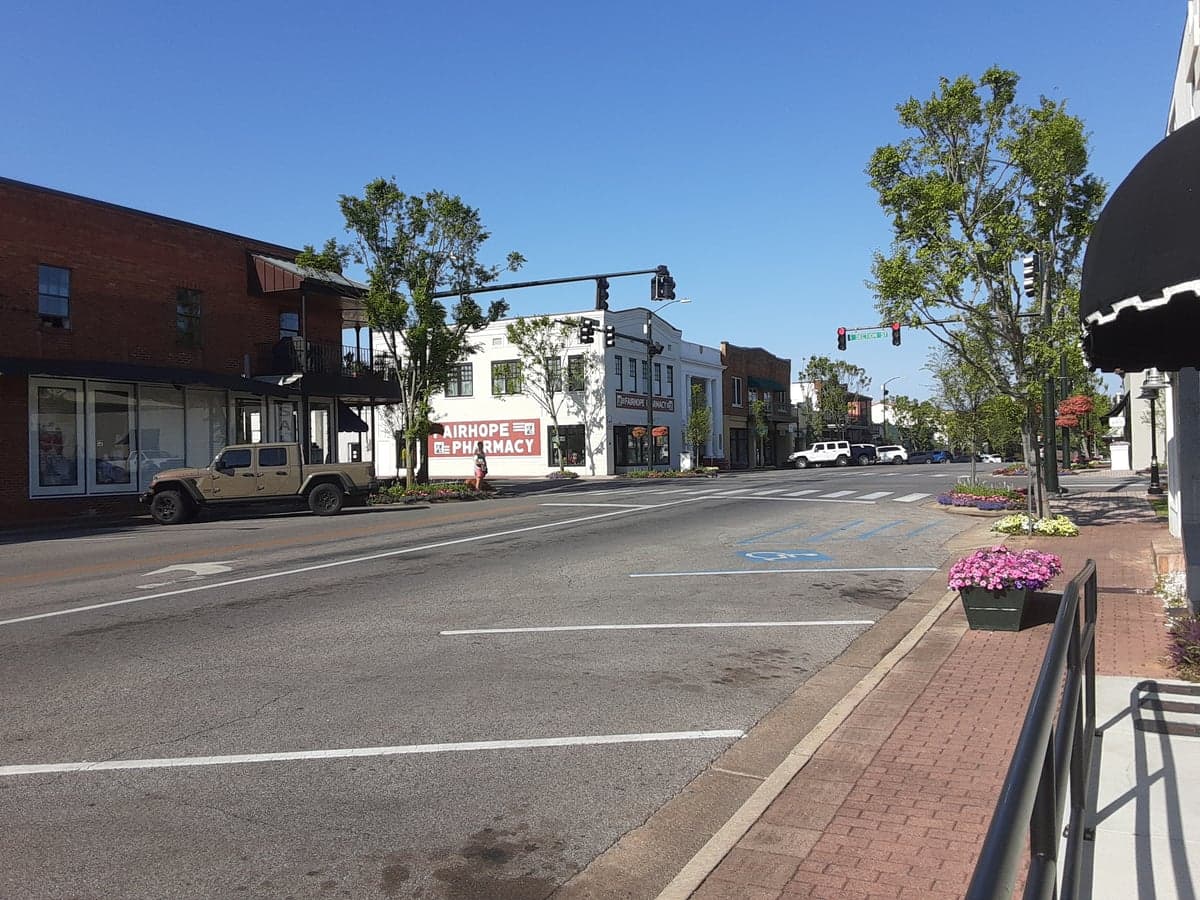
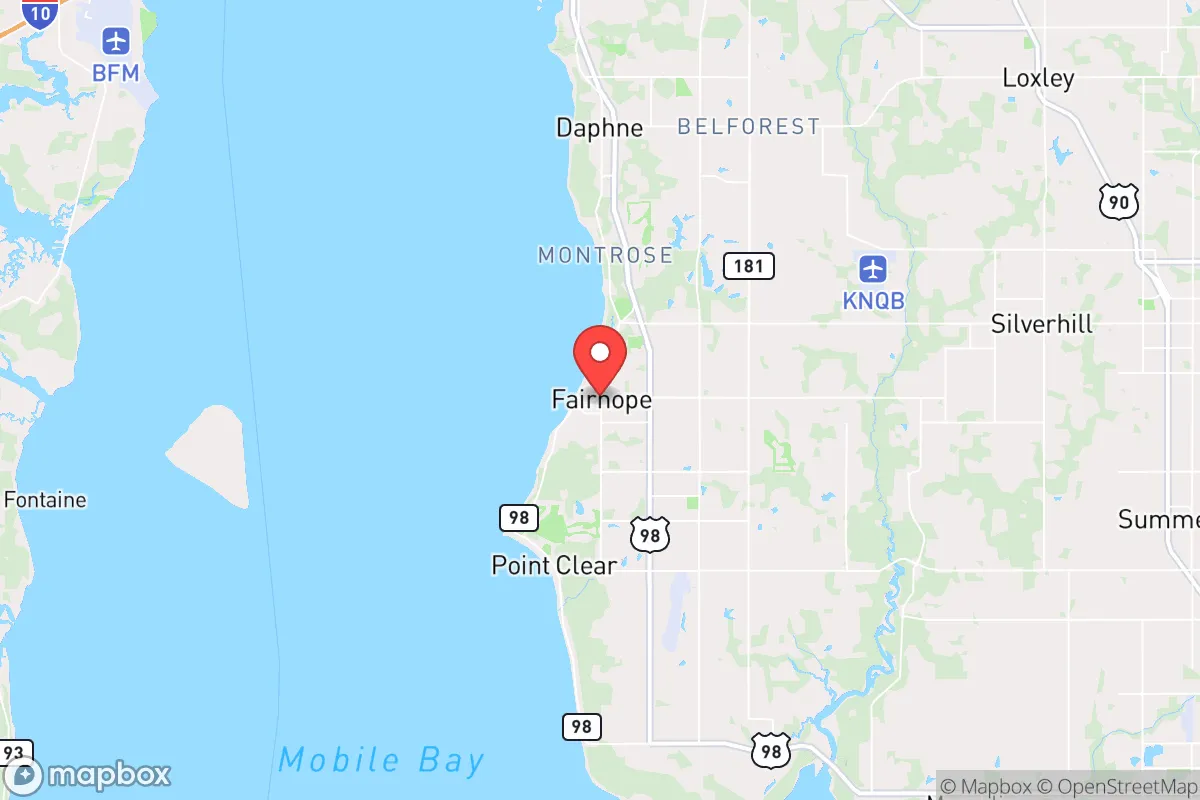
Photo: Wikipedia
Demographics of Fairhope, AL
Affluence Level in Fairhope, AL
A middle-class area roughly in line with national averages across income, home values, education, and employment.
People of Fairhope, AL
The people of Fairhope, Alabama today form a predominantly white, highly educated, and politically conservative community of roughly 23,360 residents, with a distinctive character shaped by its history as a planned utopian colony and later as a magnet for retirees and professionals seeking a slower Gulf Coast lifestyle. The city is notably homogeneous: 87.1% of residents identify as white, while Hispanic residents make up 7.1%, Black residents 3.0%, and East/Southeast Asian and Indian subcontinent communities each account for less than 1%. Over half of adults hold a college degree, a figure that far exceeds state and national averages, reflecting the city's draw for knowledge workers, entrepreneurs, and those who can work remotely.
How the city was settled and grew
Fairhope was founded in 1894 not by settlers following a land grant or industrial boom, but by a group of Midwestern followers of Henry George's single-tax philosophy, who sought to create a cooperative, morally grounded community on the eastern shore of Mobile Bay. These original colonists—largely white, middle-class, and reform-minded—established the town's core in what is now the Historic Downtown Fairhope district, building simple homes and a village green that still anchors the city. The single-tax experiment attracted a steady trickle of like-minded families through the early 1900s, but the population remained small—under 1,000—until after World War II. The post-war boom brought the first major wave of newcomers: returning veterans and their families, drawn by the mild climate and affordable land. They settled in the North Fairhope area, where modest ranch homes and small farms dotted the landscape, and in the Volanta neighborhood, which grew as a working-class enclave along the bayou. By 1960, Fairhope had reached roughly 3,000 residents, still overwhelmingly white and native-born, with a small Black population concentrated in the Baldwin County rural areas just outside city limits.
Modern era (post-1965)
The post-1965 era transformed Fairhope from a quiet village into a thriving small city, driven primarily by domestic in-migration rather than international immigration. The 1965 Hart-Cellar Act had little direct effect here—the foreign-born population remains just 1.8% today, one of the lowest rates among Alabama's growing cities. Instead, the city's growth came from white professionals and retirees relocating from the Midwest, Northeast, and Florida, attracted by the area's reputation for good schools, low crime, and a conservative social climate. The Lake Forest subdivision, developed in the 1970s and 1980s, became a primary landing spot for these newcomers, offering large lots, golf course access, and a country-club lifestyle. Meanwhile, the Fairhope Point neighborhood along Mobile Bay saw a wave of second-home buyers and wealthy retirees building custom waterfront homes. The Hispanic population, which now stands at 7.1%, began growing in the 1990s and 2000s, primarily as workers in construction, landscaping, and the service industry; they are concentrated in the South Fairhope area and along the Highway 98 corridor, where rental housing and mobile home parks are more common. The Black population, at 3.0%, has remained stable and is largely composed of families who have lived in the area for generations, with newer arrivals drawn by professional opportunities in healthcare and education.
The future
Fairhope's population is heading toward continued growth—projections suggest it could reach 30,000 by 2035—but the city is likely to become more homogeneous, not less. The foreign-born share is so low that even modest growth will keep it below 3%, and the Hispanic population, while the fastest-growing minority group, is growing slowly and assimilating into the broader white-majority culture. The East/Southeast Asian and Indian subcontinent communities remain tiny (0.1% and 0.5% respectively) and are concentrated among a few dozen professionals working at the nearby Thomas Hospital or the University of South Alabama's Baldwin County campus. The city is not tribalizing into distinct ethnic enclaves; rather, it is homogenizing around a white, college-educated, conservative identity. New subdivisions like Rock Creek and Belforest are attracting families from across the country who share this demographic profile, while the historic downtown is becoming a hub for affluent retirees and remote workers. The main demographic tension is not racial but generational: younger families are being priced out of the historic core and pushed toward the northern edges of the city and into neighboring Daphne.
For someone moving to Fairhope now, the bottom line is this: you are joining a community that is overwhelmingly white, well-educated, and conservative, with a strong sense of place rooted in its single-tax history and small-town Gulf Coast character. The city is growing steadily but not diversifying rapidly, and the population is likely to remain culturally and politically cohesive for the foreseeable future. If you value a homogeneous, family-oriented environment with excellent schools and a low-stress lifestyle, Fairhope will feel like a natural fit. If you seek racial or ethnic diversity, you will find little of it here.

* Values derived from national, state, county, city and local statistics and may differ in a specific area. Last updated: 2026-04-19T18:49:55.000Z
Narrative content on this page is AI-generated and may contain mistakes. Verify any details that matter before acting on them.
ReloMaps may earn a commission from affiliate links at no extra cost to you.

