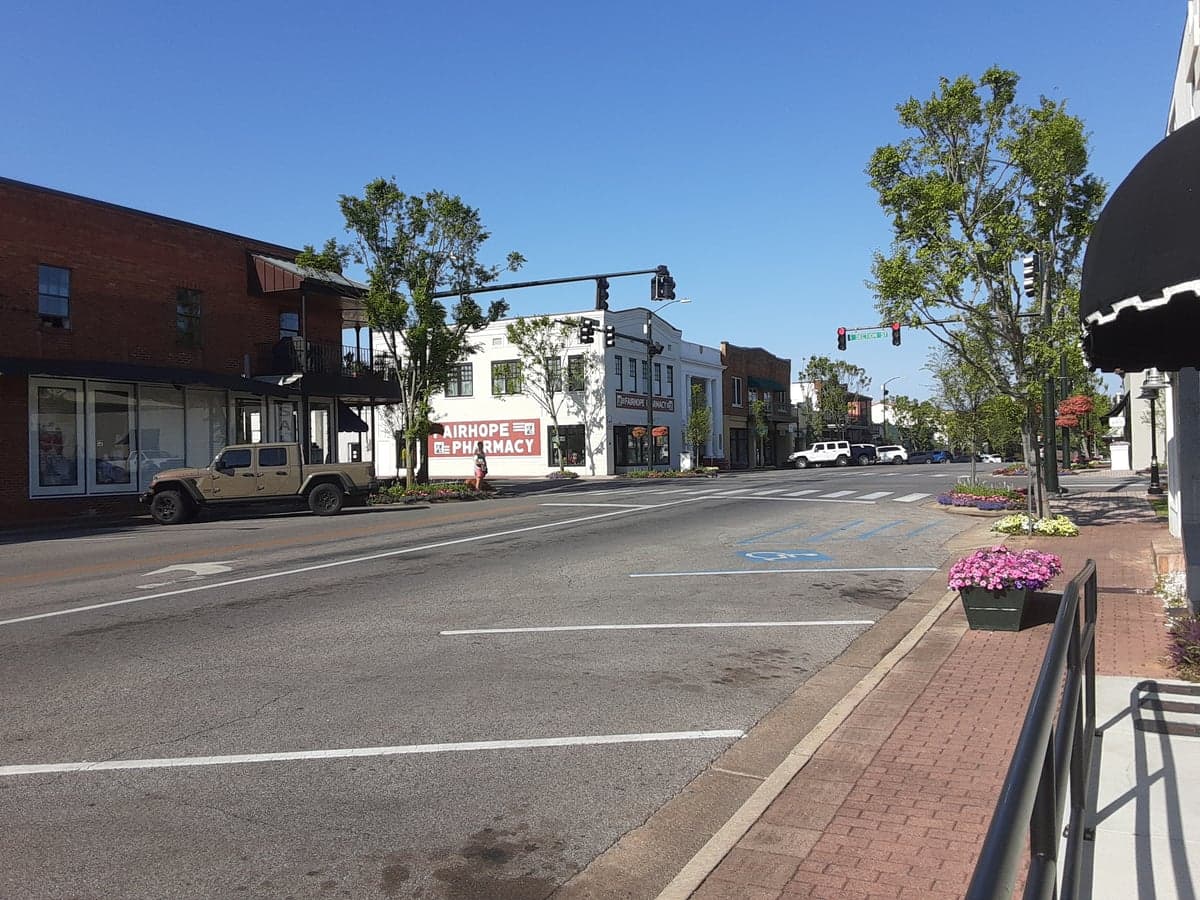
Photo: Wikipedia
Strategic Assessment of Fairhope, AL
Meaningful friction. Expect exposure to either population pressure, blast zones, or natural disaster risk. Consider buying a retreat property.
What does the Strategic Assessment tell us?
Our Strategic Assessment grades tactical survivability of an area. Major population centers, military targets, fallout zones, natural disasters, and border exposure all drive risk — lower exposure means a more defensible position in a crisis.
This is heavily inspired by Joel Skousen's Strategic Relocation book. Highly recommended you checkout the book ($)What does this tell us?
Our Strategic Assessment grades tactical survivability of an area. Major population centers, military targets, fallout zones, natural disasters, and border exposure all drive risk — lower exposure means a more defensible position in a crisis.
This is heavily inspired by Joel Skousen's Strategic Relocation book. Highly recommended you checkout the book ($)Strategic Pillars

Key Distances
Regional Safe Places
Below is our recommended "safe zones" in Alabama and the surrounding area based on our strategic heuristics. For most people, it's unrealistic to live in a “safe zone” full-time due to work, family or other personal reasons. They tend to be more rural. However, many of these areas are perfect for second homes and retreat properties that double as a vacation home or even a short-term rental.
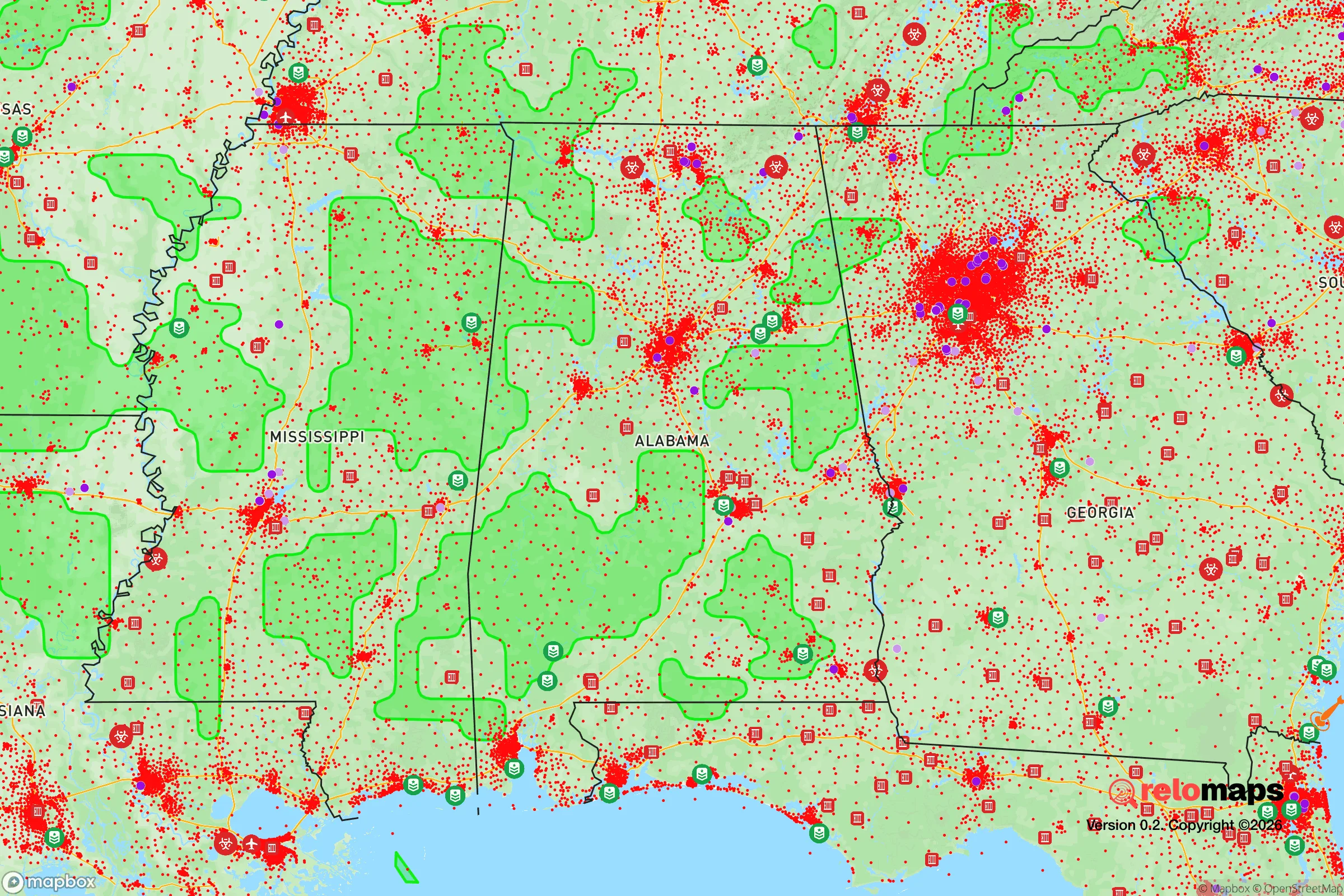
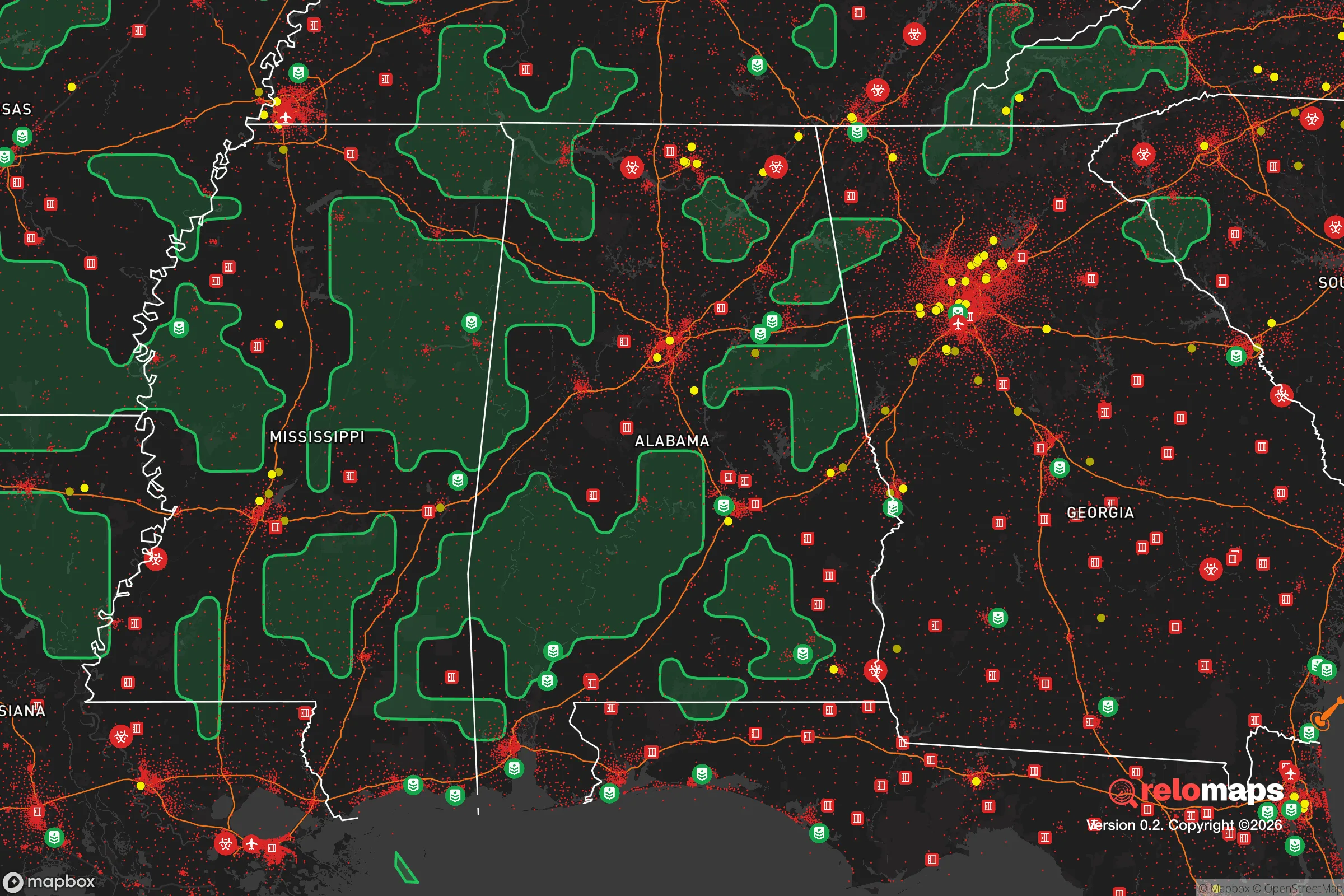


Important Note: For informational purposes only. This does not mean nothing bad ever happens in the green zones. Please use common sense. This is based on public data and modeled with AI. We tried to take a conservative approach but mistakes happen. We update this regularly as new information becomes available.
Solar Generator Recommendations
Backup power matters more here than in safer locations. We've picked three solar generators across budgets and capacity tiers — start with the budget unit if you only need a few essentials, or step up if you want to run a fridge and HVAC for days at a time.

Jackery Portable Power Station Explorer 300
Budget OptionPower on the Go: Weighing only 11 lbs, it's convenient to set up and store with book-sized foldable solar panels

BLUETTI Portable Power Station AC180
Designed for both indoor and outdoor scenarios, AC180 is highly capable as it has a robost capacity and continuous output power.

EF ECOFLOW DELTA Pro Ultra Power Station
Upgraded PickEcoFlow DELTA Pro Ultra is a whole-home energy system designed to grow with your family. Integrated with the Smart Home Panel 2, it scales to meet your evolving energy needs — keeping your home powered, intelligent, and secure through every stage of life.
We earn a commission, at no additional cost to you.
Strategic Assessment Analysis
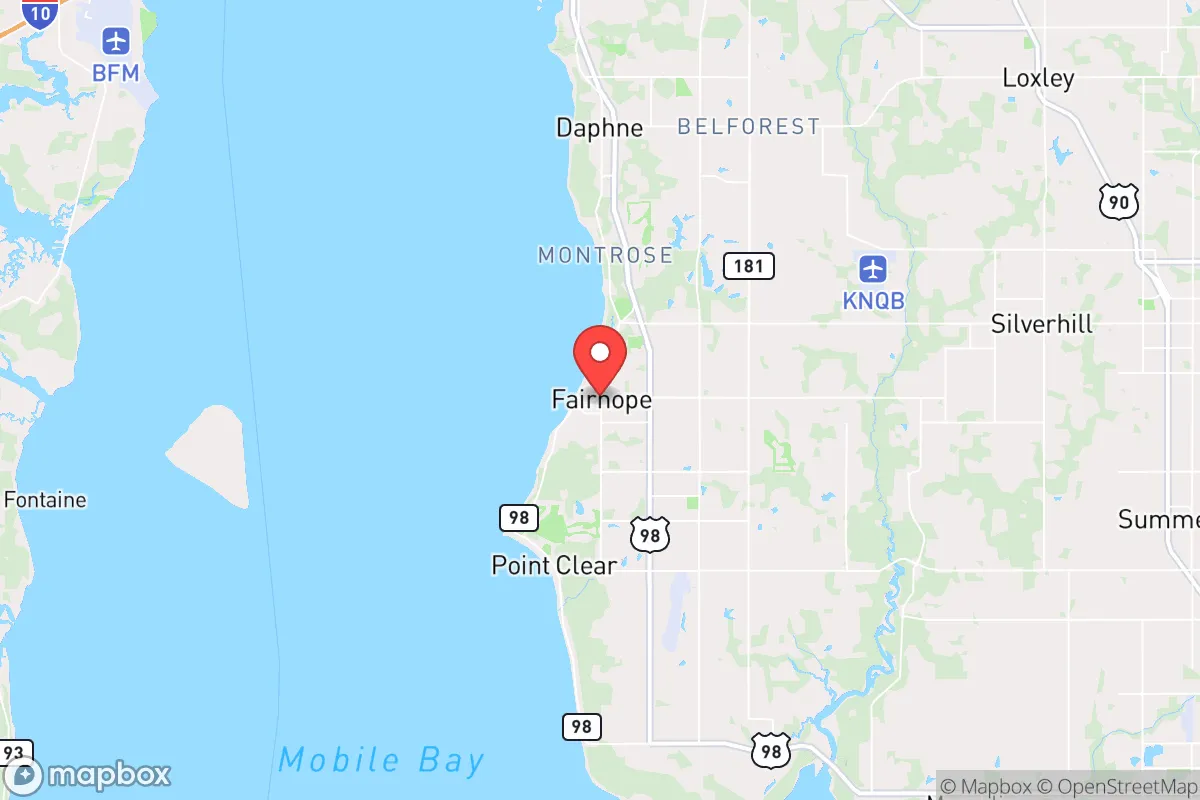
Fairhope, Alabama, offers a compelling strategic position for those prioritizing resilience, but its advantages come with significant caveats that require careful consideration. Located on the eastern shore of Mobile Bay, this town of roughly 25,000 sits about 20 miles southeast of downtown Mobile and 45 miles west of Pensacola, Florida. Its location provides a buffer from the most immediate fallout of major urban collapse while still offering access to critical infrastructure and supply chains. For a relocator with a prepper mindset, Fairhope’s real value lies in its blend of coastal access, a relatively stable local economy, and a community that leans heavily conservative—but its proximity to a major port city and petrochemical corridor introduces risks that cannot be ignored.
Geographic position and natural advantages for long-term survival
Fairhope’s geography is a double-edged sword. On the plus side, the town sits on a bluff overlooking Mobile Bay, providing natural elevation that reduces flood risk compared to low-lying areas like Daphne or Spanish Fort. The surrounding Baldwin County is one of the fastest-growing in Alabama, but it remains largely rural outside the coastal strip, with dense pine forests, farmland, and wetlands offering both resources and concealment. The Eastern Shore is also a natural choke point: the only major road access to the Gulf beaches and the Florida Panhandle runs through this corridor, meaning Fairhope could serve as a strategic waypoint or a bottleneck in a crisis. The area’s temperate climate allows for year-round gardening and foraging, with a growing season that stretches from March to November. Freshwater sources include the Fish River and numerous creeks, though groundwater quality varies—wells are common in rural Baldwin County, but the coastal aquifer is susceptible to saltwater intrusion. For a relocator, the ability to tap into local food networks (farmers’ markets, community gardens, and hunting leases) is a real asset, but the region’s dependence on tourism and seasonal residents means that supply chains could strain during a prolonged event.
Risks, exposures, and proximity to fallout-relevant landmarks
The most glaring vulnerability is Fairhope’s proximity to Mobile, a major port city and industrial hub. Mobile is home to the Alabama State Port Authority, a massive chemical and petroleum processing complex, and a major U.S. Coast Guard station. In a scenario involving civil unrest, mass casualty events, or a coordinated attack, Mobile would be a high-value target. The chemical plants along the Mobile River and the tank farms near the port are obvious risks for industrial accidents or sabotage. Fairhope is also within the blast radius of the Mobile Bay Causeway and the I-10 tunnel, both critical infrastructure that could be targeted or become impassable. Additionally, the area is in Hurricane Alley—the 2020s saw Hurricane Sally (2020) and Hurricane Zeta (2020) cause widespread power outages and flooding. While Fairhope fared better than Gulf Shores, the storm surge from a Category 4 or 5 hurricane could inundate low-lying parts of the town and cut off road access for days. The nearby Weeks Bay National Estuarine Research Reserve is a natural buffer, but it also means that storm surge can funnel up the bay. For a prepper, the biggest concern is that Fairhope is not remote—it’s a bedroom community for Mobile, and in a crisis, the population could swell with evacuees from the city, straining resources and creating security risks.
Practical resilience for a relocator: food, water, energy, and defensibility
On the practical side, Fairhope offers a mixed bag. The local food scene is strong—the Fairhope Farmers Market operates year-round, and the surrounding Baldwin County is a major agricultural producer (soybeans, corn, pecans, and livestock). For a relocator willing to invest in land, the rural areas east of Fairhope (toward Robertsdale and Loxley) offer affordable acreage with good soil and access to the Conecuh National Forest for hunting and timber. Water is a concern: municipal water comes from the Mobile River and the Big Creek Lake reservoir, both of which are vulnerable to contamination from industrial spills or upstream disruption. A well with a hand pump is a wise investment, but the coastal aquifer is shallow and brackish in places—test before buying. Energy infrastructure is decent, with Baldwin EMC providing reliable power, but the grid is vulnerable to hurricane damage and cyberattacks. Solar panels with battery storage are a practical hedge, and the area gets plenty of sun (over 220 sunny days per year). Defensibility is moderate: Fairhope is a compact town with a few major roads (U.S. 98, AL-181, and AL-104), making it easy to monitor ingress and egress. The Baldwin County Sheriff’s Office is well-funded and has a strong presence, but in a prolonged crisis, law enforcement could be overwhelmed. The local population is heavily armed—Alabama has some of the most permissive gun laws in the country, and the culture is pro-Second Amendment. For a relocator, this means a higher baseline of community self-defense capability, but also a potential for conflict if resources become scarce. The best strategy is to buy land outside the town limits, ideally with a defensible perimeter (creeks, dense woods, or a hill), and establish a self-sufficient homestead with a well, solar, and a garden before any crisis hits.
The overall strategic picture for Fairhope is one of calculated risk. It is not a bug-out location in the wilderness sense—it’s too close to Mobile and too dependent on tourism and external supply chains to be truly resilient in a total collapse scenario. However, for a relocator who wants a comfortable, conservative community with good schools, a strong local economy, and a reasonable buffer from urban chaos, Fairhope is a solid choice. The key is to treat it as a base of operations, not a fortress. Build relationships with local farmers, join a church or a civic group, and invest in off-grid capabilities before you need them. The area’s natural beauty and mild climate make it a pleasant place to live, but don’t let that lull you into complacency. The same bay that provides stunning sunsets also channels storm surges and industrial traffic. If you’re looking for a place to ride out the coming storms—both literal and figurative—Fairhope can work, but only if you go in with eyes wide open and a plan for the worst-case scenario. The smartest move is to buy land in the rural eastern part of the county, keep a low profile, and maintain a network of trusted neighbors. In a world where the unthinkable is becoming thinkable, that’s about as good as it gets on the Gulf Coast.

* Values derived from national, state, county, city and local statistics and may differ in a specific area. Last updated: 2026-04-19T18:49:55.000Z
Narrative content on this page is AI-generated and may contain mistakes. Verify any details that matter before acting on them.
ReloMaps may earn a commission from affiliate links at no extra cost to you.

