
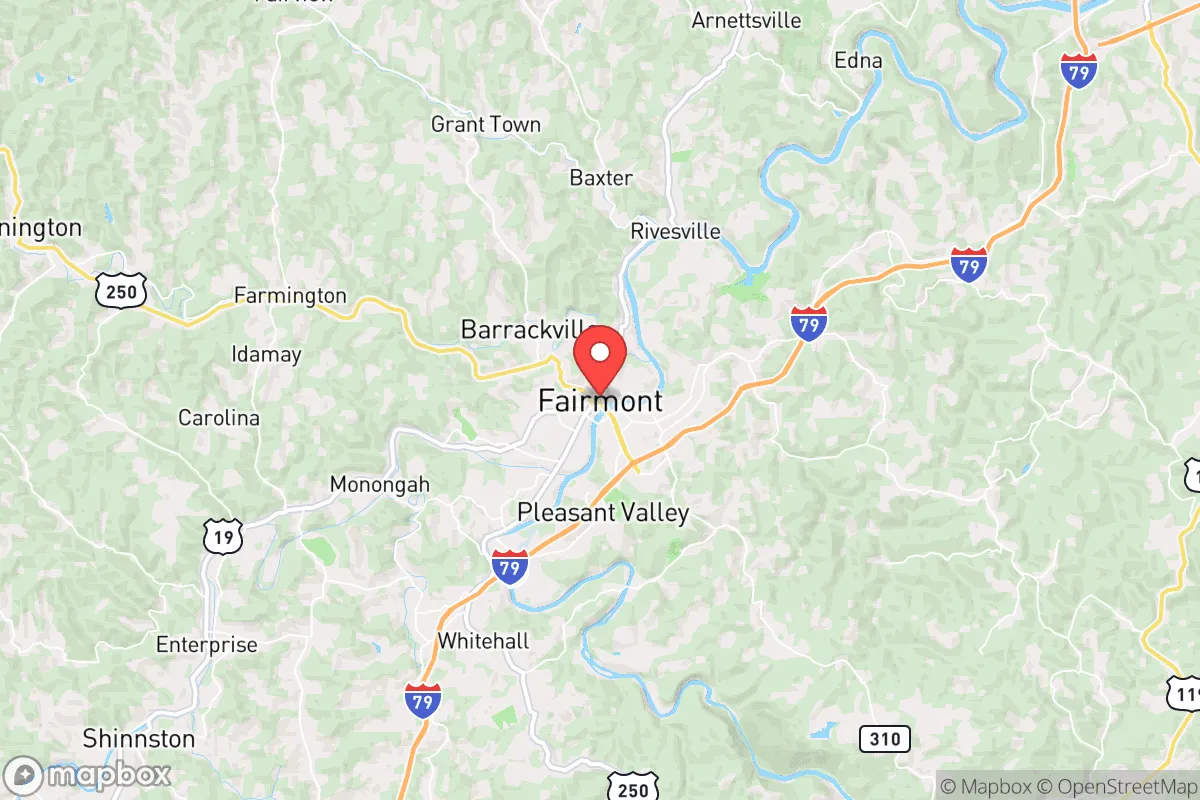
Photo: Wikipedia
Personal Sovereignty in Fairmont, WV
Viable for self-reliance. Generally workable, though some barriers may limit total independence.
What does Personal Sovereignty tell us?
Personal Sovereignty measures your capacity for self-reliance and independence with minimal government friction. Higher scores mean fewer barriers between you and the way you want to live... but it assumes you have the space you need and good neighbors.
What does this tell us?
Personal Sovereignty measures your capacity for self-reliance and independence with minimal government friction. Higher scores mean fewer barriers between you and the way you want to live... but it assumes you have the space you need and good neighbors.
State Policy
Energy independence: Net exporter (200% of energy produced in-state)
Personal Liberty
Homesteading

Personal Liberty Analysis
Fairmont, West Virginia, offers a notably high degree of personal sovereignty compared to much of the eastern United States, largely due to the state’s deeply ingrained culture of self-reliance and a legal framework that actively resists federal overreach. For a conservative-leaning individual or family prioritizing autonomy—whether from a prepper, survivalist, or simply liberty-minded perspective—this small city in north-central West Virginia presents a strategic environment where government intrusion into daily life is comparatively low. The state’s motto, *Montani Semper Liberi* (Mountaineers Are Always Free), isn’t just a slogan; it’s reflected in property rights, gun laws, and a regulatory climate that leaves residents largely to their own devices. However, the trade-off is a limited local economy and aging infrastructure, meaning personal sovereignty here demands genuine self-sufficiency, not just legal permission to be left alone.
Tax burden and regulatory posture: How Fairmont compares to high-tax states
West Virginia’s tax structure is a significant draw for those fleeing the fiscal overreach of states like New York, California, or Illinois. The state has no gross receipts tax and a relatively low corporate net income tax, but the key for individuals is the personal income tax, which is a flat 3.99% as of 2026—a single rate that eliminates the progressive brackets that punish higher earners. Property taxes are among the lowest in the nation, with effective rates on owner-occupied homes typically around 0.5% to 0.6% of market value, meaning a $200,000 home in Fairmont might carry an annual tax bill of roughly $1,000 to $1,200. Sales tax is 6% (with no local add-ons in Marion County), and groceries are exempt. The regulatory posture in Fairmont is equally favorable: there are no county-level zoning codes in many unincorporated areas surrounding the city, and even within city limits, the permitting process for home improvements, sheds, or small-scale agriculture is minimal compared to urban jurisdictions. For a prepper mindset, this means fewer bureaucratic hurdles when building a root cellar, installing a backup generator, or adding a workshop—activities that in other states would trigger inspections, fees, and delays.
Self-defense and gun law specifics: Stand your ground and permitless carry
West Virginia is a constitutional carry state, meaning that as of 2026, no permit is required to carry a concealed firearm for any law-abiding adult 21 or older (18 for open carry). This is a foundational liberty for those who view self-defense as a non-negotiable personal right. The state also has a strong Stand Your Ground law, codified in West Virginia Code §55-7-22, which removes any duty to retreat before using deadly force if you are lawfully present and reasonably believe it is necessary to prevent imminent death or great bodily harm. Fairmont itself is a relatively low-crime area—violent crime rates are roughly half the national average—but the legal environment ensures that residents are not dependent on police response times for their safety. There are no state-level magazine capacity bans, no "assault weapon" registry, and no red flag laws as of this writing. For a survivalist, this means you can stockpile ammunition, maintain a defensive rifle, and train without fear of sudden legislative confiscation. The local sheriff’s office in Marion County is generally pro-Second Amendment, and the state preempts local gun ordinances, so Fairmont city council cannot impose its own restrictions—a critical protection against the kind of municipal overreach seen in places like Seattle or Denver.
Self-reliance and homesteading viability: Lot sizes, zoning, and off-grid feasibility
Fairmont’s geography and land-use policies make it a strong candidate for those seeking to reduce dependence on centralized systems. Within the city limits, standard residential lots range from 0.1 to 0.5 acres, but the real opportunity lies in the surrounding Marion County countryside, where undeveloped parcels of 1 to 10 acres are common and affordable, often priced between $3,000 and $10,000 per acre. Zoning in unincorporated areas is virtually nonexistent, meaning you can keep chickens, goats, or even a small number of livestock without needing a special permit. Off-grid feasibility is high: the region receives about 45 inches of rain annually, making rainwater catchment viable, and well water is accessible on most rural parcels (drilling a well typically costs $3,000–$6,000). Solar panels are permitted without restrictive homeowner association (HOA) interference in most areas, though net metering laws are favorable—West Virginia requires utilities to credit excess generation at the retail rate. The biggest practical limitation is the harsh winter: heating with wood is common, and many preppers install wood stoves as a backup. Fairmont’s older housing stock (much of it built before 1950) often includes basements that can be converted into storm shelters or food storage rooms, a tangible asset for those planning for grid-down scenarios.
Personal liberties: Parental rights, medical autonomy, speech, and property
West Virginia has a mixed record on medical autonomy, but the trend is positive for conservatives. The state passed the Medical Freedom Act in 2023, which prohibits employers and government entities from mandating COVID-19 or other vaccines as a condition of employment or service—a concrete protection for those wary of public health overreach. Parental rights are strong: West Virginia law explicitly recognizes parents’ authority to direct the upbringing, education, and healthcare of their minor children, and the state has a robust homeschool statute that requires only a simple notice and a basic educational plan, with no standardized testing mandates or teacher certification requirements. This makes Fairmont a viable base for families who want to opt out of public school curricula they find objectionable. Free speech is protected by the state constitution, and there are no local hate speech ordinances or social media censorship mandates that would chill political expression. Property rights are reinforced by the state’s right-to-farm law, which shields agricultural operations from nuisance lawsuits, and by a relatively weak eminent domain framework—the state cannot seize land for private economic development, only for genuine public use. For a survivalist, this means your land is your castle, and the government has limited tools to take it or restrict how you use it.
In the broader context of personal sovereignty across the United States, Fairmont, WV, ranks as a strong contender for those prioritizing liberty over convenience. It lacks the extreme libertarian legal frameworks of places like New Hampshire or Alaska, but it offers a more affordable land base and a lower cost of entry. The trade-offs are real: the local economy is stagnant, with a median household income around $45,000, and the opioid crisis has left scars in the community. But for a strategic relocation aimed at maximizing personal autonomy—where you can carry a firearm without a permit, build a homestead without a zoning board, and raise your children without government interference in their education or healthcare—Fairmont represents a pragmatic balance of legal freedom and practical affordability. The state’s motto isn’t just a decoration on the license plate; it’s a living legal culture that, for now, still respects the individual’s right to be left alone.

* Values derived from national, state, county, city and local statistics and may differ in a specific area. Last updated: 2026-04-23T06:06:23.000Z
Narrative content on this page is AI-generated and may contain mistakes. Verify any details that matter before acting on them.
ReloMaps may earn a commission from affiliate links at no extra cost to you.

