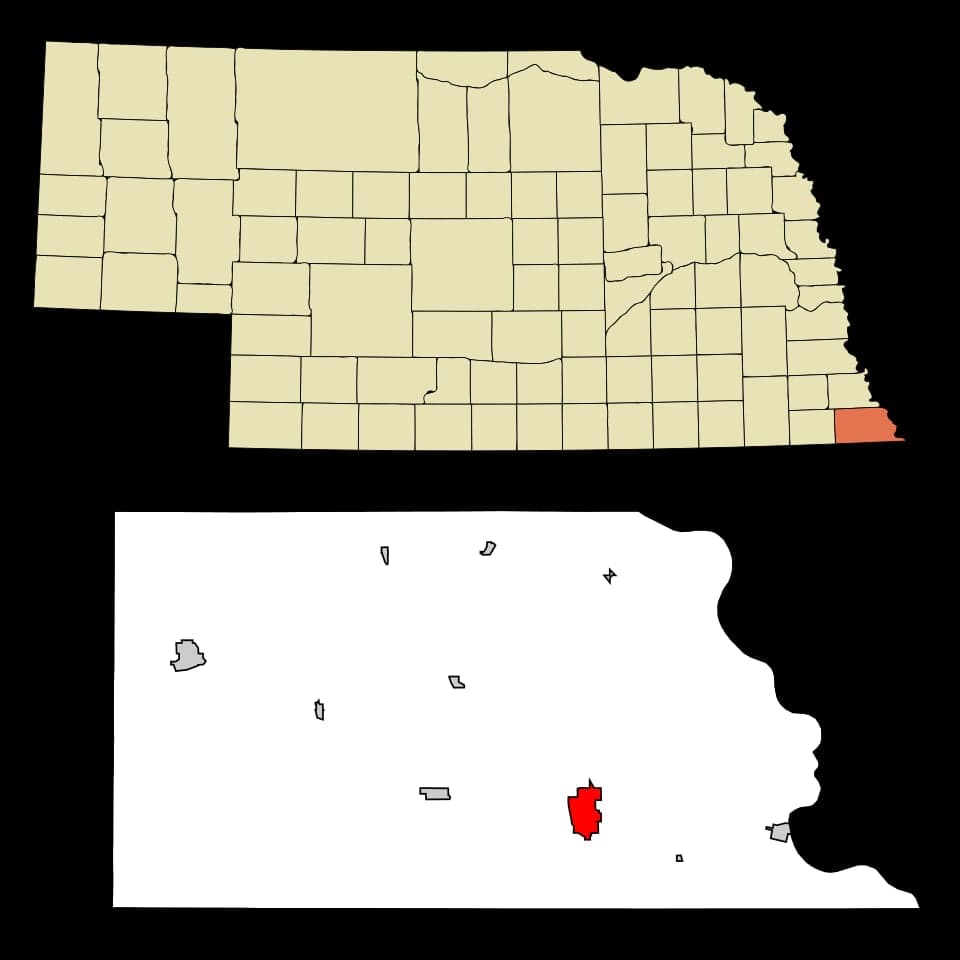
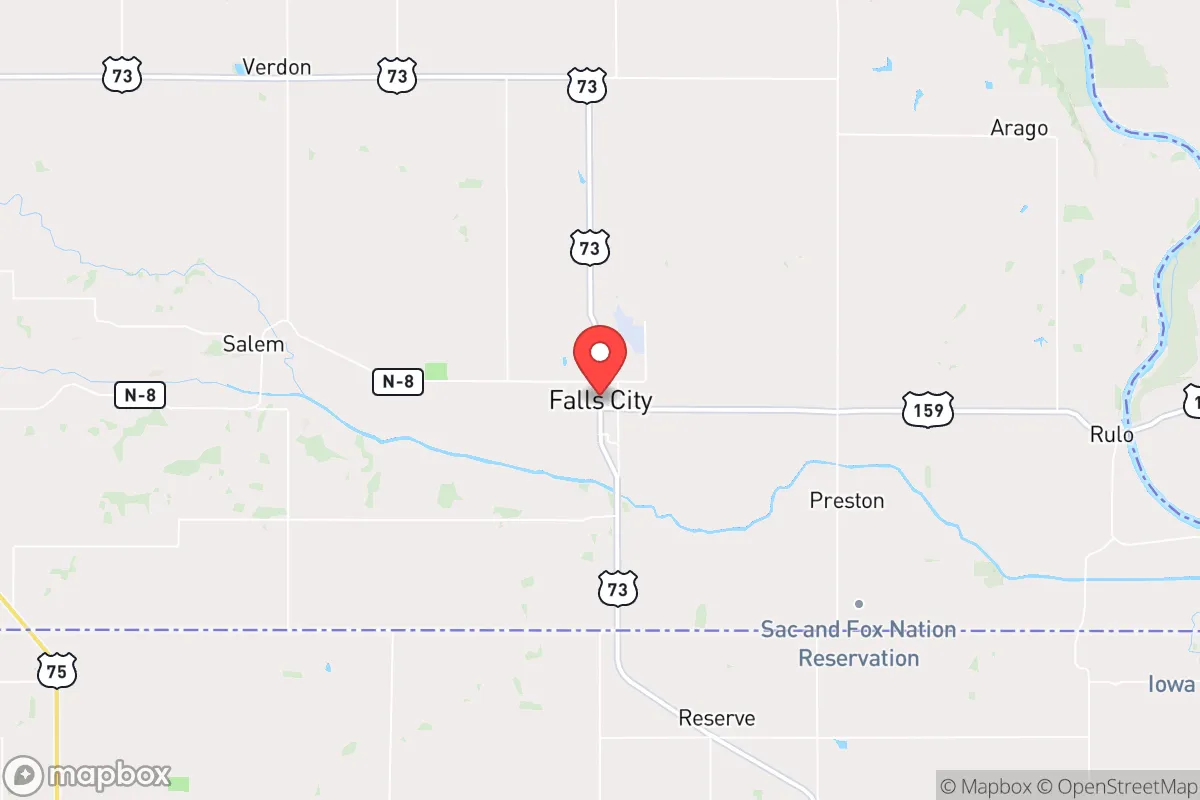
Photo: Wikipedia
Demographics of Falls City, NE
Affluence Level in Falls City, NE
A middle-class area roughly in line with national averages across income, home values, education, and employment.
People of Falls City, NE
The people of Falls City, Nebraska, today number 4,099, forming a predominantly white, native-born community with a distinctly small-town Midwestern character. The population is 91.1% white, with a foreign-born share of just 0.9%, and a college attainment rate of 24.4%—below the national average but typical for a rural county seat. This is a place where generational roots run deep, and the city’s identity is shaped by its agricultural and railroad heritage, not by rapid demographic change.
How the city was settled and grew
Falls City was founded in 1857 along the Missouri River bluffs, drawing its first wave of settlers from the Ohio River Valley and the Upper South. These early arrivals—primarily of English, German, and Scotch-Irish stock—were attracted by the promise of fertile bottomland and the establishment of the town as the Richardson County seat. The arrival of the Burlington and Missouri River Railroad in the 1870s triggered a second wave, bringing German Catholic immigrants who farmed the surrounding countryside and built the St. Mary’s Parish district, centered around the church and school at 15th and Harlan Streets. A third wave of Danish and Swedish families arrived in the 1880s and 1890s, settling in the North Side neighborhood near the railroad depot, where they worked as craftsmen, merchants, and railroad laborers. The original town plat, laid out in a grid around the courthouse square, became the Downtown Historic District, where the earliest English-speaking settlers built brick storefronts and frame houses that still stand today. By 1900, Falls City was a stable, ethnically homogeneous community of roughly 2,500, with German and Scandinavian enclaves concentrated in distinct but integrated blocks.
Modern era (post-1965)
The post-1965 period brought little demographic disruption to Falls City. The Immigration and Nationality Act of 1965, which reshaped many American cities, had virtually no effect here: the foreign-born population remains below 1%, and there is no significant Asian, Indian, or Hispanic community. The city’s population peaked at roughly 4,600 in the 1960 census and has since declined gradually, reflecting the broader rural depopulation of the Great Plains. Domestic in-migration has been minimal, consisting mostly of retirees returning to family land and a small number of workers drawn to the Industrial Park along Highway 73, where employers like the Falls City Sac Osage Electric Cooperative and the local meatpacking plant offer stable but modest-wage jobs. The West Side addition, platted in the 1970s, absorbed most new single-family home construction, attracting younger families from within Richardson County rather than newcomers from outside. The South End, historically a working-class area of smaller homes near the old stockyards, has seen gradual depopulation as younger residents leave for Lincoln or Omaha. No new ethnic enclaves have formed; the city’s racial composition has remained virtually unchanged since 1970.
The future
The demographic trajectory for Falls City points toward continued slow decline and homogenization. The population has fallen from 4,600 in 1960 to 4,099 today, a drop of roughly 11%, driven by out-migration of young adults and a birth rate that no longer offsets deaths. The Hispanic share, at 1.6%, is barely above zero and shows no sign of rapid growth; there is no immigrant gateway or refugee resettlement program in the area. The Prairie View Estates subdivision, built in the 2000s on the city’s eastern edge, has attracted a handful of commuters who work in nearby Auburn or Hiawatha, Kansas, but it has not reversed the overall trend. Over the next 10–20 years, Falls City will likely become older and whiter, with the remaining population concentrated in the Downtown Historic District and the West Side, while the South End and North Side continue to see housing vacancies. The city is not tribalizing into distinct enclaves—it is simply shrinking as a culturally cohesive, ethnically uniform community.
For someone moving in now, Falls City offers a stable, low-crime environment where neighbors share a common cultural background and local institutions—the county fair, the volunteer fire department, the school system—remain the social anchors. The trade-off is limited economic opportunity and a population that is not growing or diversifying. This is a place for those seeking continuity, not change.

* Values derived from national, state, county, city and local statistics and may differ in a specific area. Last updated: 2026-04-19T07:06:23.000Z
Narrative content on this page is AI-generated and may contain mistakes. Verify any details that matter before acting on them.
ReloMaps may earn a commission from affiliate links at no extra cost to you.

