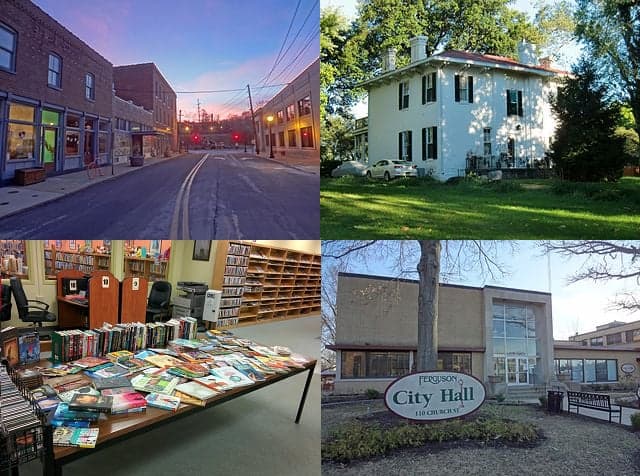
Photo: Wikipedia
Political ClimatePolitical Climate in Ferguson, MO
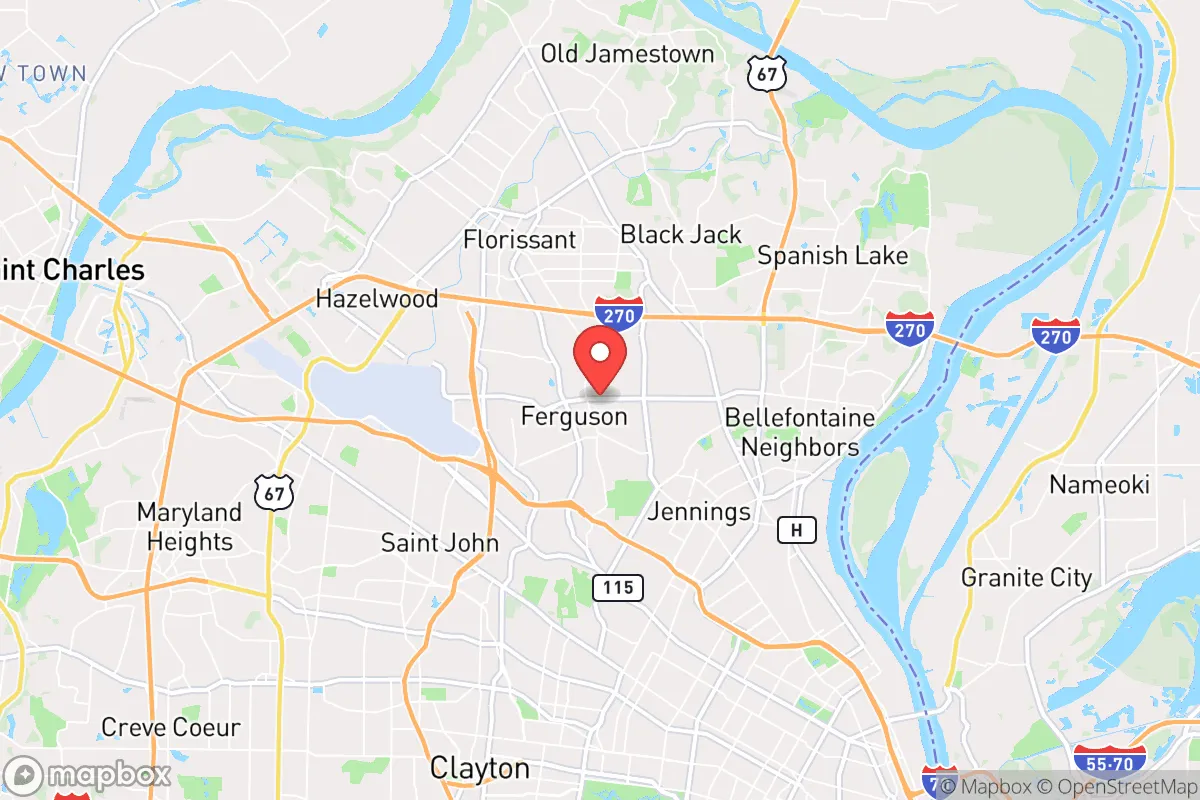
District shown is the primary district for this city’s centroid. Cities may span multiple districts.
Local Political AnalysisPolitical Analysis of Ferguson, MO
Ferguson, Missouri, has a political climate that leans heavily Democratic, with a Cook PVI of D+29, meaning it votes about 29 points more Democratic than the national average. This isn't a recent shift; it's been trending this way for decades, but the trajectory has accelerated since 2014. If you're looking for a place where your vote might feel like it actually counts against the machine, this isn't it—the local elections are often decided in the Democratic primary, and the general election is a formality. The real story is how this one-party control has shaped everything from policing to property taxes, and not always in a way that benefits the average working person.
How it compares
Drive ten miles west to St. Charles County, and you're in a completely different world politically. Places like St. Peters and O'Fallon lean reliably Republican, with lower taxes and a more hands-off approach to local business regulations. Ferguson, by contrast, sits in north St. Louis County, which is a Democratic stronghold. The contrast is stark: in St. Charles, you might see a city council that hesitates to raise fees or impose new mandates; in Ferguson, the local government has a history of aggressive code enforcement and traffic fines that feel less about safety and more about revenue. The surrounding suburbs like Florissant and Jennings share Ferguson's political lean, creating a bloc where progressive policies on housing and policing are the norm, with little pushback from the other side.
What this means for residents
For someone who values personal freedom and limited government, this political climate can be frustrating. The city council and school board are often dominated by voices that see government as a tool for social engineering rather than basic services. You'll see things like new ordinances on short-term rentals, stricter noise regulations, and a general willingness to spend taxpayer money on social programs that sound good on paper but rarely deliver results. Property taxes are a real concern here—they're higher than in neighboring St. Charles County, and there's little appetite for cutting them. The police department, after the DOJ consent decree, operates under heavy oversight that can make officers hesitant to act, which some residents feel has led to a rise in petty crime and a general sense that the law isn't being enforced equally for everyone.
Culturally, Ferguson has become a symbol of a certain kind of progressive activism, and that's reflected in local policy. The city has embraced "equity" initiatives in hiring and contracting, and there's a strong push for "affordable housing" mandates that can actually drive up costs for everyone else by limiting market-rate development. If you're a small business owner, you'll find more red tape here than in the surrounding conservative areas—permits take longer, fees are higher, and there's a general attitude that business exists to serve the city's social goals, not the other way around. For a long-time resident like me, the biggest change is the loss of that "leave me alone" vibe. The government is in your business more than it used to be, and that's not likely to change anytime soon. If you're considering a move here, just know that your vote for fiscal restraint or individual liberty is going to be a lonely one.

State Political ClimatePolitical Climate in Missouri
State Political AnalysisPolitical Environment in the State
Missouri has long been a bellwether state, but over the past 20 years, it has shifted from a classic purple swing state to a solidly red one, with a Republican trifecta controlling the governor’s mansion and both legislative chambers. The state voted for Donald Trump by 18 points in 2020 and by a similar margin in 2024, a stark contrast to the razor-thin margins of the 2000s. This rightward drift is driven by a powerful coalition of rural conservatives, suburban families fleeing St. Louis and Kansas City, and a growing population of conservative-leaning transplants from Illinois and California, particularly in the fast-growing southwestern corner of the state.
Urban vs. rural divide
The political map of Missouri is a textbook study in geographic polarization. The two major metros—St. Louis and Kansas City—are deep blue islands in a sea of red. St. Louis City and County, along with Jackson County (Kansas City), reliably deliver 60-70% of their votes to Democrats, driven by union households, university faculty, and a growing minority population. But the real story is the exurban and rural shift. St. Charles County, just west of St. Louis, has flipped from a swing county to a solidly Republican stronghold (+20 points for Trump in 2024), as families flee the city’s crime and tax burdens. Greene County (Springfield) is the conservative anchor of the Ozarks, while Boone County (Columbia) remains a liberal outlier thanks to the University of Missouri. The most dramatic shift is in the Lake of the Ozarks region (Camden and Miller counties), where retirees and remote workers have turned a once-moderate area into a deep-red bastion. The Bootheel (Dunklin, Pemiscot counties) remains culturally conservative but economically struggling, often voting Democratic in local races but Republican in presidential ones.
Policy environment
Missouri’s policy environment is aggressively pro-business and pro-freedom, with a few notable exceptions. The state has a flat income tax of 4.95% (down from 6% in 2018) and a sales tax cap that keeps local rates manageable. There is no state property tax on vehicles, and property taxes on homes are among the lowest in the Midwest. The regulatory climate is light: Missouri is a right-to-work state (though the law was repealed by referendum in 2018, the practical effect was minimal), and occupational licensing requirements are being steadily rolled back. On education, the state has a robust charter school system in St. Louis and Kansas City, and the Missouri Empowerment Scholarship Accounts program (passed in 2021) provides tax-credit scholarships for low-income families to attend private schools. Healthcare policy is mixed: Missouri expanded Medicaid in 2021 via ballot initiative (against legislative wishes), but the state also passed a law in 2023 banning gender-affirming care for minors and restricting abortion to the first eight weeks (with no exceptions for rape or incest). Election laws have tightened: voter ID is required, absentee ballot drop boxes are limited to one per county, and the state purged over 100,000 inactive voters in 2023. For a conservative, the overall direction is positive—lower taxes, school choice, and parental rights—but the Medicaid expansion and the 2018 right-to-work repeal show that voters can still push back against the legislature.
Trajectory & freedom
Missouri is clearly trending more free on most fronts, but with some worrying countercurrents. The biggest win for personal liberty was the Second Amendment Preservation Act (SAPA) of 2021, which declares federal gun laws that infringe on the Second Amendment to be null and void in Missouri. This law has been challenged in court, but it remains on the books and has made Missouri a de facto sanctuary state for gun owners. On parental rights, the Missouri Parents’ Bill of Rights (2022) gives parents the right to review curriculum and opt their children out of any instruction they find objectionable. Medical freedom saw a boost with the 2023 ban on vaccine mandates for state employees and the prohibition of COVID-19 passport requirements. However, the state’s abortion ban (triggered in 2022) is a double-edged sword: it protects unborn life but also restricts medical autonomy in cases of ectopic pregnancy or miscarriage, leading to some high-profile horror stories. Property rights are strong—Missouri has no statewide zoning code, and counties like Christian County (outside Springfield) have minimal building restrictions. The biggest threat to freedom is the state’s high incarceration rate (among the top 10 in the nation) and a criminal justice system that still imposes harsh mandatory minimums for nonviolent drug offenses. Overall, a conservative moving here will find a state that respects gun rights, parental authority, and low taxes, but should be aware that the criminal justice system remains heavy-handed.
Civil unrest & political movements
Missouri has seen its share of civil unrest, most notably the Ferguson protests of 2014, which erupted after the police shooting of Michael Brown and sparked a national movement. While the violence has subsided, the political aftershocks are still felt: St. Louis County remains deeply divided along racial lines, and the city of St. Louis has seen a spike in homicides (over 200 in 2023) that many attribute to a defund-the-police sentiment that took hold after Ferguson. On the right, the Missouri Freedom Caucus has become a powerful force in the state legislature, pushing for school choice, election integrity, and nullification of federal gun laws. The Missouri State Highway Patrol has been deployed to the Texas border in 2023 and 2024 as part of Operation Lone Star, a move popular with conservatives but criticized by civil libertarians. Immigration politics are relatively quiet—Missouri has a small foreign-born population (about 4%), and there are no sanctuary cities. However, the St. Louis area has seen a surge in refugee resettlement (mostly from Afghanistan and Ukraine), which has caused some friction in suburban school districts. Election integrity remains a hot-button issue: the 2020 election in Missouri was smooth, but the legislature passed a law in 2022 banning private funding of election administration (a response to Zuckerberg-funded grants in 2020). A new resident will notice that political signs are ubiquitous in rural areas, and that conversations about politics are common and often heated, but generally civil outside of St. Louis and Kansas City.
Projection
Over the next 5-10 years, Missouri is likely to become even more conservative, driven by two demographic trends. First, the continued exodus from St. Louis and Kansas City to the suburbs and exurbs—places like Wentzville (St. Charles County) and Lee’s Summit (Jackson County) are growing fast, and these new residents are overwhelmingly Republican. Second, the influx of retirees and remote workers from blue states (Illinois, California, Colorado) into the Ozarks and Lake of the Ozarks region is accelerating. These newcomers are often fleeing high taxes and crime, and they vote accordingly. The state’s rural areas will continue to depopulate, but the political power will shift to the exurbs, which are even more conservative than the countryside. The biggest wildcard is the St. Louis region: if the city’s crime crisis continues, it could trigger a state takeover of the St. Louis Metropolitan Police Department (already proposed in 2024), which would be a major expansion of state power. On the policy front, expect a push for a flat income tax of 3-4%, further school choice expansion (possibly universal ESAs), and a constitutional amendment to require a supermajority for any future tax increases. The abortion debate will continue to simmer, but the current ban is likely to remain in place. For a conservative moving in now, the Missouri of 2035 will look very familiar—redder, freer, and more prosperous, but with the same urban-rural tensions that define the state today.
Bottom line for a new resident: Missouri is a great fit for conservatives who value low taxes, gun rights, and local control. You’ll find a welcoming community in the exurbs and small towns, but you’ll need to be prepared for the cultural and political divide if you live near St. Louis or Kansas City. The state is trending in the right direction, but keep an eye on the criminal justice system and the ongoing fight over local control in the cities. If you’re looking for a place where your values are respected and your freedoms are expanding, Missouri is a solid bet.
* Values derived from national, state, county, city and local statistics and may differ in a specific area. Last updated: 2026-04-21T10:43:02.000Z
Narrative content on this page is AI-generated and may contain mistakes. Verify any details that matter before acting on them.
ReloMaps may earn a commission from affiliate links at no extra cost to you.

