Photo: Wikipedia
Demographics of Findlay, OH
Affluence Level in Findlay, OH
A middle-class area roughly in line with national averages across income, home values, education, and employment.
People of Findlay, OH
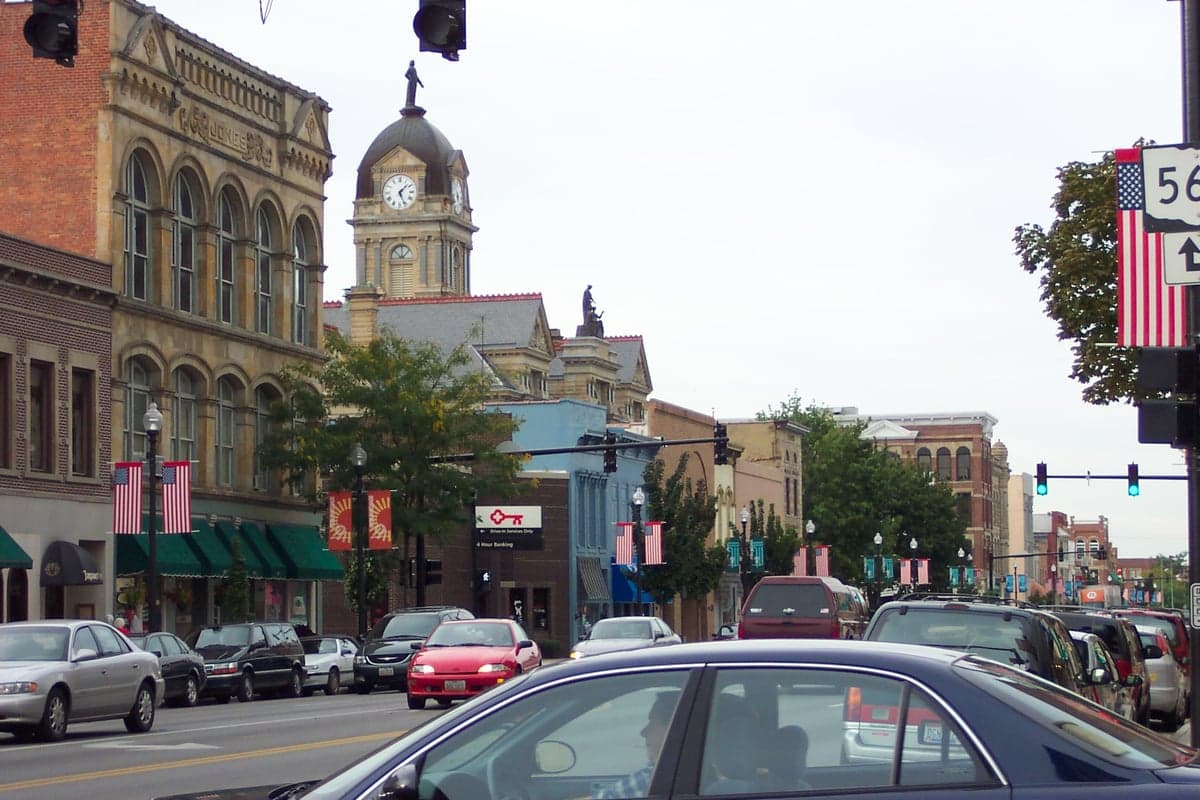
Findlay, Ohio, is a city of 40,280 residents that remains predominantly white (83.9%) with a notably small foreign-born population of just 2.6%, reflecting a community shaped more by domestic migration and generational continuity than by international immigration. The city’s identity is rooted in its industrial and agricultural heritage, with a population density that feels suburban and family-oriented. Distinctive markers include a strong sense of local pride centered on the University of Findlay and the Marathon Petroleum Corporation headquarters, and a demographic profile that is less diverse than Ohio’s major metropolitan areas.
How the city was settled and grew
Findlay’s original population was drawn by the 1880s oil boom, which transformed a small agricultural settlement into a bustling industrial town. The discovery of natural gas and oil under the city attracted a wave of workers from the eastern United States, particularly Pennsylvania and West Virginia, who arrived to work in the oil fields and refineries. These early settlers built the East End neighborhood, a working-class area of modest homes near the original refinery sites, which remains a predominantly white, blue-collar enclave today. A second wave came with the expansion of the Hancock County fairgrounds and the railroad in the early 1900s, drawing German and Irish immigrants who settled in the West Park district, known for its tree-lined streets and older single-family homes. By the mid-20th century, Findlay’s population had stabilized around 30,000, with the South Main Street corridor becoming a commercial and residential hub for the growing middle class.
Modern era (post-1965)
After the 1965 Immigration and Nationality Act, Findlay saw only modest demographic change compared to larger Ohio cities. The foreign-born population remains low at 2.6%, with the largest non-white group being Hispanic residents at 7.9%, many of whom arrived in the 1990s and 2000s to work in agriculture and food processing. These families concentrated in the Northridge area, a newer suburban development on the city’s northern edge, where a small but growing Hispanic community has established churches and small businesses. The Black population (2.6%) is largely concentrated in the Central Avenue corridor, a historically integrated area near the downtown core. East/Southeast Asian residents (1.8%) are a small but visible presence, primarily professionals and students associated with the University of Findlay, living in the College District around the campus. The Indian subcontinent population (0.5%) is even smaller, mostly employed in healthcare and engineering, and scattered across the city without a distinct ethnic enclave. Domestic in-migration from rural Ohio and the Rust Belt has been the primary driver of population change, with many new residents drawn by jobs at Marathon Petroleum and the Whirlpool Corporation.
The future
Findlay’s population is projected to remain stable or grow slowly, with the white majority likely to persist but gradually decline as the Hispanic and Asian communities expand through natural increase and continued domestic migration. The city is not tribalizing into distinct ethnic enclaves; instead, the West Park and East End neighborhoods are becoming more age-diverse as young families move in and retirees age in place. The Hispanic population, concentrated in Northridge, is showing signs of assimilation, with second-generation residents moving into mixed neighborhoods like South Main Street. The foreign-born population is unlikely to rise dramatically, as Findlay lacks the large employers or refugee resettlement programs that drive immigration in other Ohio cities. Over the next 10–20 years, the city will likely become slightly more diverse, but it will remain a predominantly white, middle-class community with a strong local identity.
For someone moving in now, Findlay offers a stable, family-oriented environment with a low crime rate and a strong sense of community, but with limited racial and ethnic diversity. The city is becoming slightly more varied in its population, but it is not a place of rapid demographic change or cultural fragmentation. New residents will find a community that values tradition, local institutions, and a quiet suburban lifestyle.

* Values derived from national, state, county, city and local statistics and may differ in a specific area. Last updated: 2026-04-21T19:12:13.000Z
Narrative content on this page is AI-generated and may contain mistakes. Verify any details that matter before acting on them.
ReloMaps may earn a commission from affiliate links at no extra cost to you.

