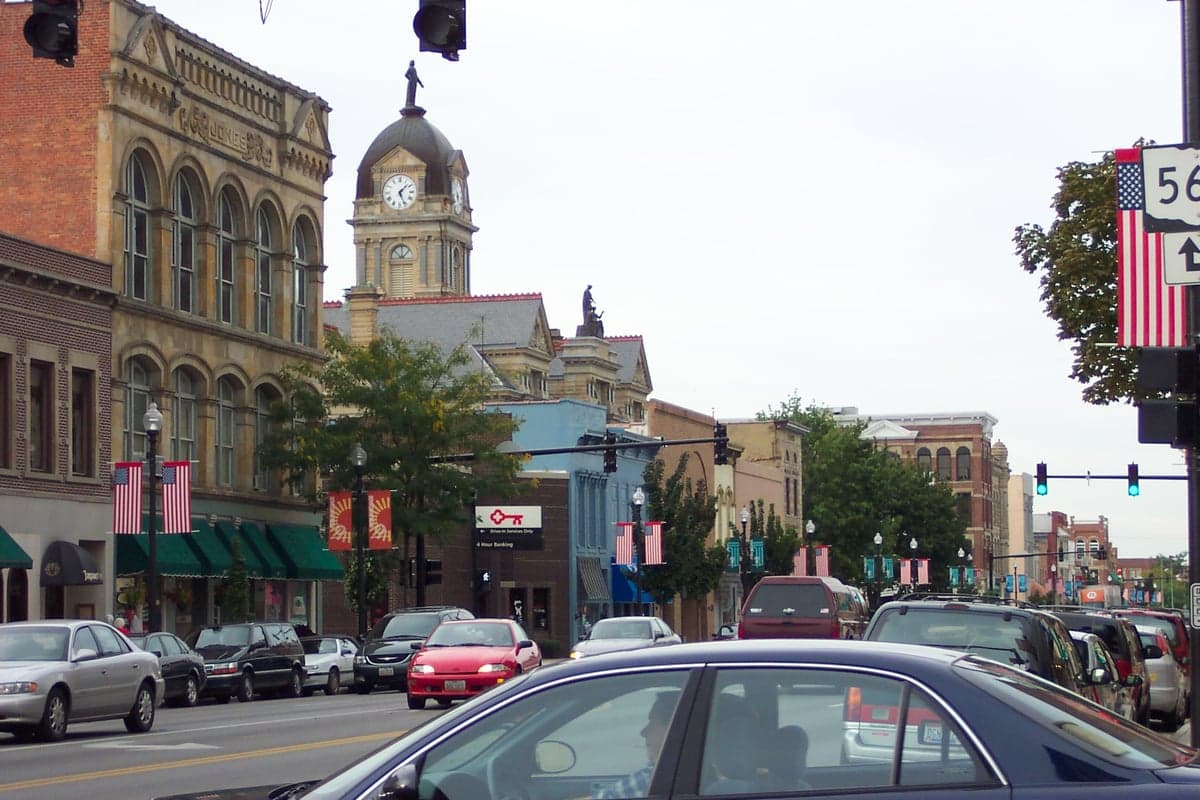
Photo: Wikipedia
Strategic Assessment of Findlay, OH
Meaningful friction. Expect exposure to either population pressure, blast zones, or natural disaster risk. Consider buying a retreat property.
What does the Strategic Assessment tell us?
Our Strategic Assessment grades tactical survivability of an area. Major population centers, military targets, fallout zones, natural disasters, and border exposure all drive risk — lower exposure means a more defensible position in a crisis.
This is heavily inspired by Joel Skousen's Strategic Relocation book. Highly recommended you checkout the book ($)What does this tell us?
Our Strategic Assessment grades tactical survivability of an area. Major population centers, military targets, fallout zones, natural disasters, and border exposure all drive risk — lower exposure means a more defensible position in a crisis.
This is heavily inspired by Joel Skousen's Strategic Relocation book. Highly recommended you checkout the book ($)Strategic Pillars

Key Distances
Regional Safe Places
Below is our recommended "safe zones" in Ohio and the surrounding area based on our strategic heuristics. For most people, it's unrealistic to live in a “safe zone” full-time due to work, family or other personal reasons. They tend to be more rural. However, many of these areas are perfect for second homes and retreat properties that double as a vacation home or even a short-term rental.

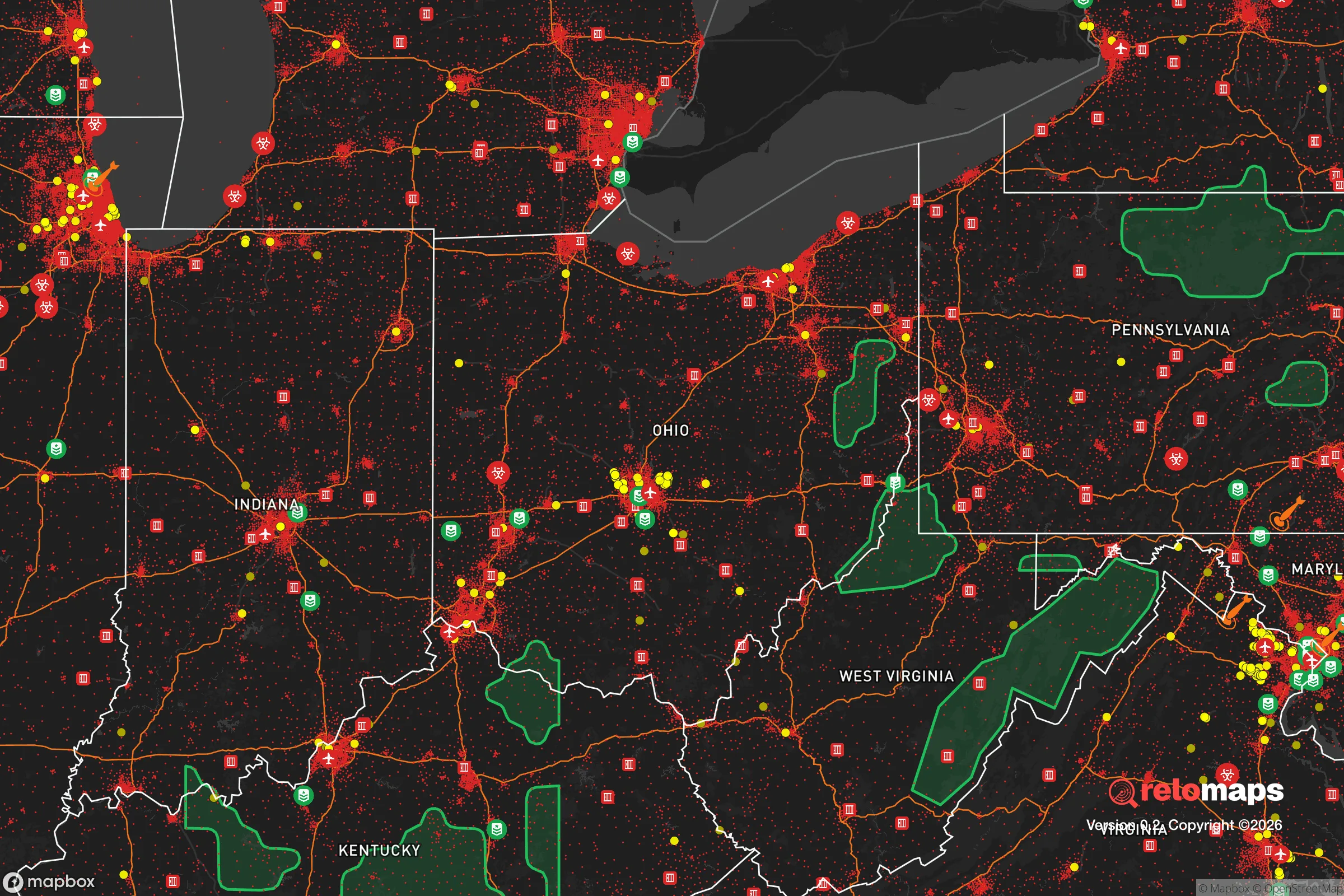


Important Note: For informational purposes only. This does not mean nothing bad ever happens in the green zones. Please use common sense. This is based on public data and modeled with AI. We tried to take a conservative approach but mistakes happen. We update this regularly as new information becomes available.
Solar Generator Recommendations
Backup power matters more here than in safer locations. We've picked three solar generators across budgets and capacity tiers — start with the budget unit if you only need a few essentials, or step up if you want to run a fridge and HVAC for days at a time.

Jackery Portable Power Station Explorer 300
Budget OptionPower on the Go: Weighing only 11 lbs, it's convenient to set up and store with book-sized foldable solar panels

BLUETTI Portable Power Station AC180
Designed for both indoor and outdoor scenarios, AC180 is highly capable as it has a robost capacity and continuous output power.

EF ECOFLOW DELTA Pro Ultra Power Station
Upgraded PickEcoFlow DELTA Pro Ultra is a whole-home energy system designed to grow with your family. Integrated with the Smart Home Panel 2, it scales to meet your evolving energy needs — keeping your home powered, intelligent, and secure through every stage of life.
We earn a commission, at no additional cost to you.
Strategic Assessment Analysis
Findlay, Ohio, sits in a sweet spot for strategic relocation: far enough from major metro chaos to avoid the immediate blast radius of societal collapse, but close enough to supply chains and infrastructure to matter. This Hancock County seat of roughly 40,000 people has quietly built a reputation as a resilient, middle-American hub—think manufacturing backbone, solid water access, and a political culture that leans heavily conservative. For someone thinking about where to hunker down when things go sideways, Findlay offers a mix of industrial self-sufficiency and geographic insulation that’s hard to beat in the Midwest.
Geographic position and natural advantages for long-term stability
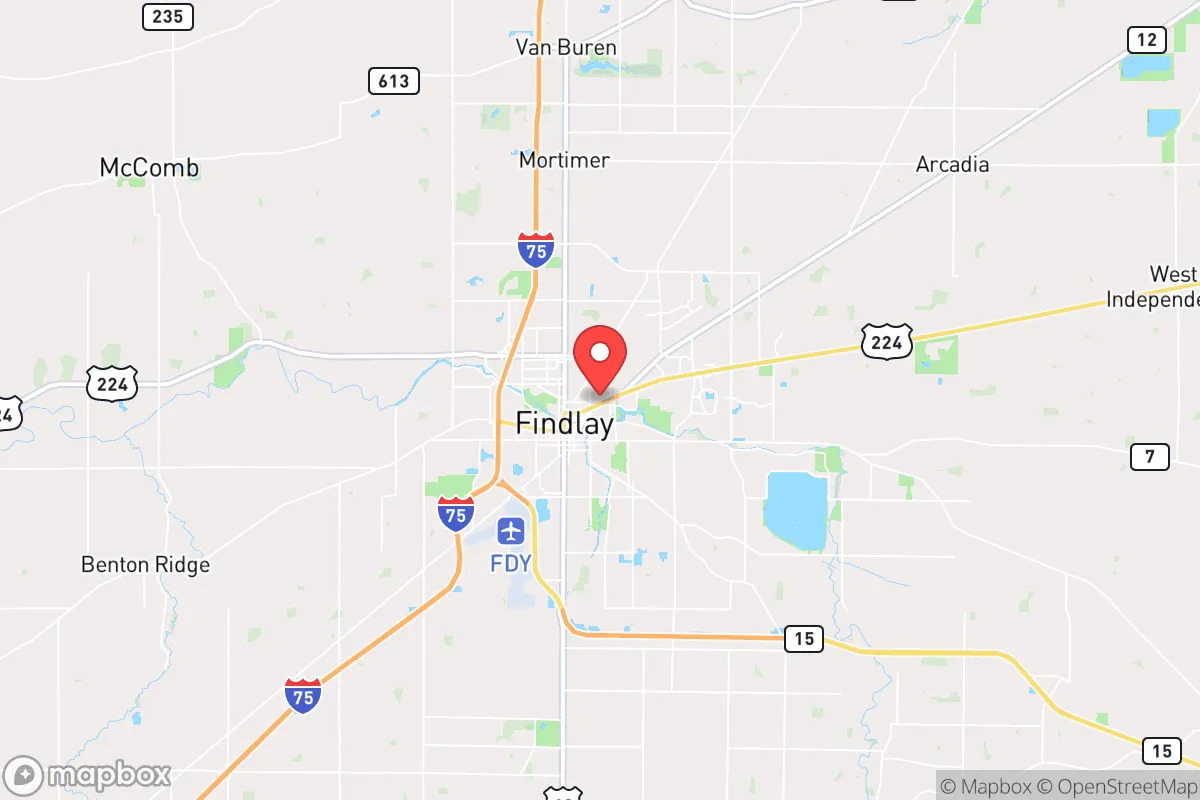
Findlay’s location at the intersection of I-75 and US 224 gives it a logistical edge without the vulnerability of a major interchange like Columbus or Toledo. It’s roughly 45 miles south of Toledo and 90 miles north of Dayton—close enough to tap into regional resources, but far enough that you won’t be caught in the initial wave of unrest from a city of 500,000+. The area sits on the Blanchard River, which provides a surface water source, but more importantly, Findlay is perched atop the massive Findlay Arch, a geological formation that yields abundant groundwater. The city’s water utility draws from a deep aquifer system, meaning even if surface supplies get contaminated or disrupted, there’s a backup that most towns can’t claim. The surrounding farmland is some of the most productive in the state—corn, soybeans, wheat—so local food production isn’t a pipe dream; it’s the baseline economy. The terrain is flat to gently rolling, which makes farming and construction straightforward, but it also means you’re not relying on mountain passes or bridges that could become chokepoints. Winters are cold but manageable, with average snowfall around 25 inches, so you’re not dealing with the extreme cold of the Upper Peninsula or the lake-effect snow belts of Erie, Pennsylvania.
Risks, exposures, and proximity to fallout-relevant landmarks
No place is a fortress, and Findlay has its share of vulnerabilities. The biggest concern is the Blanchard River itself—the city has a history of flooding, most notably in 2007 and 2019, when the river crested at record levels and inundated parts of downtown. The Army Corps of Engineers has been working on flood mitigation projects, but it’s not solved. If you’re looking at property, check flood maps carefully; the floodplain is real. On the man-made risk side, Findlay is about 60 miles from the Davis-Besse nuclear power plant near Oak Harbor, Ohio. That’s close enough that a major release—think Fukushima-level or worse—could put you in a fallout plume depending on wind direction. The plant has had safety incidents in the past, including a 2002 near-miss with reactor vessel corrosion. Also within 100 miles are the Perry Nuclear Power Plant and the Fermi 2 plant near Detroit. None of these are likely to fail, but in a grid-down or cascading disaster scenario, they’re a liability. Findlay itself hosts a Marathon Petroleum refinery, which is a double-edged sword: it’s a source of fuel and jobs, but it’s also a potential target for sabotage or a major industrial accident. The refinery has had fires and releases in the past, so proximity to it is something to weigh. On the plus side, there are no major military bases, no major ports, and no high-value government targets nearby. The city is not a primary target for a nuclear strike—that’s reserved for DC, New York, Chicago, and the like. In a civil unrest scenario, Findlay’s relative isolation from major population centers means you’re less likely to see looting mobs or refugee flows, though I-75 could become a corridor for people fleeing Toledo or Detroit.
Practical resilience for a relocator: food, water, energy, and defensibility
For a prepper or survivalist, Findlay checks several boxes. Water is the big one—the aquifer is deep and reliable. The city’s water treatment plant pulls from 12 wells that tap into the Tymochtee and Greenfield formations, and the system has backup generators. If the grid goes down, you’re not immediately dry. For food, the surrounding agricultural base means you can buy direct from farmers, and there are multiple local meat processors, grain elevators, and a strong Amish and Mennonite presence in the region (especially east toward Holmes County) that keeps traditional skills alive. The Marathon refinery gives the area a fuel security edge—even if national distribution falters, local supply is likely to hold longer than in most places. Electricity comes from the regional grid, but natural gas is plentiful (the area sits on the Utica Shale play), and many homes already have gas furnaces and stoves, which work without grid power if you have a generator for the blower. Defensibility is moderate. Findlay is a compact city with a grid street pattern, which isn’t ideal for creating chokepoints, but the surrounding rural areas offer plenty of space. The city has a strong police presence and a conservative sheriff’s office in Hancock County, which in a crisis would likely prioritize order over political correctness. There’s also a small but active gun culture—multiple gun shops and ranges in the area, and Ohio is a constitutional carry state. For community resilience, Findlay has a robust network of churches, volunteer fire departments, and civic organizations that would likely self-organize in a breakdown scenario. The downside is that the city is not particularly defensible against a determined group; it’s flat, open, and has multiple entry points. If you’re looking for a remote mountain redoubt, this isn’t it. But if you want a place where you can live a normal life while being ready for disruptions, Findlay offers a solid baseline.
The overall strategic picture for Findlay is one of calculated trade-offs. You get industrial resilience, good water, and a conservative social fabric that’s likely to hold together under stress. You trade that for flood risk, proximity to nuclear plants, and a location that’s not remote enough to be truly off-grid. For a single individual or a family who wants to be prepared without living in a bunker, Findlay is a strong candidate. It’s not a bug-out location—it’s a live-in location where you can build a life that’s already oriented toward self-reliance. The key is to pick your specific property wisely: avoid the floodplain, stay a few miles from the refinery, and get to know your neighbors before the crisis hits. If you do that, Findlay gives you a fighting chance to ride out whatever comes next.

* Values derived from national, state, county, city and local statistics and may differ in a specific area. Last updated: 2026-04-21T19:12:13.000Z
Narrative content on this page is AI-generated and may contain mistakes. Verify any details that matter before acting on them.
ReloMaps may earn a commission from affiliate links at no extra cost to you.

