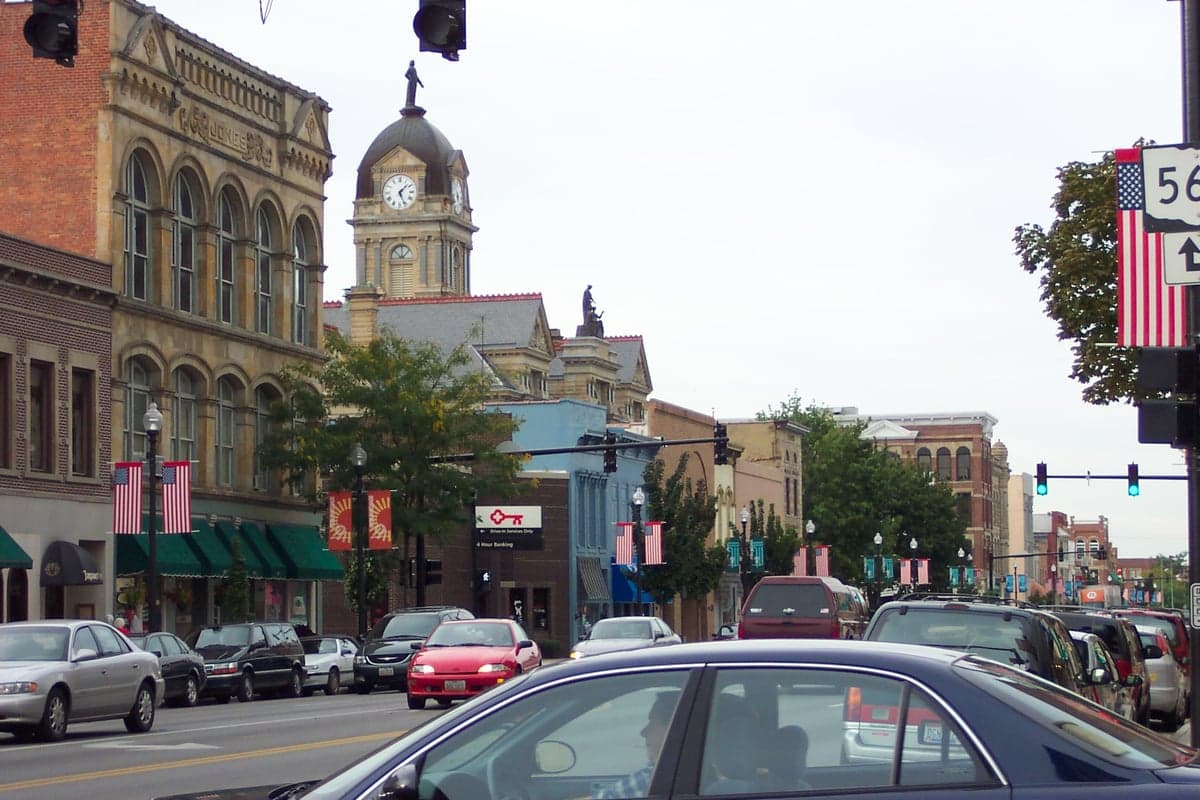
Photo: Wikipedia
Personal Sovereignty in Findlay, OH
Viable for self-reliance. Generally workable, though some barriers may limit total independence.
What does Personal Sovereignty tell us?
Personal Sovereignty measures your capacity for self-reliance and independence with minimal government friction. Higher scores mean fewer barriers between you and the way you want to live... but it assumes you have the space you need and good neighbors.
What does this tell us?
Personal Sovereignty measures your capacity for self-reliance and independence with minimal government friction. Higher scores mean fewer barriers between you and the way you want to live... but it assumes you have the space you need and good neighbors.
State Policy
Energy independence: Importer (40% of energy produced in-state)
Personal Liberty
Homesteading

Personal Liberty Analysis
Findlay, Ohio, offers a notably high degree of personal sovereignty for those prioritizing autonomy, largely due to Ohio’s status as a preemption state and its relatively light local regulatory footprint. While no location is immune from federal overreach, Findlay sits in a state that has actively pushed back against pandemic-era mandates, firearm restrictions, and property-use overrides, creating an environment where a survivalist or prepper mindset can operate with fewer bureaucratic obstacles. The city’s political culture leans conservative, with Hancock County voting +38 points Republican in 2024, and local governance tends to favor individual responsibility over collective compliance.
Tax burden and regulatory posture for self-reliant individuals
Ohio’s tax structure is moderate but trending in the right direction for those seeking to keep more of their own resources. The state’s income tax was cut from a top rate of 3.99% to a flat 3.5% in 2025, and Findlay adds a 1.5% municipal income tax on residents and 0.5% on non-residents working in the city. Property taxes in Hancock County average about 1.3% of assessed value, which is below the national average and manageable for a homestead. The regulatory posture in Findlay is business-friendly and low-touch: there are no city-level rent control ordinances, no plastic bag bans, and no local energy codes beyond state minimums. Zoning is present but not oppressive—most residential lots in the city are standard 50- to 70-foot frontages, and the county allows for more flexible agricultural and rural residential uses. For a prepper, the key takeaway is that you can own a modest property, run a small generator, and keep livestock (within city limits, chickens are allowed with a permit, but no roosters) without facing the kind of HOA-style micromanagement found in suburban Columbus or Cincinnati. The state’s right-to-work status was repealed in 2006, but Ohio remains a “right-to-work” state in practice for many private-sector jobs, meaning you cannot be forced to join a union as a condition of employment.
Self-defense and gun law specifics in Findlay and Ohio
Ohio is a constitutional carry state as of 2022, meaning no permit is required to carry a concealed handgun for anyone 21 or older who is legally allowed to possess a firearm. Findlay itself has no additional local gun restrictions—no magazine capacity limits, no assault weapon bans, and no waiting periods beyond the federal NICS check. The city does have a “safe storage” ordinance that requires firearms to be secured from minors, but this is a general safety measure, not a confiscation tool. Stand-your-ground laws are fully in effect: there is no duty to retreat in any place where you are lawfully present. For preppers, this means you can defend your home, vehicle, or campsite without fear of prosecution for using deadly force against a credible threat. The state also has strong preemption laws—Ohio Revised Code 9.68 explicitly prohibits any local government from passing gun laws stricter than state law, and Findlay has not attempted to challenge this. The sheriff’s office in Hancock County is known for issuing CCW permits (now optional) quickly, and the local gun culture is robust, with multiple indoor ranges and gun shops within a 15-minute drive. One practical note: Ohio does require a background check for private firearm sales at gun shows, but private sales between individuals not engaged in the business are exempt, preserving the secondary market for preppers building inventory.
Self-reliance and homesteading viability: lot sizes, zoning, and off-grid feasibility
For those looking to live off-grid or semi-off-grid, Findlay’s zoning is permissive but not lawless. Within city limits, minimum lot sizes are typically 6,000 to 8,000 square feet for single-family homes, which is tight for serious homesteading but workable for a large garden and small chicken coop. The real opportunity lies in the surrounding Hancock County townships—places like Liberty Township, Blanchard Township, or Van Buren Township—where minimum lot sizes are 1 to 5 acres, and agricultural zoning allows for livestock, beekeeping, and even small-scale farming without special permits. Off-grid solar is legal in Ohio, and net metering is available, but the state does not have a specific “right to solar” law that prevents HOAs from banning panels; however, Findlay has very few HOAs, so this is rarely an issue. Rainwater collection is unrestricted in Ohio, and you can drill a private well without a permit for personal use, though a water quality test is recommended. Composting toilets are legal under Ohio’s plumbing code if they are certified to NSF/ANSI Standard 41, but you will need a septic system for graywater. The biggest regulatory hurdle for full off-grid living is the building code: any new dwelling must meet the Ohio Residential Code, which includes insulation, egress, and electrical standards, but there is no requirement to connect to municipal water or sewer if you have a well and septic. For a prepper, the county’s lack of zoning enforcement in rural areas means you can build a pole barn, store supplies, and maintain a low profile without constant inspections.
Personal liberties: parental rights, medical autonomy, speech, and property
Ohio has been a battleground for parental rights, and the current legal landscape is favorable. The state’s “Parents’ Bill of Rights” (HB 8, passed in 2023) requires schools to notify parents of any medical or mental health services offered to their child, and it prohibits schools from withholding information about a student’s gender identity or sexual orientation from parents. Findlay City Schools have complied with this law, and the district’s curriculum is traditional, with no critical race theory or comprehensive sex education that overrides parental values. Medical autonomy is mixed: Ohio does not have a state-level vaccine mandate for adults, but some employers (especially hospitals and large manufacturers like Marathon Petroleum) may require COVID-19 or flu shots. The state banned vaccine passports in 2021, so no government entity can demand proof of vaccination for services. For medical freedom advocates, Ohio’s “Right to Try” law allows terminally ill patients to access experimental treatments, and the state has a robust health freedom movement. Free speech is well-protected under Ohio’s constitution, which has its own free speech clause that courts have interpreted broadly. Property rights are strong: Ohio is a “Dillon’s Rule” state, meaning local governments only have powers explicitly granted by the state, but the state legislature has been proactive in preempting local overreach—for example, banning local bans on natural gas hookups and prohibiting local rent control. Eminent domain is rarely abused in Hancock County, and property taxes are predictable.
Compared to blue-state strongholds like New York, California, or Illinois, Findlay offers a dramatically higher degree of personal sovereignty. The combination of constitutional carry, parental rights protections, low taxes, and permissive zoning creates a refuge for those who value self-reliance and distrust government overreach. While no location is perfect—Ohio still has state income tax and some federal compliance burdens—Findlay’s local culture and state-level legal framework make it one of the more viable options in the Midwest for a prepper or survivalist seeking to live on their own terms. The city’s small-town feel, with a population of 40,000, means you can know your neighbors, build a network, and operate under the radar, all while being within a two-hour drive of major resources in Toledo or Columbus. For a single individual or family prioritizing sovereignty, Findlay is a solid, unglamorous choice that delivers where it counts.

* Values derived from national, state, county, city and local statistics and may differ in a specific area. Last updated: 2026-04-21T19:12:13.000Z
Narrative content on this page is AI-generated and may contain mistakes. Verify any details that matter before acting on them.
ReloMaps may earn a commission from affiliate links at no extra cost to you.

