
Photo by Alex Reynolds on Unsplash
Political ClimatePolitical Climate in Five Forks, SC
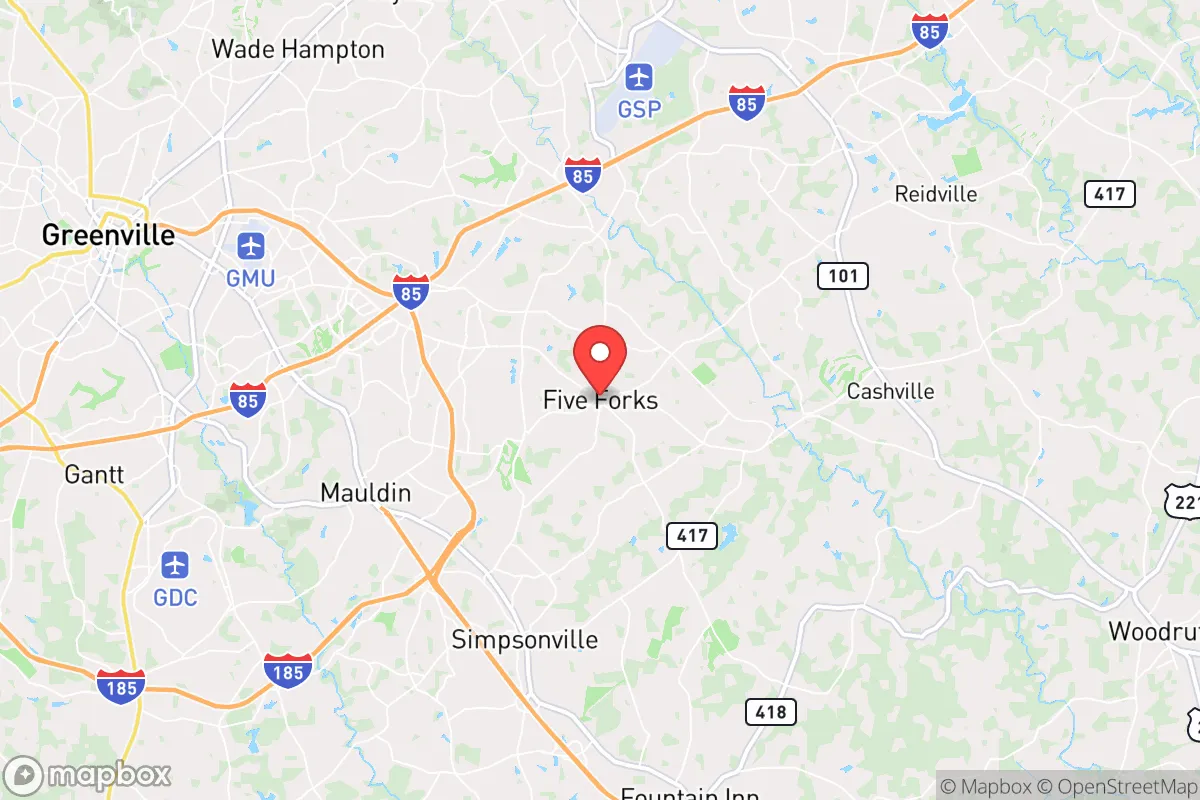
District shown is the primary district for this city’s centroid. Cities may span multiple districts.
Local Political AnalysisPolitical Analysis of Five Forks, SC
Five Forks, South Carolina, leans solidly conservative, with a Cook PVI of R+11 that reflects a deep-rooted preference for limited government and personal responsibility. This isn't a recent shift; the area has long been a stronghold for traditional values, where folks vote with their wallets and their principles. The trajectory here is one of cautious stability—most residents are wary of the progressive trends creeping into nearby Greenville and Simpsonville, and they see Five Forks as a bulwark against that kind of government overreach.
How it compares
Compared to the broader Upstate region, Five Forks stands out as a conservative anchor. While Greenville city proper has seen a noticeable leftward tilt in recent years—with more bike lanes, density pushes, and talk of "equity" initiatives—Five Forks remains a place where the Second Amendment isn't debated, and property rights are taken seriously. Simpsonville, just a few miles west, has a similar vibe but is starting to feel the pressure of newcomers from blue states, bringing with them higher taxes and zoning restrictions. Five Forks, by contrast, has held the line. The contrast is stark: in Greenville, you'll hear chatter about public transit expansions and affordable housing mandates; in Five Forks, the conversation is about keeping school boards accountable and ensuring local ordinances don't infringe on how you use your land. The R+11 rating isn't just a number—it's a reflection of a community that votes against any hint of progressive overreach, whether it's in county commission races or state-level referendums.
What this means for residents
For someone living here, the political climate means you can generally expect local government to stay out of your business. Taxes are relatively low, and there's little appetite for new regulations on everything from home-based businesses to firearm ownership. That said, the pressure is mounting. As more families move in from places like California and New York, there's a real concern that the culture could shift. Longtime residents watch school board meetings closely, worried about curriculum changes that might push a progressive agenda. The good news is that Five Forks still has a strong network of civic groups and churches that keep the conservative ethos alive. If you value personal freedoms—like choosing your own healthcare, educating your kids without government interference, or building a shed without a dozen permits—this is still a safe haven. But it's one that requires vigilance; the political winds are changing in the broader region, and Five Forks is a bit of a last stand for common-sense governance.
Culturally, Five Forks has a distinct policy distinction that sets it apart: a fierce independence from county-level overreach. Unlike some neighboring towns that have embraced "livability" studies and climate action plans, Five Forks residents have consistently voted down measures that would expand government's role in daily life. The local sheriff's office is known for its no-nonsense approach, and there's a palpable distrust of federal mandates—whether on environmental rules or health directives. Looking ahead, the next five years will be telling. If the influx of new residents continues, the conservative character could be diluted. But for now, Five Forks remains a place where the old-school values of self-reliance and limited government aren't just talked about—they're lived. It's a community that knows what it stands for, and it's not afraid to push back against anything that threatens that.

State Political ClimatePolitical Climate in South Carolina
State Political AnalysisPolitical Environment in the State
South Carolina has long been a reliably red state, with a solid Republican lean that has only deepened over the past two decades. The GOP holds supermajorities in both chambers of the state legislature, and the state has voted for the Republican presidential candidate in every election since 1980, with margins widening from single digits in the 1990s to double digits in recent cycles. The dominant coalition is a blend of traditional conservatives, evangelical Christians, and a growing number of fiscally conservative transplants from the Northeast and Midwest, particularly in the coastal and upstate regions. However, the state is not monolithic — a rapidly diversifying population and a handful of urban strongholds are slowly shifting the political landscape, though the overall trajectory remains firmly conservative for the foreseeable future.
Urban vs. rural divide
The political map of South Carolina is a textbook study in the urban-rural split. The state's largest metro, Charleston, has become a battleground — Charleston County itself is now reliably blue in presidential elections, driven by a booming tech and tourism economy, a growing Black professional class, and an influx of out-of-state transplants. In 2020, Biden won the county by nearly 12 points. Just a few miles north, Mount Pleasant and Summerville remain more competitive, with the latter trending redder as families flee Charleston's rising costs. The Columbia metro area, anchored by the state capital and the University of South Carolina, is a purple island in a sea of red — Richland County is solidly Democratic, while neighboring Lexington County is one of the most reliably Republican suburbs in the Southeast. The Greenville-Spartanburg corridor in the Upstate is the state's conservative engine: Greenville County, once a GOP stronghold, has seen a slight blue shift in its urban core, but the surrounding counties of Spartanburg, Anderson, and Pickens remain deeply red, fueled by manufacturing jobs and a strong evangelical presence. Rural counties like Allendale and Bamberg in the Lowcountry are predominantly Black and vote heavily Democratic, but their populations are small and shrinking. The real story is the exurban and rural white vote, which has only hardened in its conservatism since the 2010s.
Policy environment
South Carolina's policy environment is a conservative's dream on paper, though implementation can be messy. The state has a flat income tax rate of 6.2% (set to drop to 6.0% by 2026), no estate tax, and a relatively low property tax burden thanks to a 1990s-era assessment cap that keeps primary residence valuations from skyrocketing. The regulatory posture is business-friendly, with a right-to-work law and a tort reform system that caps noneconomic damages in medical malpractice cases. On education, the state has expanded charter schools and passed a universal school voucher program in 2023 (the Education Scholarship Trust Fund), allowing families to use state funds for private school tuition — a major win for school choice advocates. Healthcare is a mixed bag: the state refused Medicaid expansion under the ACA, leaving a coverage gap for low-income adults, but the private insurance market is relatively stable. Election laws have tightened in recent years: voter ID is required, absentee ballot drop boxes were restricted in 2021, and the state now bans ballot harvesting. Overall, the policy environment leans heavily toward limited government and individual responsibility, though the state's heavy reliance on federal dollars (especially for military bases and highway funding) creates a practical tension with its rhetoric of independence.
Trajectory & freedom
On the freedom front, South Carolina has been moving in a decidedly pro-liberty direction over the past five years, particularly on gun rights and parental autonomy. In 2021, the state passed constitutional carry (permitless concealed carry), making it the 21st state to do so. In 2023, the legislature overrode the governor's veto to pass a ban on gender-affirming care for minors, and in 2024, it passed a Parents' Bill of Rights that requires schools to notify parents about curriculum changes and medical services. Property rights were strengthened with a 2023 law limiting the use of eminent domain for private economic development. On the taxation front, the legislature has been slowly chipping away at the state's income tax, with a goal of reaching 4.99% by 2030. However, there are concerning signs: the state's medical marijuana bill has stalled repeatedly, and a 2024 attempt to legalize sports betting failed. The biggest red flag for liberty-minded residents is the state's growing reliance on federal COVID-era funds, which have created a temporary expansion of government programs. Still, the overall trajectory is toward more personal freedom, especially on the cultural front — the state's "freedom" is increasingly defined by what the government won't do, rather than what it will.
Civil unrest & political movements
South Carolina has seen its share of political flashpoints, though the state's culture of politeness often masks deep tensions. The 2015 Charleston church shooting at Mother Emanuel AME Church sparked a statewide debate over the Confederate flag, which was removed from the Statehouse grounds later that year — a move that still rankles some conservatives who see it as government overreach into historical symbolism. The 2020 George Floyd protests were relatively muted compared to other states, but there were notable demonstrations in Columbia and Charleston, including a controversial statue toppling in the capital. Immigration politics are less heated than in border states, but the 2023 "Sanctuary City" ban (which prohibits local governments from adopting non-cooperation policies with ICE) passed with bipartisan support. The most visible political movement in recent years has been the rise of the "Constitutional Conservatives" within the state GOP, who have pushed for nullification of federal gun laws and a state-level abortion ban (the current law bans abortion at 6 weeks, with no exceptions for rape or incest). Election integrity remains a hot-button issue: the 2020 election saw no major scandals in the state, but the legislature has nonetheless tightened absentee ballot rules and created a new election police unit. A new resident would notice that political conversations are common in coffee shops and church halls, but rarely spill into open conflict — South Carolinians tend to resolve their differences with a smile and a passive-aggressive prayer.
Projection
Looking ahead 5-10 years, South Carolina is likely to remain a reliably red state, but the margins will narrow in the coastal and Upstate metros. The biggest demographic shift is the influx of retirees and remote workers from high-tax states like New York, New Jersey, and California — these newcomers tend to be fiscally conservative but socially moderate, which could soften the state's hardline positions on abortion and marijuana. The Charleston metro is projected to add 200,000 residents by 2035, and if even a fraction of them vote like their former home states, the coastal counties will become competitive. The Greenville area is also growing fast, but its newcomers are more likely to be conservative-leaning families from the Midwest. The rural counties will continue to shrink and redden, while the Black Belt counties in the Lowcountry will remain Democratic but lose political clout. The most likely scenario is a state that stays Republican at the presidential level (by 8-12 points) but sees more competitive races for governor and Senate, especially if a charismatic Democrat emerges. For a conservative moving in now, the next decade will feel like a slow-motion version of what happened in Georgia — a red state that doesn't flip, but becomes a battleground for the soul of the GOP.
For a new resident, the bottom line is this: South Carolina offers a genuinely conservative policy environment with low taxes, strong gun rights, and a culture that values personal responsibility. The state is not without its tensions — the urban-rural divide is real, and the influx of out-of-state transplants is slowly shifting the political center of gravity. But if you're looking for a place where your vote counts, your freedoms are respected, and the government mostly stays out of your way, South Carolina is one of the best bets in the Southeast. Just don't expect it to stay exactly the same — the state is changing, and the question is whether the change will be managed by conservatives or imposed by newcomers. So far, the locals are holding the line.
* Values derived from national, state, county, city and local statistics and may differ in a specific area. Last updated: 2026-04-23T04:01:08.000Z
Narrative content on this page is AI-generated and may contain mistakes. Verify any details that matter before acting on them.
ReloMaps may earn a commission from affiliate links at no extra cost to you.

