 Popular
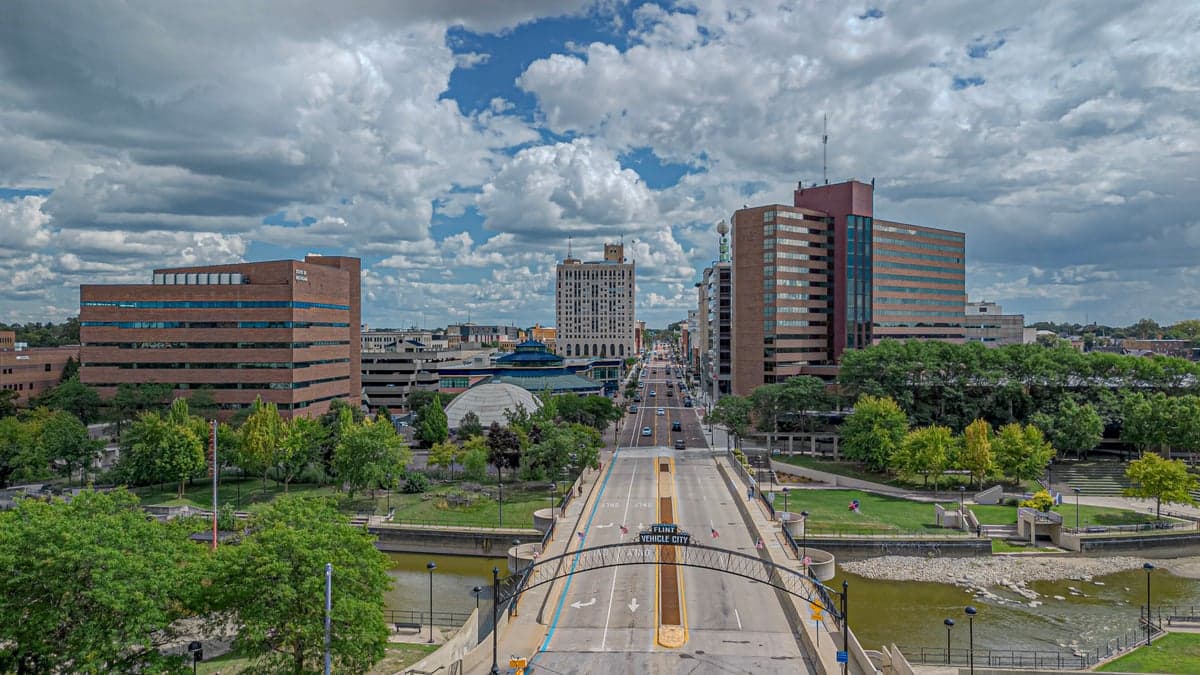
Photo: Wikipedia
Personal Sovereignty in Flint, MI
Strong independent fundamentals that actively favor personal liberty and low regulation.
What does Personal Sovereignty tell us?
Personal Sovereignty measures your capacity for self-reliance and independence with minimal government friction. Higher scores mean fewer barriers between you and the way you want to live... but it assumes you have the space you need and good neighbors.
What does this tell us?
Personal Sovereignty measures your capacity for self-reliance and independence with minimal government friction. Higher scores mean fewer barriers between you and the way you want to live... but it assumes you have the space you need and good neighbors.
State Policy
Energy independence: Importer (20% of energy produced in-state)
Personal Liberty
Homesteading

Personal Liberty Analysis
Flint, Michigan, presents a complex and often contradictory environment for personal sovereignty. While the city’s well-documented water crisis and economic struggles have eroded trust in public institutions, the underlying legal and regulatory framework in Michigan offers a surprisingly strong foundation for individual autonomy, particularly for those with a survivalist or prepper mindset. The key is understanding that local dysfunction can, paradoxically, create more space for self-reliance, but only if you are prepared to navigate the challenges of a city with a diminished tax base and strained municipal services. For the strategic relocator, Flint is less a turnkey sanctuary and more a high-risk, high-reward proposition where state-level protections for gun rights and property must be weighed against the realities of a struggling local government.
Tax burden and regulatory posture: How Michigan’s state-level policies affect Flint
Michigan’s overall tax burden is moderate compared to high-tax states like New York or California, but Flint’s local situation adds layers of complexity. The state’s income tax is a flat 4.25%, and while there is no state-level sales tax on groceries or prescription drugs, the general sales tax is 6%. For a prepper, the more critical factor is property tax. Flint’s property tax rates are among the highest in Michigan due to the city’s declining property values and the need to fund essential services. However, the state’s Headlee Amendment and Proposal A cap annual taxable value increases to the rate of inflation or 5%, whichever is lower, providing some predictability. This means that if you buy a property during a downturn, your tax base is locked in, which can be a strategic advantage. On the regulatory front, Michigan is generally business-friendly, with no statewide zoning preemption that would prevent a homeowner from keeping chickens or a small garden in most residential areas. However, Flint’s local zoning codes are more restrictive than rural Michigan, and the city’s emergency manager history has created a patchwork of ordinances that can be difficult to navigate. For those seeking maximum autonomy, the regulatory posture is tolerable but not ideal—you will have to work within a system that is still recovering from state oversight.
Self-defense and gun law specifics: What the Second Sanctuary landscape looks like in Flint
Michigan is a “shall-issue” state for concealed pistol licenses (CPL), and Flint sits in Genesee County, which has a history of pro-Second Amendment sentiment despite the city’s Democratic leanings. The state does not require a permit to openly carry a firearm, and the CPL process is straightforward: a background check, a safety course, and a fee. Crucially, Michigan is a stand-your-ground state, meaning there is no duty to retreat before using deadly force in self-defense if you are in a place you have a legal right to be. This is a significant advantage for personal sovereignty. However, there are local nuances. Flint has a high violent crime rate, which means that carrying a firearm for self-defense is not just a philosophical choice but a practical necessity. The city also has a history of gun-free zones in certain public buildings, and the state’s preemption law prevents local governments from enacting their own firearm ordinances, but enforcement can be inconsistent. For the prepper, the key takeaway is that Michigan’s state-level protections are robust, but the local environment requires constant vigilance. The presence of the Flint Police Department is limited, and response times can be long, reinforcing the need for personal defensive capability. The state also allows for the use of suppressors and short-barreled rifles with proper federal paperwork, which is a plus for those building a more comprehensive preparedness arsenal.
Self-reliance and homesteading viability: Lot sizes, zoning, and off-grid feasibility in Flint
Flint’s urban landscape, marked by significant population decline and vacant lots, creates a unique opportunity for self-reliance that is rare in a city of its size. Many residential lots are larger than the national average, often exceeding a quarter-acre, and the city’s land bank program makes it possible to acquire adjacent vacant parcels for a nominal fee. This allows for substantial gardening, small-scale livestock (chickens are permitted in most zones with a permit), and even the potential for a modest orchard. Zoning is generally permissive for urban agriculture, but the city has specific regulations regarding the number of animals and the distance of coops from dwellings. Off-grid feasibility is mixed. Michigan’s climate requires robust heating and water systems, and Flint’s municipal water infrastructure is compromised, making a private well a priority for those seeking true autonomy. However, the city’s grid is still operational, and going fully off-grid would require significant investment in solar, battery storage, and a backup generator to handle the harsh winters. The cost of land is extremely low—often under $10,000 for a buildable lot—which makes it financially viable to create a self-sufficient compound within city limits. The trade-off is that you are still in a high-crime urban environment, so perimeter security and situational awareness are non-negotiable. For the serious prepper, Flint offers a blank canvas, but it is a canvas that requires constant maintenance and a high tolerance for urban decay.
Personal liberties: Parental rights, medical autonomy, speech, and property in Flint
Michigan has a mixed record on personal liberties that directly affect Flint residents. On parental rights, the state has a Parental Rights Restoration Act that affirms the fundamental right of parents to direct the upbringing, education, and care of their children. This is a strong legal foundation, but it has been tested in recent years by school mask mandates and vaccine requirements. Flint’s public school system, Flint Community Schools, has been under state oversight and has a history of low performance, which pushes many parents toward homeschooling or private options. Michigan is relatively permissive for homeschooling, with no requirement for teacher certification or standardized testing, though parents must submit an intent to homeschool. Medical autonomy is more contentious. Michigan has a broad medical marijuana program and has legalized recreational cannabis, which is a positive for personal choice. However, the state’s vaccine mandates for school attendance and the emergency powers of the governor (which were used extensively during COVID-19) are points of concern for those wary of government overreach. Free speech is protected under the First Amendment, but Flint’s local political climate can be hostile to dissenting views, particularly on issues related to the water crisis and public health. Property rights are generally strong, with Michigan being a “lien state” that protects homeowners from excessive eminent domain abuse, but the city’s blight removal program has led to aggressive demolition of abandoned properties, sometimes with questionable notice to owners. Overall, Flint offers a mixed bag: strong state-level protections for parental rights and gun ownership, but a local environment where government overreach is a lived reality, not a theoretical concern.
In the broader landscape of personal sovereignty, Flint, Michigan, is a high-difficulty but potentially high-reward location for the strategic relocator. The state provides a solid legal framework for self-defense, property rights, and parental autonomy, while the city’s economic distress creates opportunities for land acquisition and self-reliance that are unavailable in more prosperous areas. However, the trade-offs are significant: a compromised municipal infrastructure, a high crime rate, and a history of government mismanagement that demands constant vigilance. For the prepper or survivalist, Flint is not a sanctuary in the traditional sense—it is a proving ground. Those who succeed here will do so because they are willing to shoulder the burden of their own security, water, and food production, relying on state-level protections while navigating a local system that is often broken. Compared to rural Michigan or states like Idaho or Texas, Flint offers less immediate freedom from government interference, but it also offers a lower barrier to entry and a unique chance to rebuild autonomy from the ground up. It is a place for those who see sovereignty not as a given, but as something that must be actively defended and constructed, every single day.

* Values derived from national, state, county, city and local statistics and may differ in a specific area. Last updated: 2026-04-29T22:44:12.000Z
Narrative content on this page is AI-generated and may contain mistakes. Verify any details that matter before acting on them.
ReloMaps may earn a commission from affiliate links at no extra cost to you.

