 Popular
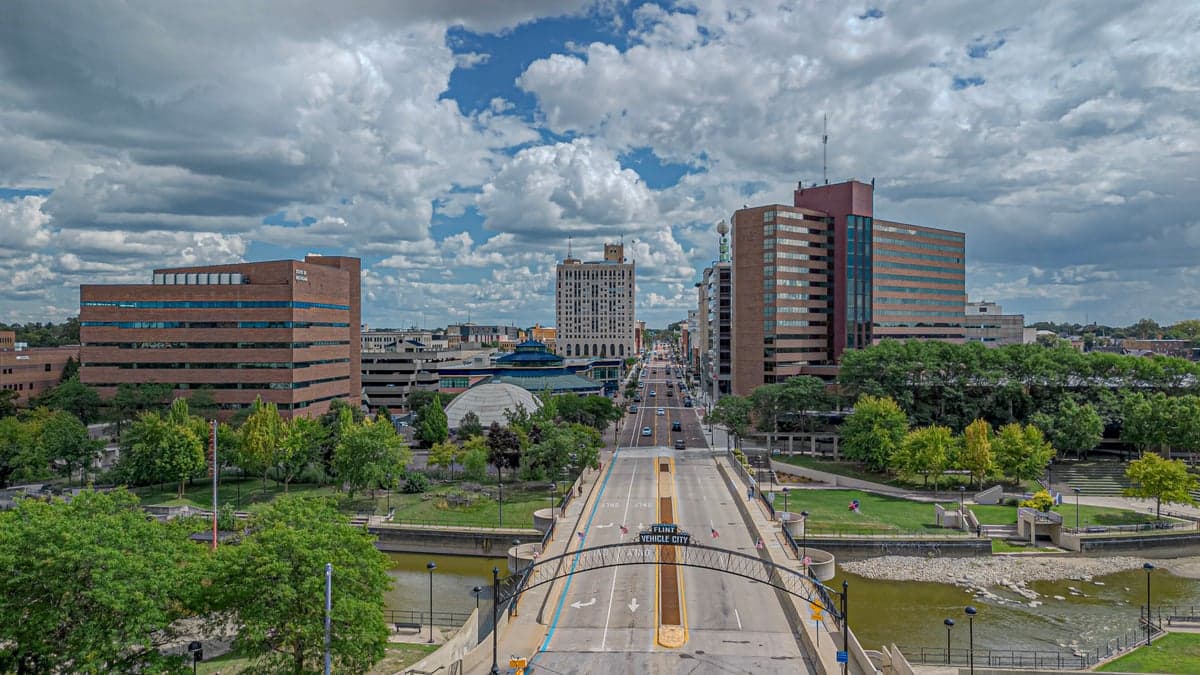
Photo: Wikipedia
Demographics of Flint, MI
Affluence Level in Flint, MI
A low-income area with significant economic hardship. Household wealth and educational attainment are well below national averages.
People of Flint, MI
Flint, Michigan, is a majority-Black city of 80,835 residents with a distinctive working-class identity forged by the rise and fall of the American auto industry. Its population is overwhelmingly native-born (98.8%), with a small Hispanic community (4.5%) and a white population of 32.6%. The city is characterized by a deep sense of place and resilience, though it faces significant challenges from population decline and a low college attainment rate of 13.1%.
How the city was settled and grew
Flint was founded in 1819 as a fur-trading post and grew slowly as a lumber and agricultural center through the 19th century. The city’s explosive growth began in 1904 when General Motors was founded in Flint, transforming it into the heart of the American automobile industry. The original white population, largely of English, German, and Irish descent, settled in neighborhoods like Woodside Park and East Village, building the city’s early infrastructure. The first major wave of Black migration came during the Great Migration (1910–1940), as African Americans from the Deep South—particularly Alabama and Mississippi—moved north for factory jobs. They concentrated in the Flint Park and St. John Street areas, forming the core of what would become the city’s Black community. A second, larger wave of Black migration occurred during World War II and the post-war boom (1940–1960), when GM’s workforce peaked at over 80,000. This wave settled into neighborhoods like Mott Park and Central Park, areas that remain predominantly Black today. By 1960, Flint’s population had reached its historic peak of nearly 200,000, with a Black share of about 20%.
Modern era (post-1965)
The post-1965 era brought dramatic demographic change. The Hart-Cellar Act of 1965 had little direct effect on Flint—its foreign-born population remains just 1.2%—but domestic migration reshaped the city. White flight accelerated after the 1967 civil unrest and the 1970s oil crisis, which devastated GM’s local operations. By 1980, the Black population had grown to over 50%, while the white population shrank. The 1980s and 1990s saw the rise of a predominantly Black middle class in neighborhoods like Pierson Road and Miller Road, though deindustrialization and the 2014 water crisis triggered a second wave of population loss. Since 2000, the city has lost over 40% of its residents. The Hispanic population, while small at 4.5%, has grown modestly, concentrated in the South Flint area near the Buick City plant. East/Southeast Asian residents (0.5%) and Indian-subcontinent residents (0.1%) remain tiny communities, largely clustered near the University of Michigan-Flint campus. The white population, now 32.6%, is older and increasingly concentrated in the College Cultural Neighborhood and the Grand Traverse Street corridor, where historic homes have attracted some reinvestment.
The future
Flint’s population is projected to continue declining slowly, though the rate has slowed since the water crisis. The city is not homogenizing into a single identity but rather tribalizing into distinct enclaves: the Black majority remains dominant in the central and north sides, while the white population is increasingly clustered in the east side and near the downtown core. The Hispanic community is growing slowly but steadily, particularly among younger families in South Flint. The foreign-born population is expected to remain negligible, as Flint lacks the job base or immigrant networks of larger Michigan cities like Detroit or Grand Rapids. The next 10–20 years will likely see a continued slow decline to around 70,000 residents, with the Black share stabilizing near 60% and the white share declining further as older white residents age out. The city’s future hinges on whether the GM plant redevelopment and new investments in healthcare (Hurley Medical Center, McLaren Flint) can attract younger, more educated residents—but the low college attainment rate (13.1%) and weak job market make a rapid turnaround unlikely.
Flint is becoming a smaller, more predominantly Black city with a stable but aging white population and a small, growing Hispanic community. For someone moving in now, it offers low housing costs and a strong sense of community identity, but limited economic opportunity and a population that is still adjusting to decades of industrial decline. The city is not diversifying in the way many American cities are; it is consolidating around its Black majority while other groups remain small and geographically concentrated.

* Values derived from national, state, county, city and local statistics and may differ in a specific area. Last updated: 2026-04-29T22:44:12.000Z
Narrative content on this page is AI-generated and may contain mistakes. Verify any details that matter before acting on them.
ReloMaps may earn a commission from affiliate links at no extra cost to you.

