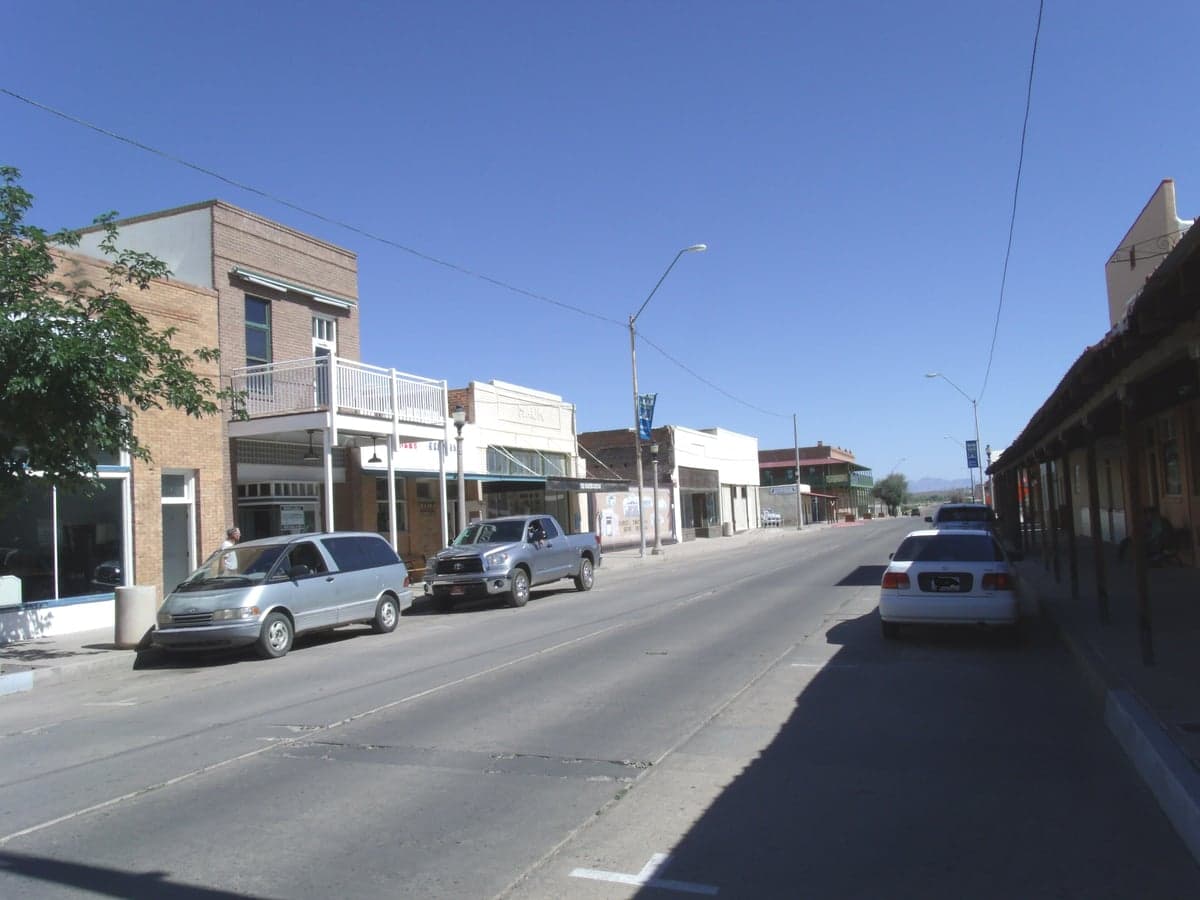
Photo: Wikipedia
Demographics of Florence, AZ
Affluence Level in Florence, AZ
A middle-class area roughly in line with national averages across income, home values, education, and employment.
People of Florence, AZ
The people of Florence, Arizona, today number 25,961, forming a community that is predominantly white (52.8%) with a substantial Hispanic population (32.1%) and a notable Black presence (9.2%). The city’s character is shaped by its dual identity as a historic county seat and a growing exurban hub, with a lower college attainment rate (16.6%) reflecting a workforce rooted in corrections, government, and trades. Distinctively, Florence is home to one of the state’s largest state prison complexes, which anchors both employment and a transient inmate population, while its historic downtown and newer subdivisions attract families seeking affordable housing within commuting distance of Phoenix.
How the city was settled and grew
Florence was founded in 1866 as the Pinal County seat, drawing its first permanent settlers—primarily Anglo-American ranchers, farmers, and merchants—who were attracted by the fertile floodplain of the Gila River and the promise of irrigated agriculture. The original population clustered around the Historic Downtown Florence district, where adobe and brick commercial buildings still stand, and along the adjacent residential streets like Ruggles Street and Main Street, where early merchants and professionals built homes. The arrival of the Southern Pacific Railroad in the 1880s spurred a second wave, bringing Mexican laborers and Chinese railroad workers—the latter forming a small but distinct enclave near the railroad depot, though their numbers dwindled by the early 1900s. By the mid-20th century, Florence’s population remained small (under 3,000) and overwhelmingly white, with a Hispanic minority concentrated in the Barrio Viejo (Old Neighborhood) area south of the railroad tracks, where adobe homes and a Catholic church anchored the community.
Modern era (post-1965)
Florence’s modern demographic transformation began with the expansion of the Arizona State Prison Complex in the 1970s and 1980s, which drew correctional officers, administrators, and support staff from across the state and country. This influx was predominantly white and Black, with many Black families settling in the Anthem at Merrill Ranch subdivision—a master-planned community developed in the 2000s that attracted middle-class families of all races seeking new homes and good schools. The Hispanic population grew steadily through natural increase and domestic migration from other Arizona towns, with many families remaining in or near Barrio Viejo and the Florence Gardens area, a newer subdivision east of the historic core. The foreign-born share (7.5%) is modest, with most immigrants being Hispanic (primarily from Mexico) and a small East/Southeast Asian community (1.0%) concentrated in the Copper Basin area near the prison complex, where some Vietnamese and Filipino families work in corrections or healthcare. The Black population (9.2%) is notably higher than the state average (4.4%), reflecting the prison’s role as a stable employer for Black correctional officers and their families, who tend to live in Anthem at Merrill Ranch and newer subdivisions like Florence Heights.
The future
Florence’s population is projected to grow steadily as Phoenix’s exurban sprawl pushes southeast along the Pinal County corridor. The city is likely to become more homogenized in its newer subdivisions, where Anthem at Merrill Ranch and Florence Heights attract a mix of white, Hispanic, and Black families with similar income levels and housing preferences, reducing the historic ethnic clustering seen in Barrio Viejo. The Hispanic share is expected to rise gradually through natural increase and continued domestic migration, while the Black population may plateau as prison employment stabilizes. The East/Southeast Asian community remains small and is unlikely to grow significantly without a new economic anchor. The foreign-born share will likely remain below 10%, as Florence lacks the immigrant-heavy industries (agriculture, hospitality) found in other Arizona towns. Over the next 10–20 years, the city will likely become a more integrated, middle-class exurb, though Barrio Viejo will retain its historic Hispanic character and the prison complex will continue to shape the local economy and demographics.
For someone moving in now, Florence offers an affordable, family-oriented environment with a strong sense of history and a growing, diversifying population. The city is becoming less tribalized by neighborhood and more integrated across newer subdivisions, though the historic core and the prison complex remain distinct anchors. The low college attainment rate and reliance on corrections and government employment mean that economic opportunities are stable but limited, making Florence best suited for those who value small-town character and proximity to Phoenix over a dynamic job market or high educational attainment.

* Values derived from national, state, county, city and local statistics and may differ in a specific area. Last updated: 2026-05-01T18:54:47.000Z
Narrative content on this page is AI-generated and may contain mistakes. Verify any details that matter before acting on them.
ReloMaps may earn a commission from affiliate links at no extra cost to you.

