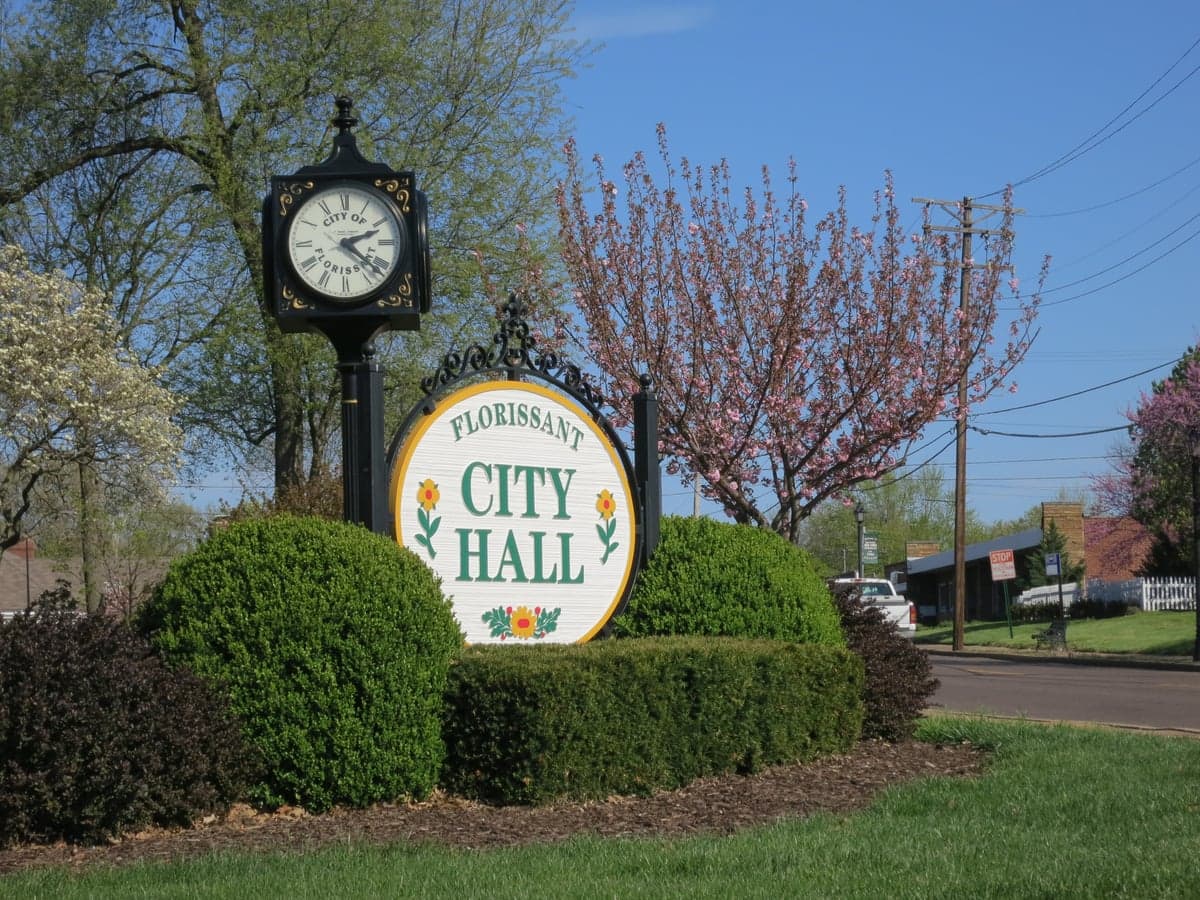
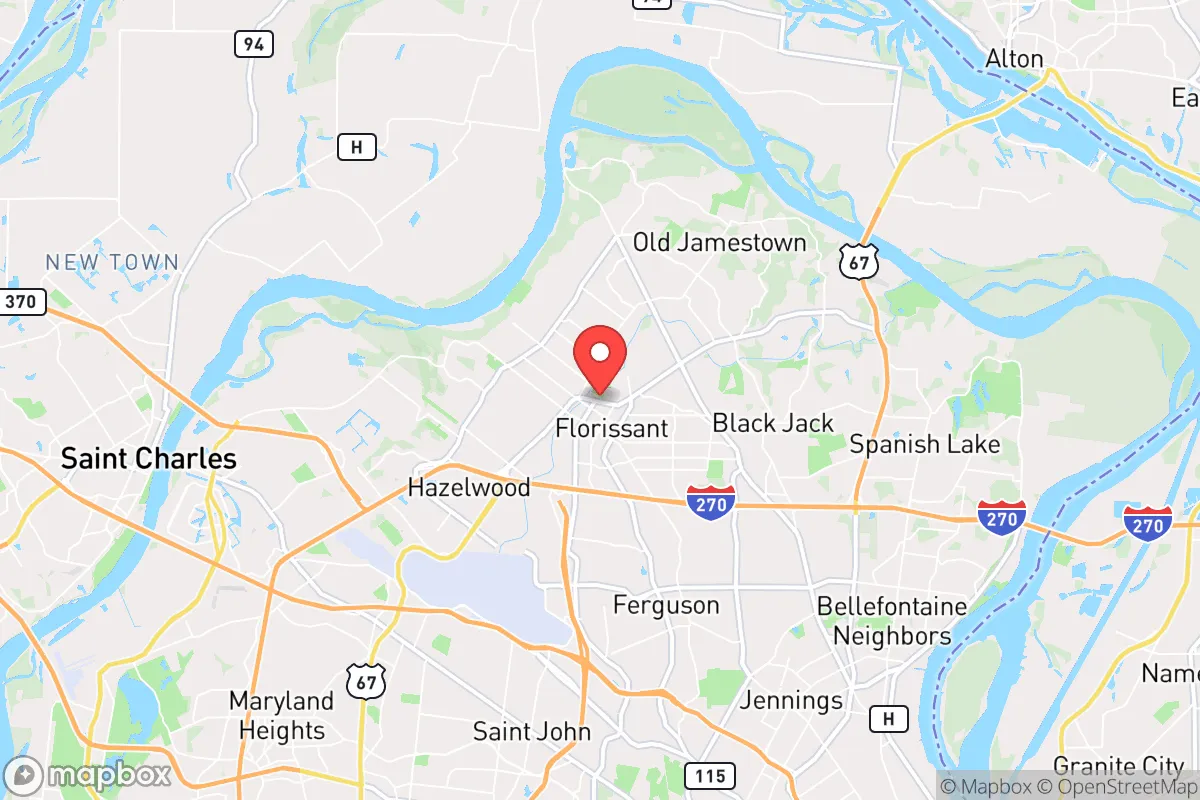
Photo: Wikipedia
Demographics of Florissant, MO
Affluence Level in Florissant, MO
A middle-class area roughly in line with national averages across income, home values, education, and employment.
People of Florissant, MO
Today, Florissant, Missouri is a predominantly Black and white suburban city of 51,915 residents, shaped by decades of white flight, Black middle-class in-migration, and a small but stable immigrant presence. The city is notably less diverse than the broader St. Louis region in its foreign-born share (just 2.1%), and its population has declined roughly 10% since its 2000 peak of 57,000. Florissant’s identity is that of a mature, aging inner-ring suburb where the original post-war white population has been steadily replaced by Black families seeking affordable homeownership and good schools, creating a community that is now nearly evenly split between Black (42.1%) and white (47.9%) residents.
How the city was settled and grew
Florissant was founded in 1786 by French fur traders and farmers, making it one of the oldest European settlements in Missouri. The original French Creole population built the historic village core around what is now St. Ferdinand Park and the Old St. Ferdinand Shrine, a neighborhood still marked by 19th-century stone houses. German immigrants arrived in large numbers after the 1848 revolutions, settling the Florissant Valley area and establishing truck farms that supplied St. Louis. The city remained a small agricultural village through the early 1900s, with a population under 3,000 as late as 1940.
The real growth came after World War II. The 1950s and 1960s saw explosive suburbanization as white St. Louis families moved north along the Missouri River floodplain. Developers built thousands of ranch-style and split-level homes in subdivisions like Duchesne and Cross Keys, attracting a solidly middle-class, predominantly Catholic population. The opening of Interstate 270 in the 1960s cemented Florissant as a bedroom community for McDonnell Douglas (now Boeing) and other defense manufacturers. By 1970, the population had surged past 65,000, making it the largest city in St. Louis County by land area.
Modern era (post-1965)
The 1970s and 1980s brought the first major demographic shift. As Black families began moving north from the city of St. Louis, white residents started leaving for farther-out suburbs like St. Charles and O’Fallon. This white flight accelerated after the 1992 desegregation settlement that bused Florissant students into St. Louis city schools. The Jana Elementary and Parker Road neighborhoods became early entry points for Black homebuyers, while older white residents concentrated in the Florissant Hills and St. Ferdinand areas near the historic core.
By 2000, Florissant was roughly 70% white and 25% Black. The next two decades saw a rapid inversion: the white share fell from 70% to 47.9%, while the Black share rose from 25% to 42.1%. This transition was largely peaceful but not seamless—the city experienced a spike in property crime during the 2010s as the population turned over, though violent crime remained below the county average. The foreign-born population remained tiny (2.1%), with the largest groups being East/Southeast Asian (0.6%) and Hispanic (2.1%). The Indian-subcontinent population is negligible at 0.1%.
The future
Florissant’s population is likely to continue its gradual decline and racial transition. The city is homogenizing into a predominantly Black and white community, with little of the immigrant-driven diversification seen in other St. Louis suburbs like University City or Chesterfield. The Duchesne and Cross Keys subdivisions, once solidly white, are now majority-Black, while the Florissant Hills area remains the most white and older-skewing. The city’s housing stock—mostly 3-bedroom ranches built in the 1950s-1970s—is affordable by regional standards (median home value ~$140,000), which will continue to attract Black first-time homebuyers but may struggle to draw younger white families who prefer newer construction farther west.
The next 10-20 years will likely see Florissant become a majority-Black city, mirroring the trajectory of nearby Jennings and Normandy. The college-educated share (22.7%) is below the county average, and the city lacks a major employer or downtown core to attract new residents. Without significant commercial reinvestment or immigration, Florissant will continue its slow demographic consolidation as a stable, working-class Black and white suburb.
For a conservative-leaning mover, Florissant offers affordable housing and a quiet suburban feel, but the demographic trends are clear: the city is becoming more Black and less white, with a declining population and limited economic dynamism. It is a place where the past—post-war white suburbia—is giving way to a new, more diverse reality, but without the immigrant energy or job growth that characterizes the region’s more dynamic suburbs.

* Values derived from national, state, county, city and local statistics and may differ in a specific area. Last updated: 2026-04-29T23:52:30.000Z
Narrative content on this page is AI-generated and may contain mistakes. Verify any details that matter before acting on them.
ReloMaps may earn a commission from affiliate links at no extra cost to you.

