Photo: Wikipedia
Demographics of Flower Mound, TX
Affluence Level in Flower Mound, TX
An upper-middle-class area. Household wealth, education levels, and homeownership run ahead of national benchmarks.
People of Flower Mound, TX
Flower Mound, Texas, is a predominantly white, highly educated suburban community of 77,886 residents where 64.3% of adults hold a college degree and the median household income significantly exceeds the national average. The city’s population is characterized by a strong family-oriented identity, with a notable and growing Indian subcontinent community (8.2%) that has become a distinctive demographic marker alongside a smaller East/Southeast Asian population (5.3%) and a Hispanic share of 13.0%. The foreign-born population stands at 6.2%, reflecting a community shaped more by domestic professional migration than by international immigration, creating a stable, affluent, and politically conservative enclave within the Dallas-Fort Worth metroplex.
How the city was settled and grew
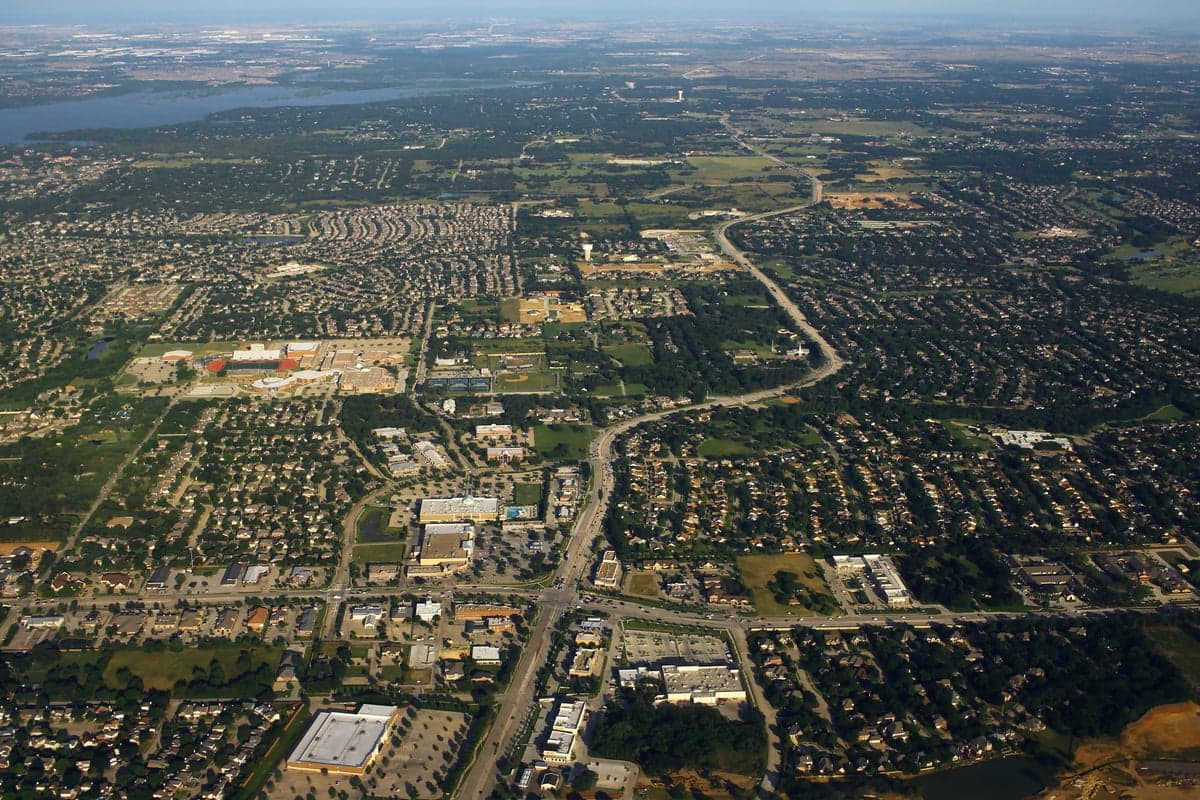
Flower Mound was not a pre-1900 settlement of any scale; its modern identity is a product of late 20th-century suburbanization. The area was originally part of the Peters Colony land grant in the 1840s, attracting a handful of Anglo-American homesteaders who established small farms and ranches. The name derives from a prominent mound covered in wildflowers, a landmark for early settlers. For over a century, the population remained sparse—fewer than 1,000 residents as late as 1960—with the original families concentrated along what is now FM 2499 and around the historic Flower Mound Presbyterian Church area. The first significant wave came in the 1970s and 1980s, when Dallas-Fort Worth’s expansion drew white middle-class families seeking larger lots and newer schools. These early suburbanites settled in neighborhoods like Wellington and Bridlewood, which remain predominantly white and upper-middle-class today. No major immigrant groups arrived during this period; the population was nearly entirely native-born and Anglo.
Modern era (post-1965)
The post-1965 Hart-Cellar Act had little immediate effect on Flower Mound, as the city remained a small, homogeneous suburb through the 1980s. The real demographic shift began in the 1990s and accelerated after 2000, driven by two forces: the tech and corporate expansion of the DFW metroplex, and the construction of master-planned communities that attracted a more diverse professional class. The River Walk at Central Park and Lakeside DFW developments, built from the early 2000s onward, drew a wave of Indian subcontinent professionals—many working in IT, engineering, and healthcare in nearby Las Colinas and Plano—who now constitute 8.2% of the population. These families concentrated in newer, higher-density sections of the city, particularly around the Lakeside DFW district and the Parker Square area. East/Southeast Asian residents (5.3%) arrived in smaller numbers, often settling in the same newer developments or in established neighborhoods like Forestwood. The Hispanic population (13.0%) grew more gradually, with many families moving into older housing stock in the Central Flower Mound area near FM 2499 and along the Cross Timbers corridor. The Black population remains small at 3.4%, with no single concentrated neighborhood. The city’s white share (66.1%) has declined from near-totality in 1990 but remains the dominant group, especially in older neighborhoods like Wellington and Bridlewood, where turnover has been slower.
The future
Flower Mound is nearing build-out, with limited undeveloped land remaining, which will slow population growth and demographic change. The Indian subcontinent community is likely to continue growing as a share, driven by chain migration and the area’s reputation for top-rated schools (Lewisville ISD) and safe neighborhoods, but this growth will plateau as housing supply constrains new arrivals. The Hispanic population is expected to increase modestly, primarily through natural increase rather than new immigration, and will likely remain concentrated in the central and southern parts of the city. The East/Southeast Asian share may stabilize or decline slightly as younger professionals gravitate toward newer suburbs farther north, such as Frisco or Prosper. The white population will remain the majority but will continue a slow decline as older homeowners age in place and younger white families choose more affordable exurbs. The city is not tribalizing into distinct ethnic enclaves; rather, it is becoming a moderately diverse, highly educated suburb where Indian and Asian professionals are integrated into the same neighborhoods and school systems as their white neighbors. For a conservative-leaning mover, Flower Mound offers a stable, low-crime environment with strong schools and a population that is diversifying in an orderly, assimilation-oriented manner—not through rapid immigration but through domestic professional relocation.
Flower Mound is becoming a mature, built-out suburb where demographic change is slow and driven by professional-class migration rather than refugee resettlement or rapid immigration. For someone moving in now, the city offers a reliably conservative, family-focused community with a growing Indian professional presence and a stable white majority, where the next decade will see gradual aging of the housing stock and modest diversification rather than dramatic transformation.

* Values derived from national, state, county, city and local statistics and may differ in a specific area. Last updated: 2026-04-19T07:18:29.000Z
Narrative content on this page is AI-generated and may contain mistakes. Verify any details that matter before acting on them.
ReloMaps may earn a commission from affiliate links at no extra cost to you.

