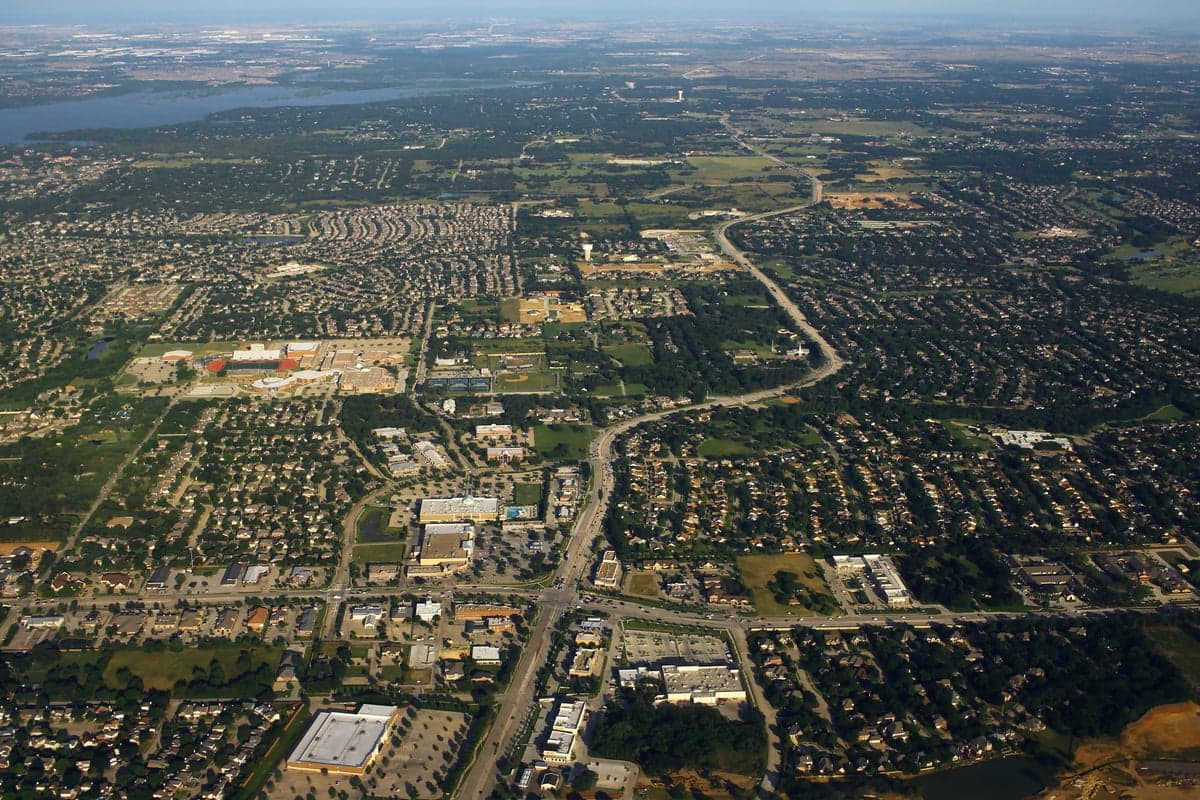
Photo: Wikipedia
Personal Sovereignty in Flower Mound, TX
Strong independent fundamentals that actively favor personal liberty and low regulation.
What does Personal Sovereignty tell us?
Personal Sovereignty measures your capacity for self-reliance and independence with minimal government friction. Higher scores mean fewer barriers between you and the way you want to live... but it assumes you have the space you need and good neighbors.
What does this tell us?
Personal Sovereignty measures your capacity for self-reliance and independence with minimal government friction. Higher scores mean fewer barriers between you and the way you want to live... but it assumes you have the space you need and good neighbors.
State Policy
Energy independence: Net exporter (220% of energy produced in-state)
Personal Liberty
Homesteading

Personal Liberty Analysis
Flower Mound, Texas offers a notably high degree of personal sovereignty compared to most of the United States, but it is not a libertarian free-for-all. The town sits within a state that aggressively protects individual rights—no state income tax, strong firearm preemption laws, and a culture of self-reliance—while also operating under the regulatory thumb of Denton County and the Dallas-Fort Worth metroplex. For a survivalist or prepper concerned with government overreach, Flower Mound provides a solid legal foundation for autonomy, but the practical realities of suburban HOA covenants, zoning restrictions, and proximity to a major urban center mean you cannot simply disappear into the woods. The trade-off is access to a robust local economy and a community that largely shares your values, but the sovereignty you gain here is the kind you have to actively defend, not the kind handed to you by geography.
Tax burden and regulatory posture: How Texas keeps the state off your back
The single biggest win for personal sovereignty in Flower Mound is the absence of a state income tax. Texas constitutionally prohibits it, meaning every dollar you earn stays in your pocket—no state-level confiscation of your labor. Property taxes, however, are the trade-off. Flower Mound sits in Denton County, where the combined property tax rate typically runs between 2.2% and 2.6% of assessed value, which is high by national standards. A $500,000 home will cost you roughly $11,000 to $13,000 annually in property taxes. That stings, but it is a direct local tax you can influence through voting and attending city council meetings, unlike an invisible income tax that funds faraway programs. The regulatory posture in Texas is famously light: no state-level occupational licensing for most trades, no state-level business income tax, and a right-to-work law that prevents forced union membership. Flower Mound itself has a relatively streamlined permitting process for home improvements, but the town enforces its zoning code strictly. If you want to build a detached workshop, a root cellar, or a rainwater catchment system, you will need permits and inspections. The city does not ban such things outright, but the bureaucracy is real. For a prepper, the key takeaway is that Texas gives you the legal runway to operate, but Flower Mound’s suburban governance adds friction you must plan for.
Self-defense and gun law specifics: What you can carry and where
Texas is a constitutional carry state, meaning as of 2021, any law-abiding adult 21 or older can carry a handgun openly or concealed without a permit. Flower Mound fully respects that right. There are no city-level gun bans, no magazine capacity limits, and no waiting periods beyond the federal background check. The town has a few "gun-free zones" mandated by state law—schools, polling places, and government meetings—but otherwise, you can carry into most businesses unless they post a 30.06 (concealed) or 30.07 (open carry) sign. In practice, many Flower Mound businesses do not post these signs, and the local culture is pro-Second Amendment. Stand-your-ground laws are in full effect: you have no duty to retreat before using deadly force if you are lawfully present and believe you or another person faces imminent threat of death or great bodily harm. Castle doctrine protections extend to your vehicle and your workplace, not just your home. For a prepper, this is a critical advantage. You can legally keep a rifle in your truck while parked at the grocery store, and you can defend your family on your property without fear of prosecution. The only real limitation is that Flower Mound is not a rural county—discharging a firearm within city limits is illegal except on a licensed range or in lawful self-defense. So you cannot plink in your backyard, but you can train at one of several nearby ranges, including the Elm Fork Shooting Sports complex in Dallas or the Fossil Pointe Sporting Grounds in Decatur, both within a 30-minute drive.
Self-reliance and homesteading viability: Lot sizes, zoning, and off-grid feasibility
Flower Mound is a master-planned suburb, and that reality constrains homesteading ambitions. The typical lot size in the town is a quarter-acre to half-acre, with many neighborhoods governed by HOAs that mandate manicured lawns, restrict outbuildings, and prohibit livestock. You will not be raising chickens, goats, or bees in most subdivisions without explicit HOA approval, and even then, the city's zoning code limits agricultural uses to properties zoned for it—which is almost none of the residential land. Off-grid living is effectively impossible within town limits. The city requires connection to municipal water and sewer, and solar panels must comply with building codes and HOA aesthetic guidelines. Rainwater harvesting is legal and even encouraged by the state (Texas offers a sales tax exemption on rainwater equipment), but you cannot disconnect from the grid. If you want true self-reliance—a well, septic, solar, and a garden big enough to feed a family—you need to look outside Flower Mound, in unincorporated Denton County or farther north toward Argyle or Pilot Point. That said, Flower Mound does have a few pockets of larger lots, particularly in the older sections near the lake, where you might find a one-acre lot with fewer restrictions. For a prepper who wants suburban convenience with some room to grow food and store supplies, the best strategy is to buy a house with a large lot in a neighborhood without an HOA, or to accept the HOA restrictions and focus on indoor food production, deep pantry storage, and community networking rather than full homesteading.
Personal liberties: Parental rights, medical autonomy, speech, and property
Texas has been a battleground for parental rights, and the state legislature has passed laws that give parents significant authority over their children's education and medical decisions. In 2023, Texas enacted a Parents' Bill of Rights that requires school districts to notify parents of any changes in a child's mental, emotional, or physical health, and to obtain parental consent before providing any medical care or mental health services. Flower Mound is served by the Lewisville Independent School District, which has largely complied with these laws, though some parents report that the district's implementation has been uneven. On medical autonomy, Texas has some of the strongest protections against vaccine mandates in the country. State law prohibits employers from requiring COVID-19 vaccination as a condition of employment, and the state has banned vaccine passports. However, private businesses can still require masks or other measures. On speech, Texas has no state-level hate speech laws, and the First Amendment is robustly protected. You can express political, religious, or survivalist views without fear of government retaliation. Property rights are strong: Texas has no state-level eminent domain abuse like some states, and the Texas Property Code gives landowners broad rights to use their land as they see fit, subject to local zoning. For a prepper, the most important liberty is the right to store firearms, ammunition, and food without government interference. Texas has no limits on how much ammunition you can buy or possess, and no restrictions on long-term food storage. The only property-related concern is that HOAs can restrict what you store in your garage or yard, so read the covenants carefully before buying.
Overall, Flower Mound delivers a level of personal sovereignty that is rare in the United States, but it is sovereignty within a suburban framework. You will not face state-level oppression—no income tax, no gun confiscation, no forced medical mandates—but you will deal with local restrictions on land use, HOA rules, and property taxes that fund a well-run but intrusive municipal government. Compared to a place like rural Montana or Idaho, Flower Mound offers less physical autonomy but more economic opportunity and community support for conservative values. For a prepper who wants to be near a major metro area while retaining the legal right to defend themselves, keep their earnings, and raise their children according to their own values, Flower Mound is one of the best options in the country. Just understand that the sovereignty you gain here is the kind you have to exercise actively—by voting, by attending city council meetings, by reading your HOA bylaws, and by building relationships with like-minded neighbors. The legal framework is on your side, but the culture of liberty requires constant maintenance.

* Values derived from national, state, county, city and local statistics and may differ in a specific area. Last updated: 2026-04-19T07:18:29.000Z
Narrative content on this page is AI-generated and may contain mistakes. Verify any details that matter before acting on them.
ReloMaps may earn a commission from affiliate links at no extra cost to you.

