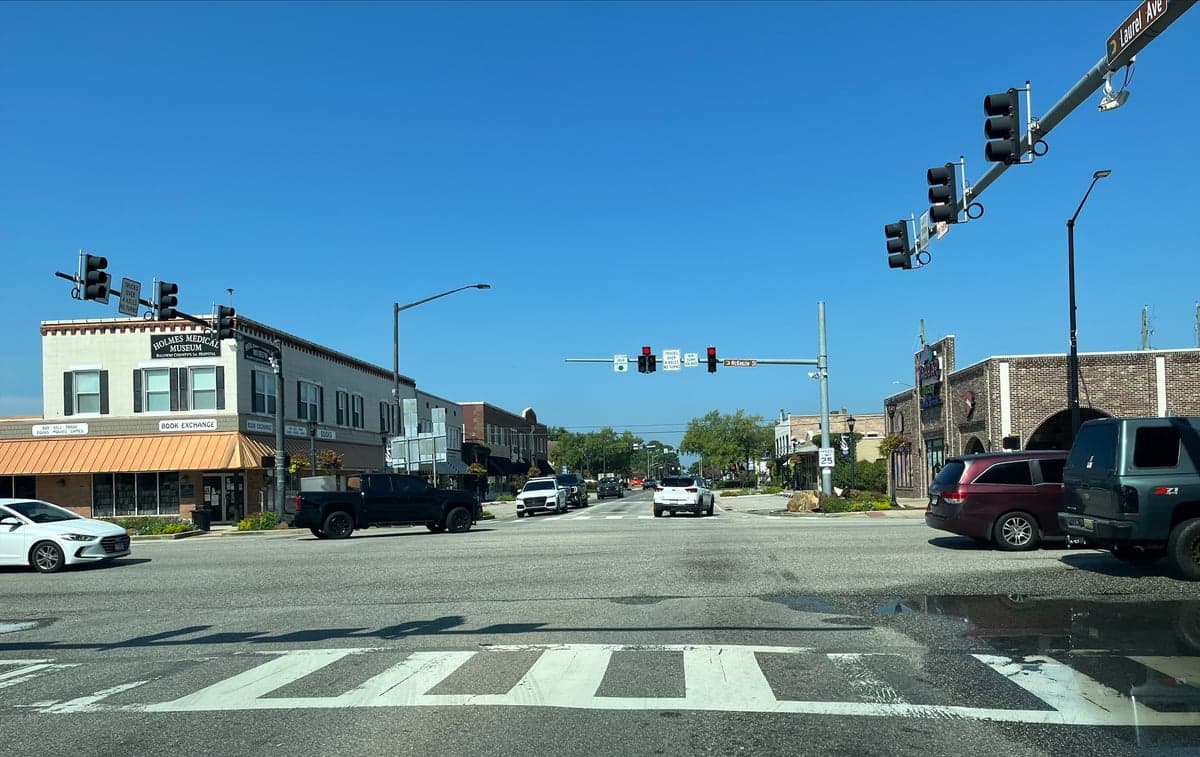
Photo: Wikipedia
Political ClimatePolitical Climate in Foley, AL
District shown is the primary district for this city’s centroid. Cities may span multiple districts.
Local Political AnalysisPolitical Analysis of Foley, AL
Foley, Alabama, sits deep in solidly conservative territory, with a Cook PVI of R+27 that reflects decades of consistent Republican voting. The city itself leans even further right than the surrounding Baldwin County, which has been a GOP stronghold since the 1980s. If you look at the last few presidential cycles, Foley routinely delivers 70-75% of its vote to the Republican candidate, and that hasn't budged much even as the area has grown. The political vibe here is rooted in a live-and-let-live, small-government ethos—people moved here to get away from the headaches of bigger cities, not to import them.
How it compares
Drive 30 minutes south to Gulf Shores, and you'll find a similar conservative tilt, though the tourist economy there brings in more transient, younger workers who lean slightly less red. Head north to Fairhope, and you'll see a more moderate Republican flavor—some of those folks are transplants from the Midwest who brought a few purple-ish habits with them. But Foley? It's the anchor of the county's right flank. The contrast is sharpest if you go east across the bay to Mobile County, where the city of Mobile itself votes reliably Democratic. Foley residents often joke that crossing the bridge into Mobile feels like entering a different state, and politically, it's not far off. The local school board, city council, and county commission are all dominated by Republicans who run on platforms of low taxes, minimal regulation, and protecting Second Amendment rights.
What this means for residents
For folks living here, the political climate translates into a government that mostly stays out of your business. Property taxes are among the lowest in the state, zoning is light, and there's no city income tax. You can build a shed in your backyard without a dozen permits, and the local sheriff's office isn't interested in enforcing federal gun laws they disagree with. That said, there's been a slow creep of progressive influence over the last five years, mostly from new arrivals fleeing higher-tax states like California and Illinois. Some of those newcomers bring ideas about "density" and "complete streets" that rub locals the wrong way. The city council has held the line so far, but you'll hear grumbling at the coffee shop about how the old Foley—where you knew your neighbor and the biggest debate was whether to pave a dirt road—is fading. The real concern among long-time residents is that as the population swells, the political culture could shift toward the kind of overreach they moved here to escape.
Culturally, Foley remains a place where church potlucks and high school football are the social calendar, and the local paper's letters to the editor still run hot over school board decisions and property rights. There's a strong strain of libertarian-leaning conservatism here—people are skeptical of mask mandates, vaccine passports, and any talk of "climate action plans" that might raise their utility bills. The city has resisted adopting the kind of affordable housing mandates that have popped up in more progressive parts of the state, and the planning board tends to side with property owners over developers. If you're looking for a place where the government assumes you can run your own life without a lot of hand-holding, Foley fits the bill. But keep an eye on those new subdivisions going in—every new family that moves here from a blue state is a roll of the dice on whether the local character holds.

State Political ClimatePolitical Climate in Alabama
State Political AnalysisPolitical Environment in the State
Alabama has been a reliably red state for decades, with a Republican lean that has only deepened since the early 2000s. The state hasn’t voted for a Democratic presidential candidate since 1976, and in 2024, Donald Trump carried it by roughly 30 points. The dominant coalition is a mix of rural conservatives, evangelical Christians, and a growing number of suburban families fleeing higher-tax states. Over the last 20 years, the shift has been dramatic: Democrats once held most statewide offices and a majority in the legislature, but today Republicans hold supermajorities in both chambers and every statewide elected position. The real story, though, is the internal tension between the old-guard establishment and a more populist, liberty-minded wing that’s pushing for deeper reforms.
Urban vs. rural divide
The political map of Alabama is a study in contrasts. The major metros—Birmingham, Montgomery, and Mobile—are the only blue dots in a sea of red. Jefferson County (Birmingham) and Montgomery County are reliably Democratic, driven by Black voters who make up a large share of the population. But even these cities have conservative suburbs: Hoover, Vestavia Hills, and Mountain Brook in the Birmingham metro are solidly Republican, with precincts often voting 70-80% for the GOP. The real engine of Alabama’s red lean is the rural and small-town belt stretching from the Tennessee Valley down to the Wiregrass. Huntsville is a fascinating exception—a fast-growing, high-tech hub that leans Republican but is more moderate and libertarian-leaning than the rest of the state, thanks to a heavy concentration of engineers and defense contractors. Auburn and Opelika in Lee County are also reliably red, driven by the university and a growing suburban base. The rural counties—like DeKalb, Marshall, and Blount in the northeast—routinely deliver 80-85% Republican margins, making them the bedrock of the state’s conservative majority.
Policy environment
Alabama’s policy environment is broadly conservative, but with some notable wrinkles. The state has no income tax on Social Security benefits and a relatively low state income tax (top rate of 5%), though it does have a high combined state and local sales tax rate—often over 9% in many cities—which hits low-income families hardest. Property taxes are among the lowest in the nation, a major draw for retirees and families. The regulatory posture is business-friendly, with right-to-work laws and minimal zoning restrictions outside of major metros. Education policy is a mixed bag: the state has a school choice program (the Alabama Accountability Act) that provides tax credits for private school tuition, but the public school system remains underfunded and ranks near the bottom nationally. In 2022, the legislature passed the Alabama School Choice and Opportunity Act, expanding charter schools and education savings accounts. On healthcare, the state did not expand Medicaid under the Affordable Care Act, a decision that has kept costs lower for taxpayers but left a coverage gap for some low-income adults. Election laws are strict: voter ID is required, early voting is limited, and absentee ballots require a notarized signature or a witness. The state also passed a 2021 law banning curbside voting and limiting ballot drop boxes, moves that election integrity advocates praised but critics called restrictive.
Trajectory & freedom
Alabama has been on a trajectory of expanding personal liberty in several key areas, though not without controversy. In 2022, the state passed a permitless carry law (HB 272), allowing law-abiding citizens to carry a concealed handgun without a permit—a major win for gun rights advocates. The same year, the legislature passed the Alabama Parental Rights Act, which requires schools to notify parents of any changes to a student’s mental, emotional, or physical health, and prohibits classroom instruction on sexual orientation or gender identity in K-5. This law, along with a 2023 ban on gender-affirming care for minors (the Vulnerable Child Compassion and Protection Act), has made Alabama a leader in the parental rights movement. On the economic freedom front, the state has no state-level rent control, no occupational licensing for many trades, and a strong property rights framework. However, there are concerns about government overreach in the form of a 2023 law that expanded the governor’s emergency powers during a state of emergency, giving the executive branch broad authority to suspend laws and regulations. Some liberty-minded residents see this as a step backward, arguing it concentrates too much power in one office. Overall, Alabama is trending more free on cultural and Second Amendment issues, but the emergency powers law is a red flag for those wary of executive overreach.
Civil unrest & political movements
Alabama has seen relatively little civil unrest compared to other states, but there have been notable flashpoints. The 2020 George Floyd protests sparked demonstrations in Birmingham, Montgomery, and Mobile, but they were largely peaceful and smaller than in other Southern cities. The state has a strong tradition of grassroots activism on both sides. On the right, the Alabama Citizens for Constitutional Freedom and local Tea Party groups remain active, pushing for lower taxes, school choice, and gun rights. On the left, the Alabama Poor People’s Campaign and Black Lives Matter chapters organize around criminal justice reform and voting rights. Immigration politics are less heated than in border states, but there have been controversies: in 2011, the state passed HB 56, one of the strictest anti-illegal immigration laws in the country, which led to boycotts and legal challenges. The law was later weakened by court rulings, but it still reflects the state’s hardline stance. Election integrity remains a hot-button issue: after the 2020 election, the state’s Republican secretary of state, John Merrill, certified the results without controversy, but grassroots activists continue to push for stricter ballot security measures. A new resident would notice the strong presence of conservative churches and civic organizations, but also a growing libertarian streak, especially in the Huntsville area, where many newcomers are engineers who value individual freedom and limited government.
Projection
Over the next 5-10 years, Alabama is likely to become even more conservative, but with a shift toward a more populist, liberty-oriented strain of Republicanism. The in-migration pattern is key: people are moving to Alabama from California, Illinois, and New York, drawn by low taxes, affordable housing, and a perceived higher quality of life. Huntsville is the fastest-growing metro, and its influx of tech workers and defense contractors is likely to push the state toward more pro-business, less socially interventionist policies. The rural areas will remain deeply conservative, but the growing suburban and exurban population—especially around Birmingham, Auburn, and the Gulf Coast—will demand more school choice, lower property taxes, and less government intrusion. The biggest wild card is the state’s dependence on federal funding: Alabama receives more federal dollars per capita than most states, and any future cuts to Medicaid or education funding could create fiscal pressure. Expect continued battles over education reform, with a push for universal school choice, and ongoing fights over executive power and emergency declarations. The state’s political trajectory is toward more freedom on cultural and economic issues, but the emergency powers law is a reminder that the fight against government overreach is never fully won.
For a new resident, the bottom line is this: Alabama offers a low-tax, low-regulation environment with strong protections for gun rights, parental rights, and religious liberty. The political climate is overwhelmingly conservative, but it’s not monolithic—the urban-rural divide is real, and the growing Huntsville area offers a more moderate, tech-driven alternative. If you value limited government, school choice, and a culture that respects traditional values, Alabama is a solid bet. Just keep an eye on the legislature’s tendency to expand executive power in emergencies—that’s the one area where the state’s freedom credentials are still a work in progress.
* Values derived from national, state, county, city and local statistics and may differ in a specific area. Last updated: 2026-04-19T18:51:31.000Z
Narrative content on this page is AI-generated and may contain mistakes. Verify any details that matter before acting on them.
ReloMaps may earn a commission from affiliate links at no extra cost to you.

