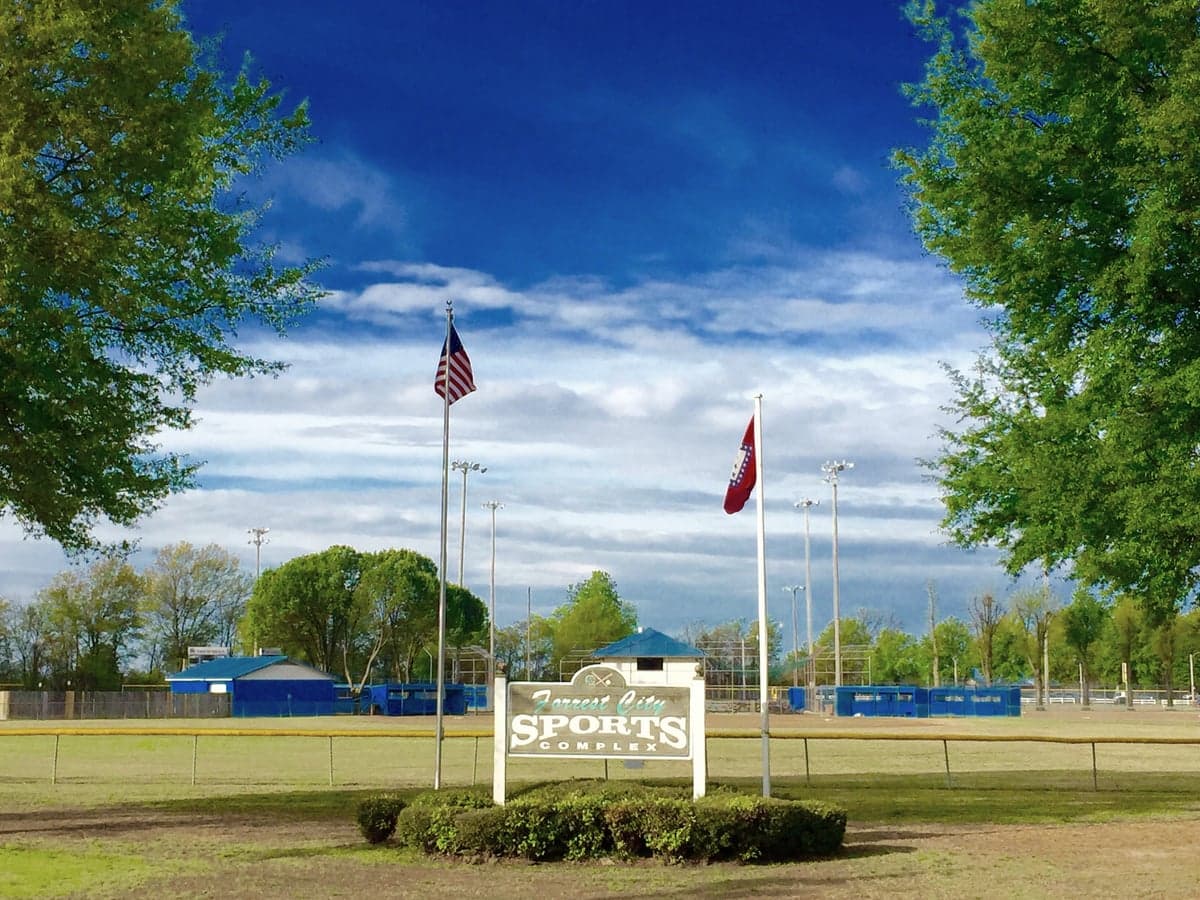
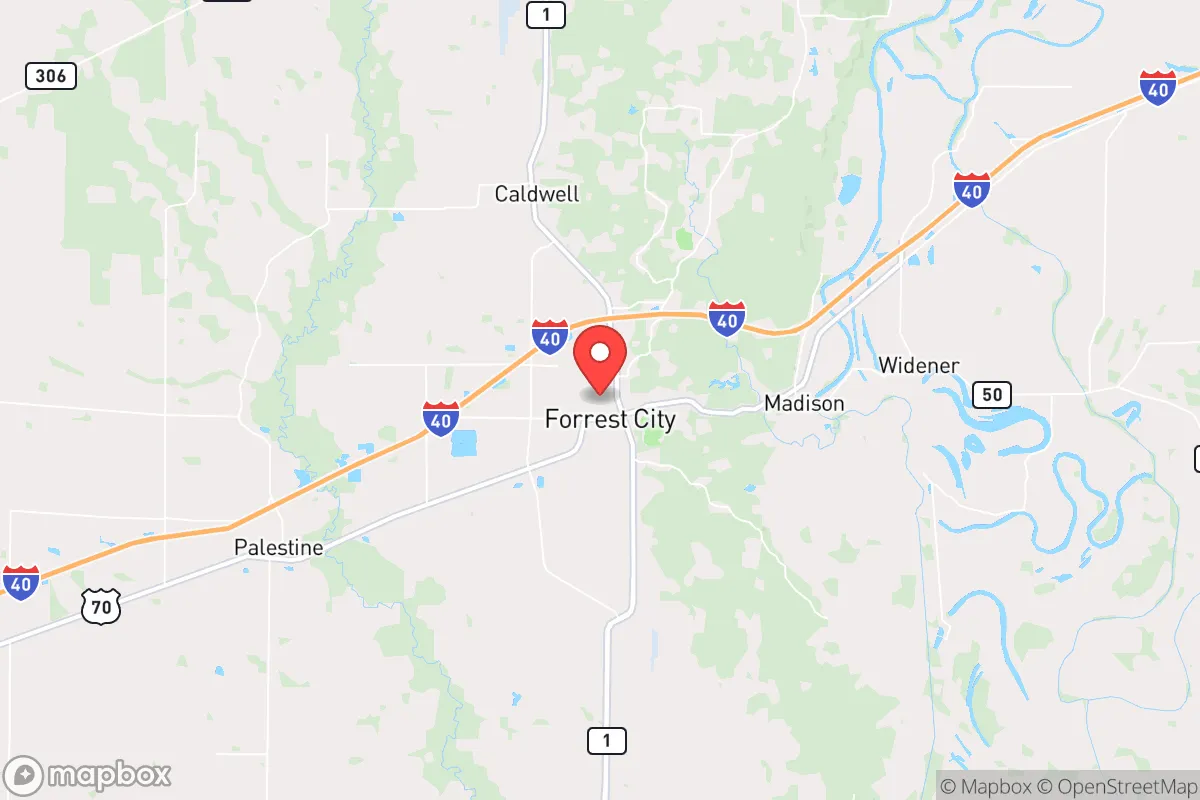
Photo: Wikipedia
Political ClimatePolitical Climate in Forrest City, AR
District shown is the primary district for this city’s centroid. Cities may span multiple districts.
Local Political AnalysisPolitical Analysis of Forrest City, AR
Forrest City is about as solidly red as it gets in eastern Arkansas, and that’s not changing anytime soon. The Cook PVI sits at R+23, meaning the area votes nearly a quarter more Republican than the national average, and that number has held steady through the last few cycles. You don’t see the kind of flip-flopping you get in some of the bigger metro areas; folks here have a pretty clear idea of what they want from government, and it’s mostly to be left alone. The local elections tend to be decided in the primary, and the general is usually a formality.
How it compares
If you drive an hour west to Little Rock, you’ll hit a much more mixed political scene—Pulaski County leans blue, especially in the city proper. But Forrest City sits in St. Francis County, which is surrounded by even redder territory like Crittenden County to the north and Lee County to the south. The contrast is sharp: Memphis is just 50 miles east, and that city’s progressive policies—higher taxes, more regulations, a bigger push for government-run programs—are a cautionary tale for a lot of locals. People here look at what’s happening in places like Memphis or even Jonesboro (which is trending a bit more moderate) and see the kind of overreach they want no part of. The rural areas around Forrest City, like Colt and Widener, are even more conservative, so the county as a whole feels a lot like the surrounding small towns.
What this means for residents
For the people who live here, the political climate means a lighter touch from government. Property taxes are low, there’s no city income tax, and the local school board and county commission tend to focus on keeping things running rather than pushing new social programs. You don’t see the kind of zoning fights or business mandates that pop up in more progressive areas. That said, there’s a growing concern about any shift toward the left—even small ones. Some folks worry about outside money coming in from state or federal grants that come with strings attached, like diversity mandates or environmental rules that could hurt local agriculture and manufacturing. The long-term worry is that if the county ever starts to lean even a little blue, you could see the same kind of regulatory creep that’s bogged down other parts of the state.
Culturally, Forrest City holds onto a few distinctions that set it apart. The annual Forrest City Crawfish Festival is a big deal, and it’s a good example of the kind of community-driven, low-government event people prefer. There’s also a strong sense of personal responsibility—neighbors help neighbors, but nobody expects the county to solve every problem. The biggest policy fights you’ll hear about are over things like school choice (which is popular here) and Second Amendment rights (which are taken very seriously). If you’re looking for a place where the government stays out of your business and the political direction is stable, Forrest City fits the bill. Just keep an eye on any ballot measures that try to bring in progressive ideas—that’s the kind of thing that could change the character of the place fast.

State Political ClimatePolitical Climate in Arkansas
State Political AnalysisPolitical Environment in the State
Arkansas has been a reliably Republican state for over a decade, but it’s not the deep-red monolith many outsiders assume. The state voted for Donald Trump by 27 points in 2020 and 30 points in 2024, but that top-line number hides a more complicated picture: a coalition of rural conservatives, suburban moderates, and a shrinking but stubbornly Democratic base in the Delta and Little Rock. Over the last 20 years, the state has shifted rightward by about 15 points, driven largely by white working-class voters leaving the Democratic Party and by in-migration of conservatives from California and the Midwest. But the shift isn’t uniform—some areas are actually getting bluer, and the state’s political culture remains more libertarian than authoritarian, which matters a lot for anyone considering a move here.
Urban vs. rural divide
The political map of Arkansas is a textbook case of the urban-rural split. Little Rock (Pulaski County) is the state’s lone blue dot, voting for Biden by 12 points in 2020 and Harris by 10 in 2024. The city itself is increasingly progressive, with a growing professional class and a significant Black population that reliably votes Democratic. But the surrounding suburbs—Conway, Benton, Bryant—are solidly red, and they’ve been getting redder as more families move out of the city. Fayetteville and Springdale in Northwest Arkansas are the other notable exceptions: Washington County went for Biden by 2 points in 2020 and Harris by 3 in 2024, driven by the University of Arkansas and a growing Hispanic population. But drive 20 minutes south to Rogers or Bentonville, and you’re back in deep-red territory. The rural counties—Stone, Van Buren, Yell—routinely vote 80%+ Republican. The Delta counties along the Mississippi River, like Lee and Phillips, are the last holdouts of the old Democratic South, but their populations are shrinking fast. The net effect is that the state’s political gravity is pulling right, even as the cities get more diverse.
Policy environment
Arkansas’s policy environment is broadly conservative, but with a strong libertarian streak that sometimes frustrates the GOP establishment. The state has a flat income tax of 4.4% (down from 7% in 2015), and the legislature is actively working to phase it out entirely. Sales tax is high—9.5% in Little Rock, 8.5% in most other places—but there’s no tax on groceries or prescription drugs. Property taxes are low, averaging about 0.6% of assessed value. The regulatory environment is business-friendly: Arkansas is a right-to-work state, and the legislature has passed tort reform that caps non-economic damages in medical malpractice cases. On education, the state has a robust school choice program: the Arkansas LEARNS Act (2023) created universal Education Freedom Accounts, allowing parents to use state funding for private school, homeschooling, or tutoring. That’s a big deal for families. On healthcare, the state expanded Medicaid under the private option model, which has been controversial among conservatives but has kept rural hospitals open. Election laws are moderately restrictive: voter ID is required, early voting is 15 days, and absentee voting requires an excuse. There’s no ballot harvesting, and the state uses paper ballots with auditable results. The legislature has also passed a constitutional carry law (2017) and a near-total abortion ban (2023), with exceptions only for rape, incest, and the life of the mother.
Trajectory & freedom
On balance, Arkansas is becoming more free in most areas, but there are warning signs. The LEARNS Act is a genuine expansion of parental rights and educational freedom. The constitutional carry law and the absence of a red flag law mean gun rights are well-protected. The state has also passed a medical freedom law (2021) that prohibits vaccine mandates by private employers and government entities, and a religious freedom restoration act (2015) that gives strong protections for conscience. Property rights are solid: there’s no statewide zoning, and the legislature has preempted local rent control and short-term rental bans. But there are concerning trends. The state’s Medical Marijuana Amendment (2016) is tightly regulated, with a limited number of dispensaries and no home grow—a classic case of government overreach in the name of “safety.” The legislature has also shown a willingness to override local control, most notably in 2021 when it banned mask mandates in schools and 2023 when it preempted local plastic bag bans. That’s a double-edged sword: it protects freedom from local overreach, but it also undermines the principle of local self-government. The biggest red flag for liberty-minded people is the state’s criminal justice system: Arkansas has one of the highest incarceration rates in the country, and the legislature has been slow to reform mandatory minimums or expand parole eligibility. That’s a government overreach issue that affects real people.
Civil unrest & political movements
Arkansas is not a hotbed of civil unrest, but there have been flashpoints. The 2020 Black Lives Matter protests in Little Rock were large by local standards—several thousand people—and resulted in some property damage and arrests. The state’s response was relatively restrained compared to Portland or Seattle, but the legislature did pass a law in 2021 increasing penalties for blocking highways during protests. On the right, the Arkansas Freedom Fund and Family Council are active, pushing for school choice and anti-abortion legislation. Immigration politics are less heated than in border states, but the legislature passed a law in 2023 requiring local law enforcement to cooperate with ICE and banning sanctuary city policies. There’s no serious secession or nullification movement, though there’s a vocal minority that talks about “state sovereignty” in the context of federal overreach. Election integrity controversies have been minimal: the state’s voting system is considered secure, and there were no major disputes in 2020 or 2024. The most visible political flashpoint for a new resident would be the ongoing fight over library content: in 2023, the legislature passed a law allowing parents to challenge “obscene” materials in public libraries, which has led to heated local debates in Fayetteville and Little Rock. It’s a classic culture war issue, but it’s playing out in school board meetings and library board elections, not in the streets.
Projection
Over the next 5-10 years, Arkansas will likely get redder but more internally divided. The in-migration from California and the Midwest is accelerating—Northwest Arkansas is growing at about 2% per year—and those newcomers tend to be conservative but not always culturally aligned with the existing population. The Bentonville-Rogers corridor is becoming a hub for tech and logistics workers who are fiscally conservative but socially moderate, which could create tension with the more traditionalist rural base. The Delta will continue to shrink and lose political influence. The biggest wildcard is the Hispanic population, which is growing fast in Northwest Arkansas and could shift the political calculus in a decade or two—though so far, Hispanic voters in Arkansas have leaned more conservative than their counterparts in Texas or California. The state’s fiscal trajectory is positive: the income tax phase-out will make Arkansas more competitive, and the school choice program will likely attract more families. But the criminal justice system and the healthcare access issues in rural areas are structural problems that won’t solve themselves. A new resident moving in now should expect to find a state that is broadly free and getting freer, but with pockets of government overreach that require vigilance.
Bottom line for a new resident: Arkansas offers a genuinely conservative policy environment with low taxes, strong gun rights, and school choice. The political culture is more live-and-let-live than in some other red states, but you’ll need to be engaged at the local level to protect those freedoms. The cities are getting more diverse and more progressive, but the rural areas are solid and the state government is reliably conservative. If you’re looking for a place where your values are reflected in the law and where you have room to live your life without excessive government interference, Arkansas is a strong bet—just keep an eye on the legislature and the local school board.
* Values derived from national, state, county, city and local statistics and may differ in a specific area. Last updated: 2026-04-30T04:51:10.000Z
Narrative content on this page is AI-generated and may contain mistakes. Verify any details that matter before acting on them.
ReloMaps may earn a commission from affiliate links at no extra cost to you.

