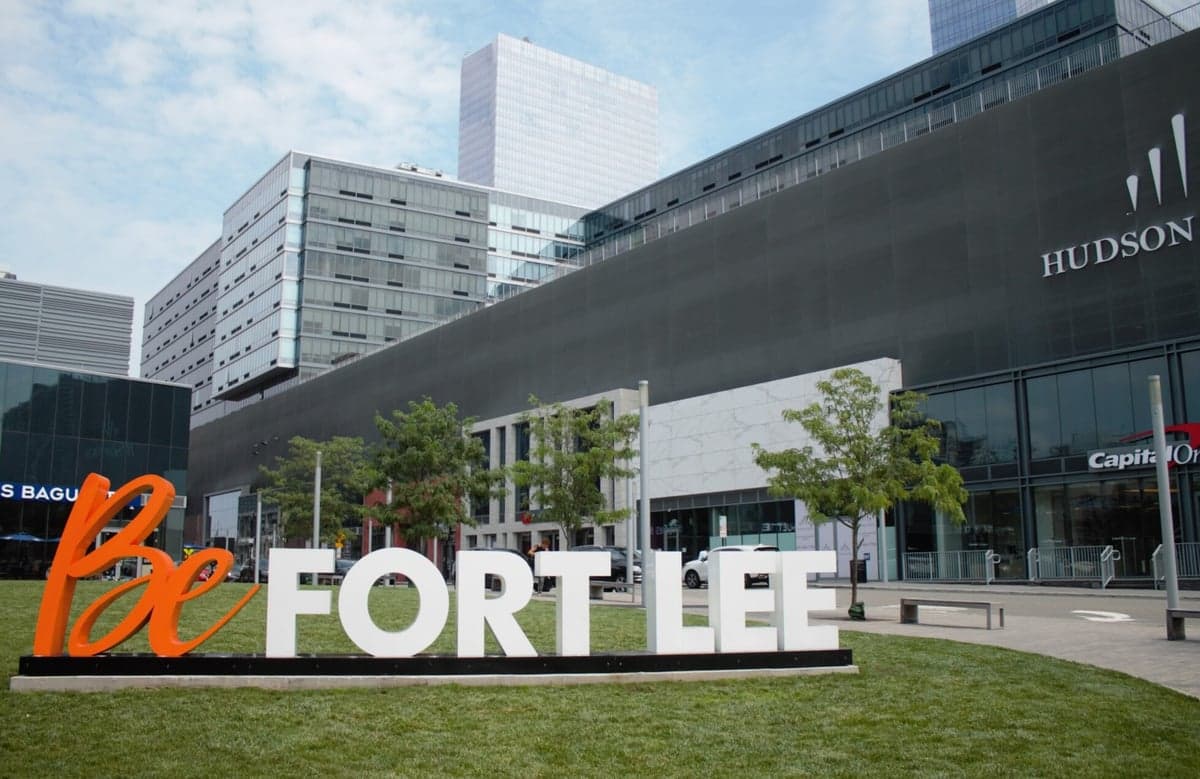
Photo: Wikipedia
Demographics of Fort Lee, NJ
Affluence Level in Fort Lee, NJ
An upper-middle-class area. Household wealth, education levels, and homeownership run ahead of national benchmarks.
People of Fort Lee, NJ
The people of Fort Lee, New Jersey, today form a dense, highly educated, and majority-Asian community of nearly 40,000 residents, defined by its position as a vertical suburb just across the George Washington Bridge from Manhattan. With 64.8% holding a college degree and a foreign-born population of 19.0%, the city is a distinct blend of long-standing Italian and Korean enclaves, a growing professional class, and a rapidly shifting racial landscape where East and Southeast Asian residents now constitute the largest single group at 40.7% of the population. Fort Lee is no longer a quiet bedroom community; it is a dense, transit-oriented hub where high-rise luxury towers sit alongside aging garden apartments, and where the character of daily life is increasingly shaped by Korean-language signage, kosher markets, and the commuter flow into New York City.
How the city was settled and grew
Fort Lee’s human history begins with its strategic geography. The Palisades cliffs overlooking the Hudson River made the area a natural fortification site during the Revolutionary War, after which it remained sparsely populated farmland for decades. The real settlement wave came in the late 19th and early 20th centuries, when the construction of the George Washington Bridge (opened 1931) and the development of the Palisades Interstate Park system transformed the area into a commuter suburb. The first major population group to build the modern town were Italian immigrants, who arrived in large numbers between 1900 and 1930 to work in construction, quarrying, and the burgeoning service economy. They settled primarily in the central and southern sections of town, particularly around Main Street and the area now known as the "Italian-American" district, where St. Nicholas Roman Catholic Church became a community anchor. By the 1950s, Fort Lee was a predominantly white, middle-class suburb of single-family homes and small apartment buildings, with a strong Italian-American and Jewish presence. The completion of the bridge and the later construction of the Palisades Parkway cemented its role as a commuter gateway, drawing additional waves of Irish and German families into neighborhoods like Lemoine Avenue and the Hilltop area near the Palisades cliffs.
Modern era (post-1965)
The post-1965 Immigration and Nationality Act fundamentally reshaped Fort Lee’s population. The first major non-European group to arrive were Korean immigrants, who began settling in the 1970s and 1980s, drawn by the city’s proximity to New York City’s Koreatown in Manhattan and the availability of affordable multi-family housing. They concentrated along Broad Avenue and the Palisade Avenue corridor, establishing Korean churches, grocery stores, and hagwon (after-school academies) that now define the commercial landscape. By 2000, the Korean community had grown to roughly 15% of the population. Simultaneously, a wave of Chinese and Taiwanese immigrants arrived, many of them professionals and investors, settling in the newer high-rise developments along River Road and the George Washington Bridge approach. The 2010s saw an acceleration of this trend: the Asian population (East and Southeast Asian) surged from roughly 25% in 2010 to 40.7% today, while the white population declined from 55% to 38.0%. The Hispanic population, at 12.4%, is concentrated in the older, lower-density areas near the Palisades Avenue and Main Street intersection, while the Black population remains small at 2.4%. The Indian subcontinent population (3.3%) is a newer, smaller group, largely professionals living in the newer towers. The city’s housing stock has shifted dramatically: the construction of luxury high-rises like The Modern and Hudson Lights has attracted affluent Asian and white professionals, while older garden apartments in the central Linwood Park area house a mix of Hispanic and working-class Asian families.
The future
Fort Lee’s demographic trajectory points toward continued Asian majority growth, driven by both immigration and in-migration from other parts of the New York metro area. The Korean and Chinese communities are not homogenizing into a single "Asian" bloc; rather, they maintain distinct enclaves—Korean along Broad Avenue, Chinese in the River Road towers—with separate churches, schools, and social networks. The white population, now 38.0%, is aging and declining, though a small influx of young professionals from Manhattan is slowing the rate of loss. The Hispanic population is stable but not growing rapidly, while the Indian community is likely to increase modestly as professionals seek the same commuter advantages. The key unknown is housing: Fort Lee has limited undeveloped land, and future growth will depend on redevelopment of older garden apartments into high-rises, which could accelerate the displacement of lower-income Hispanic and working-class Asian residents. The city is not tribalizing into hostile enclaves, but it is becoming more economically stratified, with a clear divide between the high-rise luxury corridor along the river and the older, denser neighborhoods inland.
For someone moving in now, Fort Lee is a place of distinct, self-contained communities rather than a melting pot. A new resident will find a city where Korean is spoken as commonly as English on Broad Avenue, where Italian-American social clubs still operate on Main Street, and where the skyline is dominated by glass towers filled with professionals commuting to Midtown. The city is becoming more Asian, more affluent, and more vertical, but it retains a layered, immigrant-built character that sets it apart from the generic suburbs of Bergen County. The bottom line: Fort Lee is a commuter city in transition, where the old ethnic neighborhoods are giving way to a denser, more cosmopolitan—and more expensive—future.

* Values derived from national, state, county, city and local statistics and may differ in a specific area. Last updated: 2026-04-30T00:27:51.000Z
Narrative content on this page is AI-generated and may contain mistakes. Verify any details that matter before acting on them.
ReloMaps may earn a commission from affiliate links at no extra cost to you.

